How to teach kids salah is an important question for Muslim parents who want their children to develop a strong connection with Allah from an early age. Teaching prayer involves more than memorizing movements and Arabic words. It requires patience, encouragement, regular practice, and an age-appropriate approach that helps children understand why Muslims pray.
Children learn differently depending on their ages, personalities, and previous experiences. Therefore, parents should introduce salah gradually instead of expecting young learners to understand every requirement immediately. Some children begin by copying their parents during prayer, while others become interested in learning the movements, short surahs, and daily prayer times.
With the right guidance, families can make salah a familiar and meaningful part of everyday life. This guide explains when children should start learning, how to introduce wudu, how to teach the five daily prayers, and how to address common learning difficulties. It also explores practical educational methods and how Misk Online Quran Academy can complement children’s Quran and Islamic learning.
Why Is It Important to Teach Kids Salah Early?

Prayer is one of the five pillars of Islam and an essential act of worship for Muslims. Introducing children to salah early helps them understand its importance before they reach the age when Islamic obligations apply.
However, early education should focus on building familiarity rather than demanding perfect performance. Young children need opportunities to observe, imitate, ask questions, and gradually develop their abilities.
When parents understand how to introduce salah through everyday activities, they can make worship a natural part of family life. There are several important benefits to teaching children prayer during childhood:
- Developing a relationship with Allah: Children begin to understand that prayer is a way to worship Allah, remember Him, and express gratitude.
- Building positive habits: Regular participation makes prayer a familiar part of the family’s daily routine.
- Learning Islamic values: Salah introduces children to discipline, cleanliness, patience, and responsibility.
- Improving Quranic reading: Learning prayer recitations encourages children to recognize Arabic letters and pronounce Quranic words correctly.
- Strengthening family relationships: Praying together creates opportunities for parents and children to share meaningful religious experiences.
- Developing responsibility: As children grow, they gradually understand the importance of maintaining their prayers.
Nevertheless, these benefits develop over time. Parents should recognize small improvements and avoid comparing their children with siblings or other students.
Start Your Quran Learning Journey with Misk Online Quran Academy
Begin your Quran learning journey with Misk Online Quran Academy, where students of all ages benefit from structured online Quran classes tailored to their individual level and learning needs.
Whether your goal is to improve Quran recitation, master Tajweed rules, or begin memorizing the Holy Quran, our experienced and qualified teachers provide clear step-by-step guidance through personalized one-to-one lessons. Each session is designed to help learners understand, practice, and improve with confidence and consistency.
With flexible scheduling, interactive teaching methods, and a supportive online environment, Misk Online Quran Academy makes it easier to stay committed and motivated. Students can learn comfortably from home while making steady progress in their Quran studies at their own pace.

At What Age Should Parents Teach Kids Salah?
There is no need to wait until a child reaches seven before introducing prayer. Instead, parents can begin with simple experiences during toddlerhood and gradually increase the level of instruction.
The Prophet Muhammad ﷺ instructed parents to command their children to pray when they reach seven years of age. This narration appears in Sunan Abi Dawud, Hadith 495.
Understanding this guidance helps parents distinguish between early religious education and the age at which children are instructed more regularly to establish salah.
Islamic obligations concerning prayer apply after puberty, when the relevant conditions are met. Before then, childhood provides valuable opportunities for learning, practice, and developing familiarity with worship.
How to Teach Kids Salah Between Ages 2 and 4
At this stage, children learn primarily through observation and imitation. They notice what their parents do and often want to participate in familiar household activities. Parents can introduce prayer through simple experiences:
- Place a small prayer mat beside the parent’s mat.
- Allow the child to imitate standing, bowing, and prostrating.
- Say Allahu Akbar clearly during prayer.
- Explain that Muslims pray to worship Allah.
- Welcome the child when they voluntarily join the family.
For example, a toddler may stand beside a parent during Maghrib and imitate a few movements. This participation is a positive introduction, even if the child does not understand the complete prayer. At this age, avoid lengthy explanations and complicated memorization tasks. Instead, let curiosity guide the learning experience.
How to Teach Kids Salah Between Ages 5 and 6?
Children between five and six often become more comfortable following instructions and remembering simple sequences. Consequently, parents can introduce structured lessons without making them unnecessarily demanding. A useful learning plan includes:
- Recognizing the names of the five daily prayers.
- Identifying the main positions of salah.
- Practicing the movements in their correct order.
- Learning short Islamic expressions.
- Listening to Surah Al-Fatihah regularly.
- Becoming familiar with basic wudu steps.
Parents can also use illustrated cards to help children remember each movement. For instance, one card can represent standing, another bowing, and another prostration.
When teaching children to pray at this age, remember that understanding should develop alongside physical practice. A child who can explain why Muslims perform sujud is learning something meaningful beyond simply copying movements.
How to Teach Kids Salah From Age 7 to 9?
At seven, parents should begin giving children clearer and more consistent instructions about prayer, following the prophetic guidance. Nevertheless, every child develops at a different pace. Some children may already know several recitations, while others still need assistance with Arabic pronunciation and prayer movements. Parents can support this stage by:
- Establishing a predictable prayer routine.
- Encouraging participation in family prayers.
- Teaching the correct sequence of a complete salah.
- Helping children memorize Al-Fatihah.
- Introducing the meanings of familiar prayer expressions.
- Using gentle reminders when prayer times arrive.
It may help to begin with prayers that naturally fit the family’s schedule. Maghrib, for example, often provides an opportunity for parents and children to pray together.
How to Teach Kids Salah From Age 10 and Beyond?
Older children can understand more detailed explanations about prayer, its conditions, and its spiritual significance. At this stage, parents should encourage greater independence while remaining available to correct mistakes and answer questions. Useful learning goals include:
- Recognizing the differences between obligatory and voluntary prayers.
- Memorizing the necessary recitations.
- Understanding the purpose of each prayer position.
- Learning the conditions and essential elements of salah.
- Maintaining regular prayer with appropriate family support.
- Asking knowledgeable teachers about unfamiliar religious questions.
The goal is to help children become increasingly confident in their worship rather than depending permanently on parental reminders.
How to Teach Kids Salah Through Simple Daily Activities?
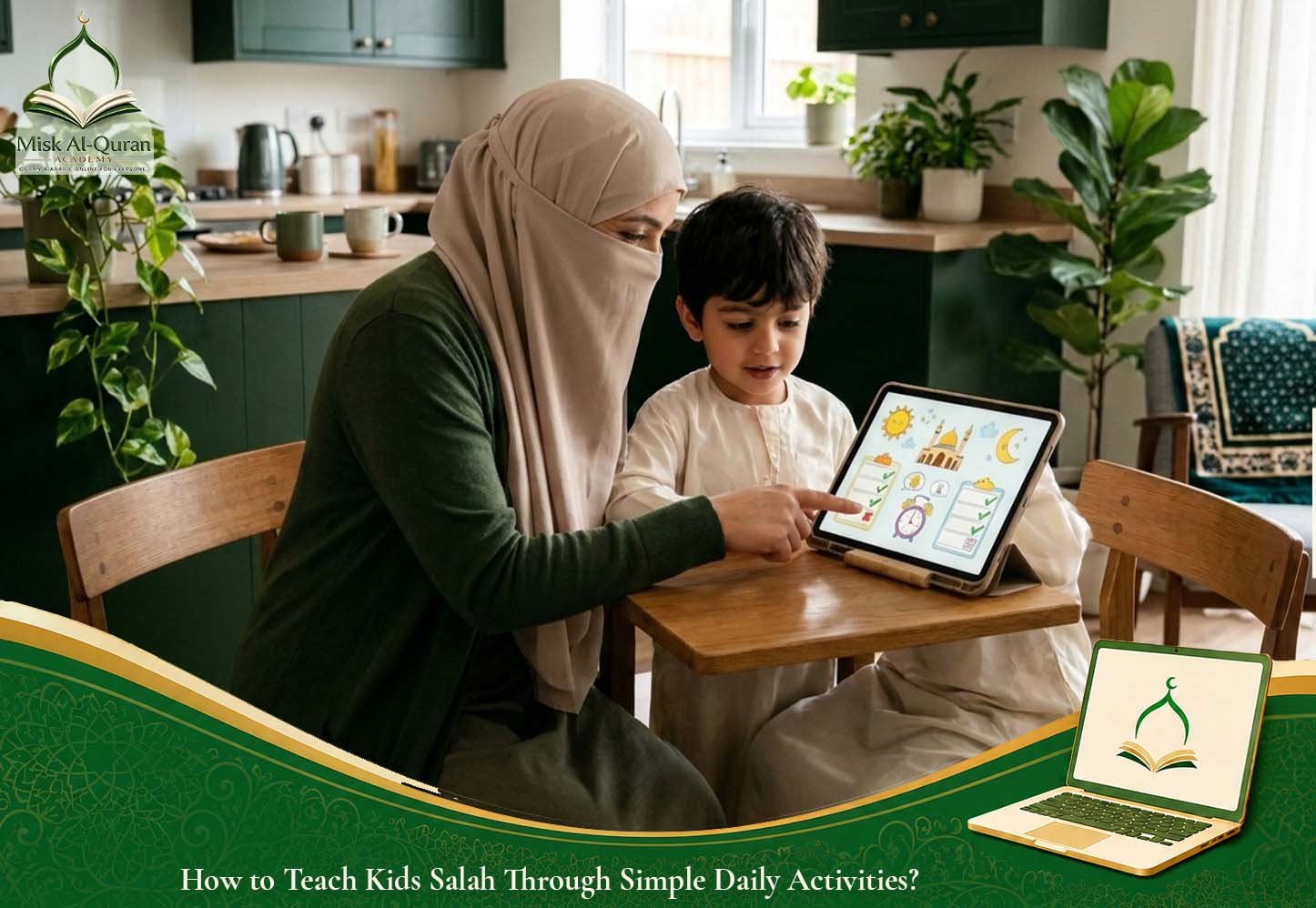
Children do not learn religious practices only through formal lessons. Everyday experiences can reinforce their understanding and make Islamic education more relevant. Therefore, parents can combine short teaching activities with regular family routines.
1. Demonstrate Salah Movements Before Explaining Them
Children often understand physical actions more easily than lengthy verbal instructions. For this reason, demonstrating each movement is an effective starting point. Show your child how to:
- Stand facing the Qiblah.
- Raise the hands for the opening takbir.
- Place the hands while standing according to your family’s practice.
- Bow during ruku.
- Return to the standing position.
- Perform sub judicatum correctly.
- Sit between the two prostrations.
After demonstrating each position, invite your child to imitate it. Do not correct every small mistake immediately. Instead, focus on one movement at a time and provide another demonstration when necessary.
2. Use Short Lessons to Explain Salah to Children
A young learner may lose interest when a lesson contains too much information. Therefore, divide prayer education into manageable sessions. For example, a short lesson might focus only on the meaning of Allahu Akbar. Another session could explain why Muslims bow during ruku. Parents can introduce simple questions:
- Who do Muslims worship when they pray?
- Why do we face the Qiblah?
- What do we say when beginning salah?
- What does sujud teach us about worship?
These conversations encourage children to think about their actions instead of memorizing instructions without understanding them.
3. Include Salah in the Family Routine
Children become familiar with activities that happen consistently. Accordingly, parents should make prayer visible throughout the day. Try to create simple habits such as:
- Preparing the prayer area before the adhan.
- Inviting children to join family salah.
- Keeping prayer clothes and mats accessible.
- Turning off distracting devices during prayer.
- Discussing the next prayer time in an age-appropriate way.
A consistent environment makes it easier for children to recognize prayer as a normal part of Muslim family life.
4. Encourage Children to Ask Questions About Prayer
Children sometimes ask questions that adults consider simple or unexpected. However, these questions provide valuable opportunities to develop religious understanding. A child might ask why Muslims pray five times, why they wash before salah, or why prayer includes different movements.
Parents should answer honestly using language appropriate to the child’s age. If a question involves a detailed religious ruling, consult a qualified Islamic teacher rather than guessing. This approach makes religious education interactive and helps children feel comfortable discussing their concerns.
How to Teach Kids Wudu Before Salah?
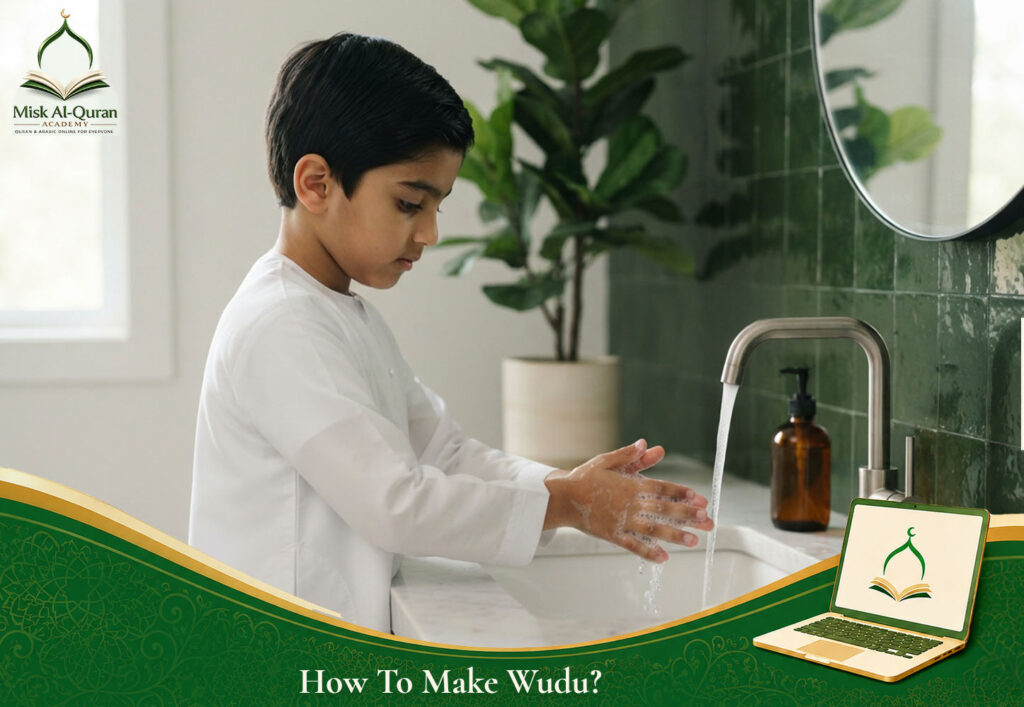
Wudu is an important part of learning how to prepare for prayer. Children should understand that Muslims perform ritual purification before salah when wudu is required. The Quran explains the prescribed washing and wiping actions in Surah Al-Ma’idah, verse 6. Parents can use this verse as an introduction to the practical steps.
A Simple Wudu Lesson for Children Learning Salah
- Make the intention: Explain that the intention is made in the heart.
- Wash both hands: Wash the hands up to the wrists.
- Rinse the mouth: Take water into the mouth and rinse gently.
- Clean the nose: Draw water gently into the nostrils and expel it.
- Wash the face: Cover the required area of the face.
- Wash the arms: Wash both arms, including the elbows.
- Wipe the head: Use wet hands to wipe the head according to the family’s school of jurisprudence.
- Wash the feet: Wash both feet, including the ankles.
The commonly taught Sunnah method includes washing several parts three times, while wiping the head is performed once. Some details differ between schools of Islamic jurisprudence. Parents should demonstrate the steps rather than expecting children to memorize the entire sequence immediately.
Make Wudu Easier for Young Children
Water-based activities can make purification lessons interesting, but safety and cleanliness should remain priorities. Consider these practical ideas:
- Provide a stable step stool when the child needs help reaching the sink.
- Keep a small towel within easy reach.
- Use comfortable water temperatures.
- Demonstrate how much water is sufficient.
- Explain why unnecessary water waste should be avoided.
- Allow children to practice under supervision.
A child who understands the purpose of wudu is more likely to approach purification as an important part of preparing for worship.
How to Teach Kids Salah Step by Step?
After children become familiar with wudu and the main prayer positions, parents can introduce a complete prayer. Learning how to teach kids salah becomes easier when parents divide the prayer into manageable steps. A two-rak’ah prayer, such as Fajr, provides a simple example for explaining the basic sequence.
Step 1 – Prepare for Prayer
Explain that prayer requires appropriate preparation before beginning. The child should:
- Perform the required purification.
- Wear clean clothing that meets the conditions of prayer.
- Choose a clean place for prayer.
- Face the Qiblah.
- Make the intention in the heart.
Clarify that the intention does not need to be announced verbally. Parents can reinforce these preparations through regular practice during family prayer.
Step 2 – Begin With Takbir
Allahu Akbar
This means Allah is the Greatest. Explain that the opening takbir marks the beginning of salah. Demonstrate the hand movement according to the practice followed by your family. Children attending namaz salah classes online can also receive guidance on prayer movements and recitations.
Step 3 – Learn the Standing Position
During standing, Muslims recite Al-Fatihah and additional Quranic verses in the appropriate rak’ahs. Begin by helping your child recognize the opening words of Al-Fatihah. Then introduce the remaining verses gradually.
Children who struggle with Arabic pronunciation should listen to correct recitation and repeat short portions under guidance. Parents may also explore the benefits of Taking Online Quran Classes for Kids to understand how online Quran learning can support children’s education.
Step 4 – Practice Ruku
Explain that ruku is the bowing position in prayer. The child should learn to bend while keeping the back appropriately positioned and placing the hands on the knees. The commonly recited remembrance is:
Subhana Rabbiyal-Azim
Explain its meaning simply: Glory be to my Lord, the Most Great.
Demonstrate the position slowly, allowing your child to repeat the movement until they become familiar with it.
Step 5 – Return to Standing
Demonstrate how to rise from ruku while reciting:
Sami’allahu liman hamidah
Then explain the response:
Rabbana wa lakal-hamd
Children can practice these expressions separately before combining them with the movements. A male quran teacher can help children improve their recitation through guided practice when families choose this teaching option.
Step 6 – Learn Sujud
Sujud is an important position that children should learn through careful demonstration. During prostration, the forehead and nose, both hands, both knees, and toes are placed appropriately on the ground. Teach the remembrance:
Subhana Rabbiyal-A’la
Explain that it means Glory be to my Lord, the Most High. Give children enough time to understand the position without rushing. Correct mistakes gently and demonstrate the movement again when necessary.
Step 7 – Practice the Second Sujud
After the first prostration, demonstrate how to sit briefly and then perform the second sujud. Encourage the child to remember the order rather than rushing through the movements. Repeating this sequence helps children connect each position with the next part of prayer.
Step 8 – Complete the Second Rak’ah
Show how to stand for the second rak’ah and repeat the required recitations and movements. A two-rak’ah prayer ends with the final sitting and tashahhud. Children who need additional support with the complete prayer sequence may benefit from zoom quran classes, depending on the lessons offered.
Step 9 – Learn Tashahhud and Salam
Older children can begin memorizing the tashahhud in small sections. Finally, demonstrate how to end the prayer by turning the head to the right and left while saying:
As-salamu alaykum wa rahmatullah
Parents should explain that the details of recitation and movement should follow reliable Islamic instruction. With consistent practice and gentle guidance, children can gradually become more familiar with the complete prayer.
Teaching Surah Al-Fatihah and Short Surahs for Salah
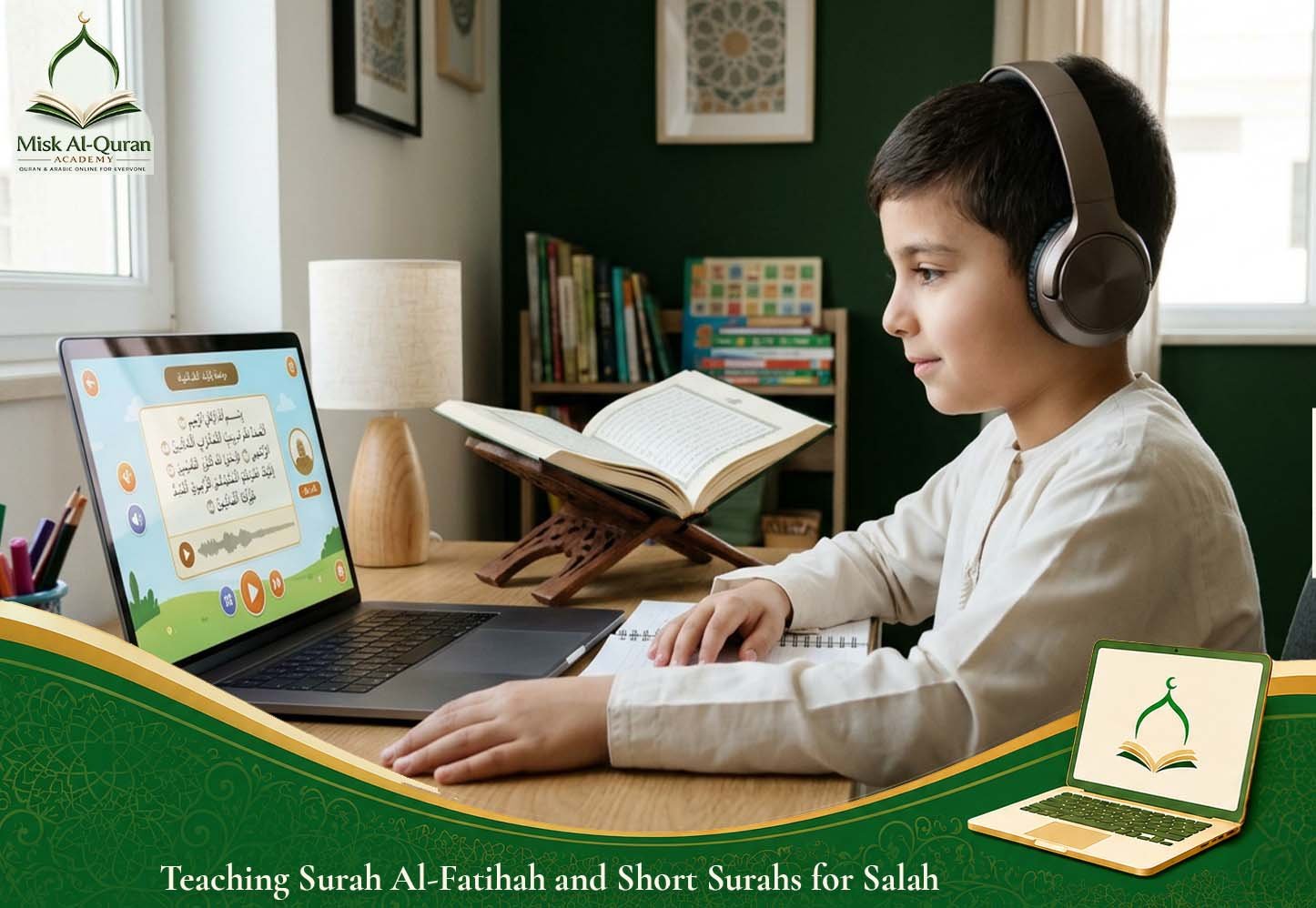
Quranic recitation is an essential learning area for children who are developing their prayer skills. Surah Al-Fatihah has a central place in salah, so children should gradually learn its verses and pronunciation. However, memorizing the complete surah may take time, particularly for children who are unfamiliar with Arabic.
How to Teach Al-Fatihah to Children One Verse at a Time?
Instead of teaching all seven verses together, divide the surah into short sections.A practical approach includes:
- Letting the child listen to a correct recitation.
- Repeating one verse slowly.
- Explaining simple meanings.
- Practicing difficult Arabic sounds.
- Reviewing previously memorized verses.
- Combining the verses after the child becomes comfortable.
Parents should pay attention to pronunciation because recognizing Arabic letters does not automatically mean producing their sounds correctly.
Which Short Surahs Should Children Learn First for Salah?
After making progress with Al-Fatihah, children can gradually memorize short surahs from Juz Amma. Suitable examples include:
- Surah Al-Ikhlas.
- Surah Al-Falaq.
- Surah An-Nas.
- Surah Al-Kawthar.
- Surah Al-Asr.
- Surah An-Nasr.
The order can depend on the child’s reading ability and the family’s learning plan.It is also useful to explain the general meanings of these surahs. Understanding the message helps children connect Quranic recitation with their daily lives.
How Many Rak’ahs Should Children Learn for Each Daily Prayer?
Learning the number of obligatory rak’ahs helps children recognize the structure of the five daily prayers. Parents can introduce this information using a simple reference table.
| Daily prayer | Obligatory rak’ahs |
|---|---|
| Fajr | 2 |
| Dhuhr | 4 |
| Asr | 4 |
| Maghrib | 3 |
| Isha | 4 |
Children do not need to memorize every detail immediately. Begin by helping them recognize the prayer names and their corresponding rak’ahs. For example, parents can explain that Fajr contains two obligatory rak’ahs, while Maghrib contains three. A visual chart can help children remember this information. Nevertheless, avoid turning the chart into a source of pressure or competition.
Practical Ways to Make Learning Salah Interesting for Kids
An effective approach to teaching children salah should include activities that encourage participation without reducing worship to entertainment. Children benefit from variety, especially when they are still developing their attention and memory.
1. Create a Child-Friendly Prayer Chart
A weekly prayer chart can help children recognize prayer times and observe their progress. Include the five daily prayers and provide a simple space for recording participation. For younger children, use pictures or stickers instead of lengthy written instructions. The purpose is to encourage consistency, not to measure a child’s religious worth or compare performance.
2. Use Prayer Position Cards
Prepare separate cards showing the main movements of salah. Children can arrange them in the correct order or identify each position when a parent names it. This activity reinforces visual memory and helps learners recognize the sequence before performing a complete prayer.
3. Practice With a Child-Sized Prayer Mat
Having a personal prayer mat can make children feel included in family worship. Allow the child to choose a suitable mat and keep it somewhere accessible. More importantly, invite the child to use it alongside family members rather than treating it as a reward that must be earned.
4. Use Stories to Explain the Importance of Salah
Islamic stories can introduce religious concepts in a way children understand. Parents can discuss how prophets worshipped Allah and explain the importance of obedience, gratitude, patience, and remembrance. Choose reliable Islamic sources and age-appropriate storytelling materials.
5. Introduce Simple Prayer-Related Games
- Matching prayer names with their rak’ahs.
- Arranging prayer movements in the correct sequence.
- Identifying the Arabic expressions heard during salah.
- Matching wudu steps with their illustrations.
- Recognizing short surahs through listening exercises.
How to Teach Kids Salah Without Pressure or Fear?
Children’s emotional experiences can influence how they approach religious learning as they grow. If prayer is constantly associated with shouting, criticism, or embarrassment, some children may become reluctant to participate. Therefore, parents should combine clear expectations with kindness and patience.
Praise Children’s Effort Instead of Demanding Perfect Salah
A child who remembers a new prayer movement has made progress, even if other parts remain difficult. Use specific encouragement, such as:
- You remembered the order of the movements today.
- Your recitation was clearer than before.
- You took your time during sujud.
- You remembered to prepare for prayer.
Specific feedback helps children recognize their progress and understand what they are learning.
Correct Salah Mistakes Privately and Gently
Children may confuse prayer positions, forget words, or pronounce Arabic expressions incorrectly. Instead of interrupting them repeatedly, identify the most serious mistake and explain the correction calmly. Demonstrating the correct action is often more helpful than simply telling the child that something is wrong.
Avoid Comparing Children With Their Siblings
Every child develops at a different pace. One child may memorize Al-Fatihah quickly, while another needs more listening and repetition.
Comparisons can create unnecessary frustration and distract children from their personal learning goals. Focus on individual improvement and provide encouragement according to each child’s needs.
Explain Why Muslims Pray
Children deserve explanations that go beyond instructions. Tell them that Muslims pray to worship Allah, remember Him, express gratitude, and seek His guidance. As children become older, introduce more detailed discussions about the spiritual meanings of salah. This understanding helps prayer become a meaningful act rather than a sequence of movements that children perform without reflection.
Common Challenges When Teaching Children Salah
Even when parents follow a consistent approach, children may experience difficulties during religious learning. Recognizing the reason behind a problem helps parents choose a suitable response.
Why Does My Child Forget the Salah Movements?
Young children have developing memory skills, so forgetting sequences is not unusual. Break the prayer into smaller sections and practice the movements in the correct order. Picture cards and demonstrations can also reinforce what children have already learned.
What Should I Do if My Child Refuses to Pray?
First, consider why the child is reluctant. They may feel tired, confused, distracted, or uncomfortable with the learning process. Invite them to participate in family prayer and explain its importance without turning every interaction into an argument.
If resistance continues, review the routine and consider whether the child needs shorter lessons or additional guidance.
How Can I Help a Child Who Rushes Through Salah?
Rushing may happen because the child wants to finish quickly or has not yet understood the prayer movements. Demonstrate the positions slowly and explain the importance of tranquility during salah. Practice individual movements separately before expecting the child to complete the entire prayer confidently.
What if My Child Struggles With Arabic Pronunciation During Prayer?
Arabic sounds can be unfamiliar to children who speak other languages at home. Use short listening exercises and repeat difficult sounds carefully.
A qualified Quran teacher can also identify pronunciation mistakes and provide appropriate correction.
How Can Misk Online Quran Academy Support Children’s Islamic Learning?
Parents sometimes need additional educational support when introducing Quran reading, Arabic pronunciation, and Islamic practices at home.
Misk Online Quran Academy can be considered by families exploring online Quran education for their children.
When evaluating an online learning option, parents should look for an educational approach that matches their child’s age, current knowledge, and learning needs.
It is important to distinguish between teaching children the practical movements of salah and providing structured Quranic instruction. Both areas contribute to religious education, but they require different learning objectives.
Connecting Quran Learning With Children’s Salah Education
Children need to develop several skills to become comfortable with Quranic recitation during salah.
These include:
- Recognizing Arabic letters and their sounds.
- Reading Quranic words correctly.
- Practicing the pronunciation of familiar verses.
- Memorizing short surahs gradually.
- Understanding basic Quranic vocabulary.
- Reviewing previously learned material.
Families considering Misk Online Quran Academy should discuss their child’s current level and the specific educational support they are seeking.
For example, a beginner may need to develop Arabic letter recognition before working extensively on Quranic recitation.
Meanwhile, a child who already reads Arabic may benefit from more focused pronunciation and memorization practice.
Choosing Suitable Quran Learning Goals for Children
A useful learning plan should reflect what the child can realistically achieve. Parents can identify a few priorities before arranging additional instruction.
| Learning area | Suggested objective |
|---|---|
| Arabic letters | Recognize letters and their different forms |
| Quran reading | Read familiar words with improving accuracy |
| Tajweed | Understand basic pronunciation rules |
| Memorization | Learn short surahs gradually |
| Islamic knowledge | Understand the importance of worship |
| Prayer practice | Become familiar with salah recitations |
These goals should be adjusted as the child progresses. Misk Online Quran Academy is a relevant name for parents researching online Quran education, particularly when they want to explore structured learning alongside their home teaching efforts.
Before choosing any program, ask about lesson content, teaching arrangements, student support, and how to choose an online quran teacher for your child progress is evaluated. This allows families to make decisions based on their actual educational requirements.
How to Teach Kids Salah When Parents Have Limited Time?
Busy schedules can make it difficult for parents to provide regular religious instruction. Nevertheless, children do not always need long lessons to develop useful prayer skills. Short, consistent learning sessions can be more manageable for the entire family. Consider this simple weekly schedule:
| Day | Learning activity | Suggested duration |
|---|---|---|
| Monday | Review prayer movements | 10 minutes |
| Tuesday | Practice Al-Fatihah | 10 minutes |
| Wednesday | Learn one wudu step | 10 minutes |
| Thursday | Memorize a short surah | 10 minutes |
| Friday | Practice a complete prayer | 15 minutes |
| Saturday | Review previously learned material | 10 minutes |
| Sunday | Discuss the meaning of salah | 10 minutes |
Parents can adjust this schedule according to their children’s ages and attention spans. When deciding how to teach children salah, consistency matters more than completing every lesson within a particular week. Some children need additional time to memorize recitations, while others benefit from repeating practical demonstrations.
Adapt Salah Lessons to Your Child’s Learning Style
Children do not all respond to the same educational methods. Some remember information through pictures, while others learn better through listening or physical practice. For example:
- Visual learners may benefit from illustrated prayer cards.
- Auditory learners may enjoy listening to Quran recitations.
- Active learners may understand movements through demonstrations.
- Children who enjoy reading may prefer simple Islamic activity books.
Combining these approaches can make learning more accessible and enjoyable. Families exploring Misk Online Quran Academy can also identify which Quranic learning areas need additional attention before selecting an educational arrangement.
How to Build a Long-Term Salah Routine for Children?
Learning the movements of prayer is only the beginning. Children also need opportunities to develop consistency and understand how salah fits into their daily responsibilities. Parents can establish a sustainable routine through several practical steps.
Connect Daily Prayer Times With Everyday Activities
Children understand routines more easily when familiar activities provide predictable reminders.For instance, parents can connect Dhuhr with the midday routine, Asr with the afternoon, and Maghrib with family time.
These associations help children recognize when prayers approach without relying entirely on repeated instructions.
Review Previously Learned Surahs for Salah
Memorization requires regular revision. Rather than introducing several new surahs every week, encourage children to review familiar verses and improve their pronunciation. A balanced approach includes:
- Listening to previously memorized surahs.
- Repeating difficult verses.
- Correcting pronunciation gradually.
- Reviewing meanings through simple explanations.
- Practicing recitation during suitable learning sessions.
Allow Children to Become More Independent in Prayer
As children grow, gradually give them more responsibility for preparing for prayer. They can begin by organizing their prayer clothes, remembering the prayer mat, and recognizing the next prayer time.
Parents should continue providing guidance whenever necessary. This gradual approach supports independence without expecting children to manage everything before they are ready.
The Role of Parents and Quran Teachers in Teaching Kids Salah
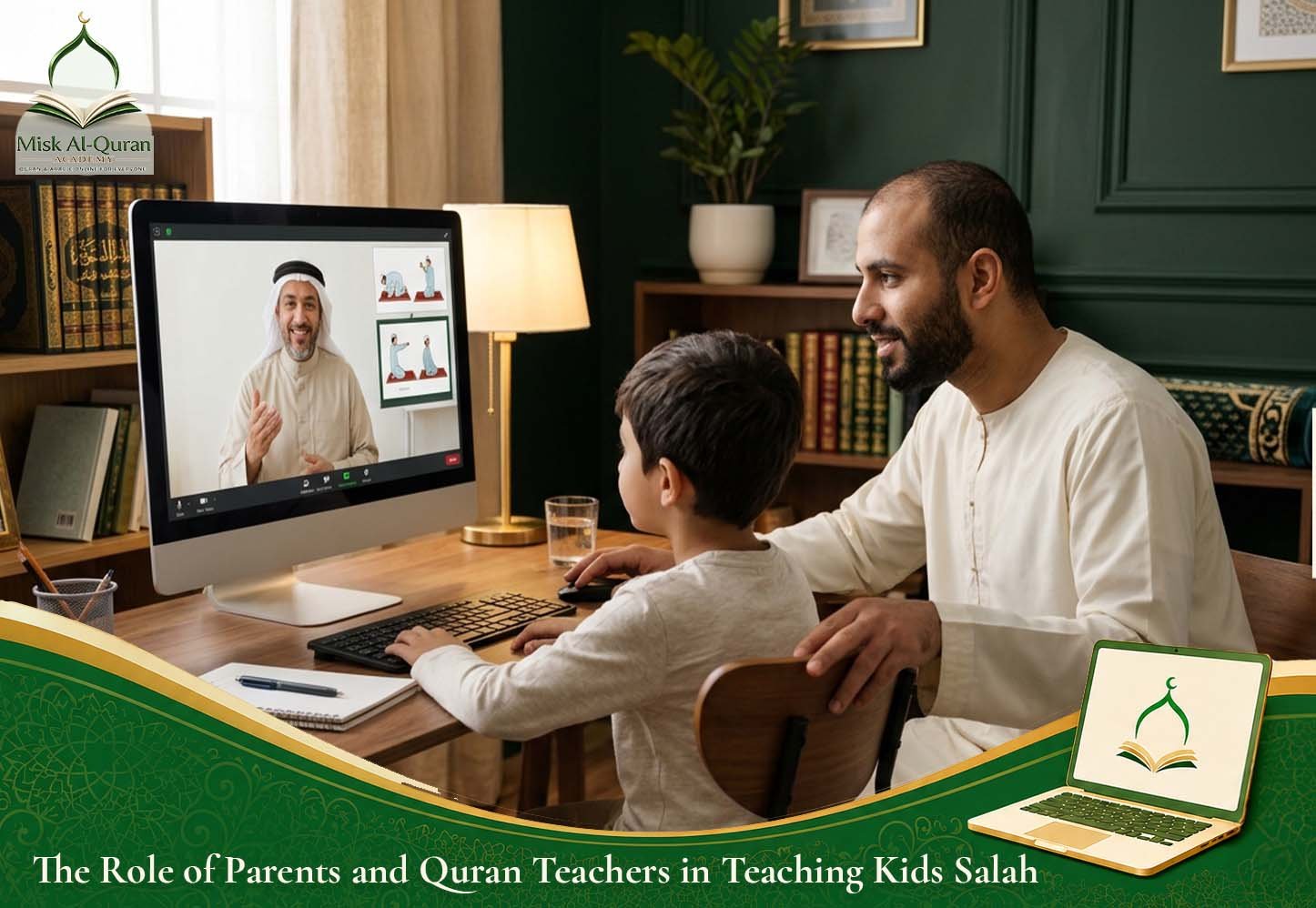
Parents are usually children’s first religious educators. Their behavior, daily habits, and attitude toward worship provide examples that children observe regularly. However, some aspects of Islamic education require additional explanation, especially Quranic pronunciation and detailed prayer rulings. This is where suitable educational guidance can complement learning at home.
What Parents Should Teach at Home About Salah?
Parents can focus on introducing prayer as a familiar family practice. Their responsibilities may include:
- Explaining why Muslims perform salah.
- Demonstrating the basic prayer positions.
- Encouraging participation in family worship.
- Introducing daily prayer names and times.
- Helping children develop positive religious habits.
- Providing emotional support when learning becomes difficult.
When Should Parents Consider Additional Quran Instruction?
Additional Quran instruction may help children who struggle with Arabic reading, Quran memorization, or pronunciation. Parents should first identify their child’s learning needs before choosing suitable educational support.
For example, beginners may need more practice recognizing Arabic letters, while fluent readers may need guidance with Tajweed and memorization. Families considering Misk Online Quran Academy should ask about teaching methods, lesson objectives, and progress communication.
The right learning arrangement should match the child’s current abilities and learning pace. Regular practice, suitable instruction, and parental encouragement can help children develop stronger Quranic skills without unrealistic expectations.
Frequently Asked Questions About How to Teach Kids Salah
Find helpful answers to common questions about how to teach kids salah, including the right age, prayer steps, and practical learning tips.
1. Should Children Learn the Meaning of Prayer Words Before Memorizing Them?
Children can learn the pronunciation and simple meanings together, although they do not need to understand every Arabic expression immediately. Explain familiar words gradually using examples appropriate to their ages. This approach helps them connect Quranic recitation with its meaning.
2. Can Children Pray While Traveling With Their Parents?
Children can accompany their parents during travel and participate in family prayers. Parents should explain that travelers have specific concessions concerning certain obligatory prayers. Detailed rulings depend on the circumstances and should be learned from a qualified Islamic scholar.
3. What Should Parents Do When Children Ask Difficult Questions About Prayer?
Listen carefully and avoid dismissing questions simply because they seem complicated. Provide an age-appropriate answer when possible. If the question involves a detailed religious ruling, seek guidance from a knowledgeable and reliable Islamic teacher.
4. How Can Parents Teach Children to Respect the Prayer Area?
Explain that the prayer area should remain clean and suitable for worship. Encourage children to keep their prayer mats organized, avoid bringing unnecessary distractions, and treat the space respectfully. Demonstrating these habits regularly makes the lesson easier to understand.
Conclusion
Learning how to teach kids salah requires patience, consistency, and gentle guidance. Start with wudu, prayer positions, Al-Fatihah, and short surahs, using demonstrations and regular family practice.
Remember that every child learns at a different pace. Encourage progress without pressure and make salah a positive part of daily life. Families can also explore Misk Online Quran Academy to support their children’s Quran learning. With parental encouragement and suitable instruction, children can gradually develop confidence in prayer and a stronger connection with Islamic worship.