The Difference Between Hafs and Warsh: The Quran is one of the most searched topics among Muslims who want to understand the science of Quranic recitation. Many learners notice slight differences while listening to reciters from different countries and naturally wonder whether these variations indicate different versions of the Quran.
However, the answer is clear: they do not. Hafs and Warsh are two authentic narrations of the same Quran, both transmitted through reliable chains back to the Prophet Muhammad ﷺ. Therefore, every Muslim can recite with confidence, knowing that both narrations preserve the exact revelation of Allah.
Moreover, learning about the Difference Between Hafs and Warsh Quran helps students appreciate the remarkable precision with which the Quran has been preserved for more than fourteen centuries.
Instead of creating confusion, these authentic recitations highlight the richness of the Arabic language and the depth of Islamic scholarship. At Misk Online Quran Academy, students receive structured lessons that explain these differences in a simple and practical way, allowing them to improve their Tajweed and recitation under the supervision of qualified teachers.
What Are Hafs and Warsh Quran Recitations?
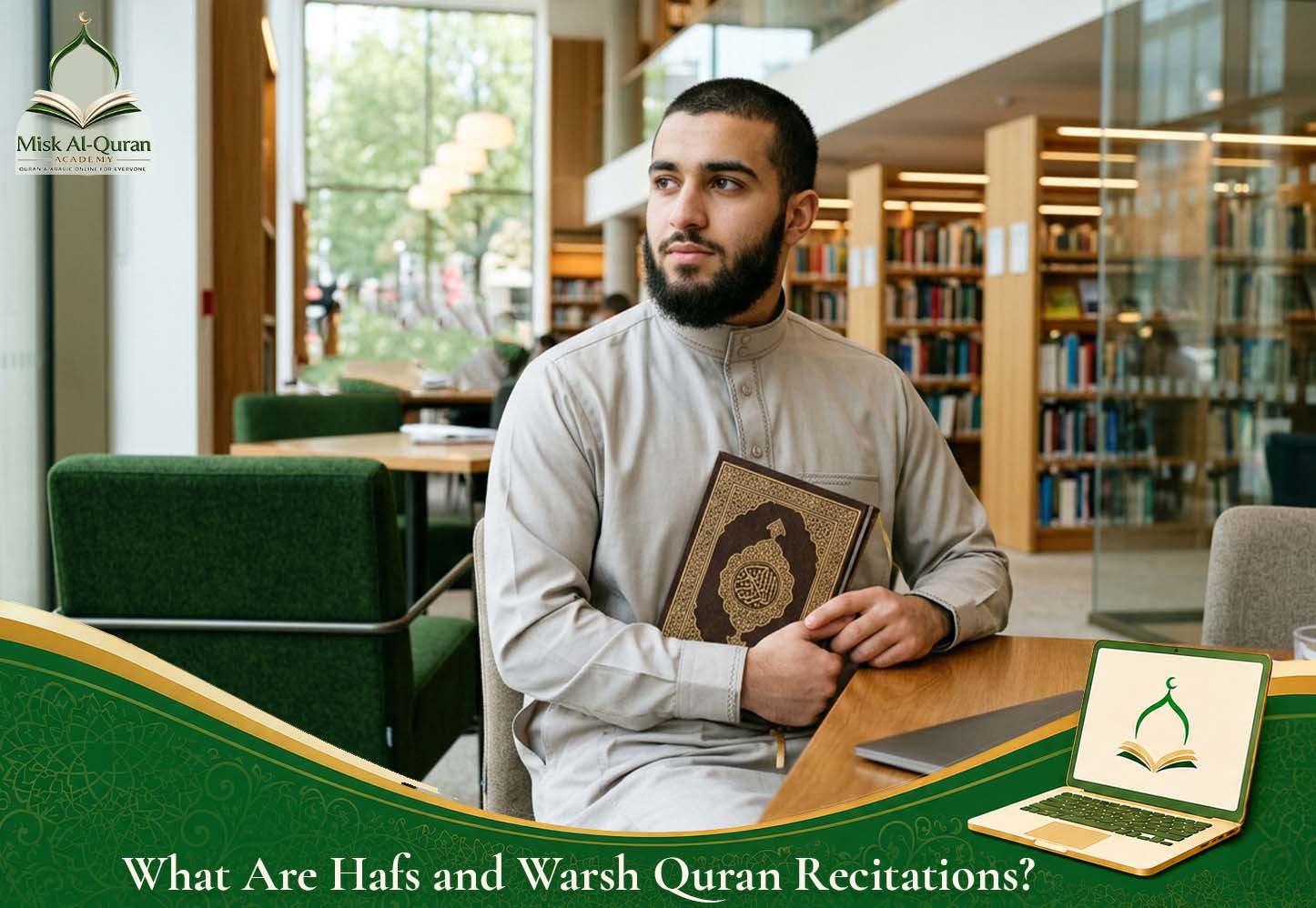
Before exploring the Difference Between Hafs and Warsh Quran, it is important to understand what Hafs and Warsh actually represent.
They are not different versions of the Quran. Instead, there are two authentic Riwayat (transmissions) within the science of Qira’at, which refers to the accepted methods of reciting the Quran taught by the Prophet Muhammad ﷺ. These methods were carefully preserved by the Companions and later transmitted through trustworthy scholars.
Today, Muslim scholars recognize ten authentic Qira’at, each supported by reliable chains of narration. Among these, Hafs and Warsh are the two most widely known and studied recitations around the world. Both narrations share the same essential characteristics because they:
- Preserve the exact words revealed to the Prophet Muhammad ﷺ.
- Follow the Uthmanic script of the Quran.
- Have authentic and uninterrupted chains of transmission.
- Are accepted by mainstream Islamic scholars.
- Continue to be taught in Quran schools and Islamic institutes worldwide.
As a result, understanding these foundations removes many common misconceptions about the Difference Between Hafs and Warsh Quran and helps students approach Quran recitation with greater confidence.
Start Your Quran Learning Journey with Misk Online Quran Academy
Begin your Quran learning journey with Misk Online Quran Academy, where students of all ages benefit from structured online Quran classes tailored to their individual level and learning needs.
Whether your goal is to improve Quran recitation, master Tajweed rules, or begin memorizing the Holy Quran, our experienced and qualified teachers provide clear step-by-step guidance through personalized one-to-one lessons. Each session is designed to help learners understand, practice, and improve with confidence and consistency. For learners who want to go further, take a look at our Tajweed classes.
With flexible scheduling, interactive teaching methods, and a supportive online environment, Misk Online Quran Academy makes it easier to stay committed and motivated. Students can learn comfortably from home while making steady progress in their Quran studies at their own pace. If this is an area you’d like to explore in more depth, check out our Quran classes.

Understanding the Science of Qira’at
To fully appreciate the Difference Between Hafs and Warsh Quran, learners should first understand the meaning of Qira’at.
The Arabic word Qira’at refers to the authentic methods of reciting the Quran that were taught directly by Prophet Muhammad ﷺ. Afterward, his Companions carefully transmitted these recitations to the next generation, ensuring that every pronunciation, elongation, and articulation remained accurate.
Furthermore, Allah allowed the Quran to be recited in multiple authentic forms to make it easier for different Arab tribes to learn the revelation according to their dialects. Although these recitations contain slight linguistic variations, they all preserve the same message, guidance, and beliefs.
Over the centuries, Muslim scholars established strict conditions before accepting any recitation. A Qira’ah had to:
- Possess an authentic chain of narration leading back to the Prophet ﷺ.
- Agree with the Uthmanic Mushaf.
- Follow the rules of classical Arabic.
- Be accepted by qualified scholars throughout Islamic history.
Consequently, every accepted Qira’ah reflects the extraordinary efforts made to preserve the Quran exactly as it was revealed. Rather than representing different texts, these recitations demonstrate the flexibility and beauty of Quranic Arabic.
Who Is Imam Hafs?
Imam Hafs ibn Sulayman is one of the most famous transmitters of Quranic recitation. He learned directly from Imam Asim, whose recitation became one of the most widely accepted throughout the Muslim world. Today, many students begin their journey through an Online Quran Hifz Course, where Hafs is the primary narration taught because of its global popularity. Many students pair this with our Ijazah program to round out their learning.
Today, the Hafs narration is the most commonly used recitation worldwide. For this reason, most printed Mushafs, Quran applications, online courses, and audio recordings follow the Hafs narration.You will commonly hear Hafs recited in:
- Saudi Arabia
- Egypt
- Jordan
- Turkey
- Pakistan
- India
- Indonesia
- Malaysia
- Most Arab and non-Arab Muslim countries
Because educational resources are widely available, many beginners choose Hafs as their first narration. With the guidance of an experienced online Quran teacher, students can build a strong foundation and continue their memorization journey with confidence wherever they live.
Who Is Imam Warsh?
Imam Warsh was one of the distinguished students of Imam Nafi’ of Madinah. His narration later became the primary recitation in many countries across North and West Africa. Today, millions of Muslims continue to recite the Quran according to the Warsh narration, especially in:
- Morocco
- Algeria
- Tunisia
- Mauritania
- Libya
- Senegal
- Mali
- Niger
- Several West African countries
Although Warsh differs from Hafs in some pronunciation and Tajweed rules, it remains equally authentic and fully accepted by Islamic scholars. The Role Of Tajweed is especially important when learning either narration because it preserves the correct pronunciation and beauty of Quranic recitation.
In addition, many students appreciate the smooth rhythm and beautiful melody that characterize the Warsh recitation. Children in these regions often memorize the entire Quran using Warsh from an early age and continue reciting with it throughout their lives.
Difference Between Hafs and Warsh Quran
Understanding the Difference Between Hafs and Warsh begins with recognizing that both narrations preserve the exact same revelation. Instead, the differences appear in pronunciation, Tajweed rules, vowelization, and a limited number of authentic word forms.
Therefore, Muslims around the world can confidently recite either narration while benefiting from online Quran memorization programs that teach these authentic traditions with qualified instructors.
Moreover, these variations never create contradictions in belief or worship. Rather, they demonstrate the richness of the Arabic language and the remarkable precision with which the Quran has been preserved. For this reason, scholars throughout Islamic history have accepted both Hafs and Warsh as authentic and reliable methods of recitation.
Difference Between Hafs and Warsh Quran in Pronunciation
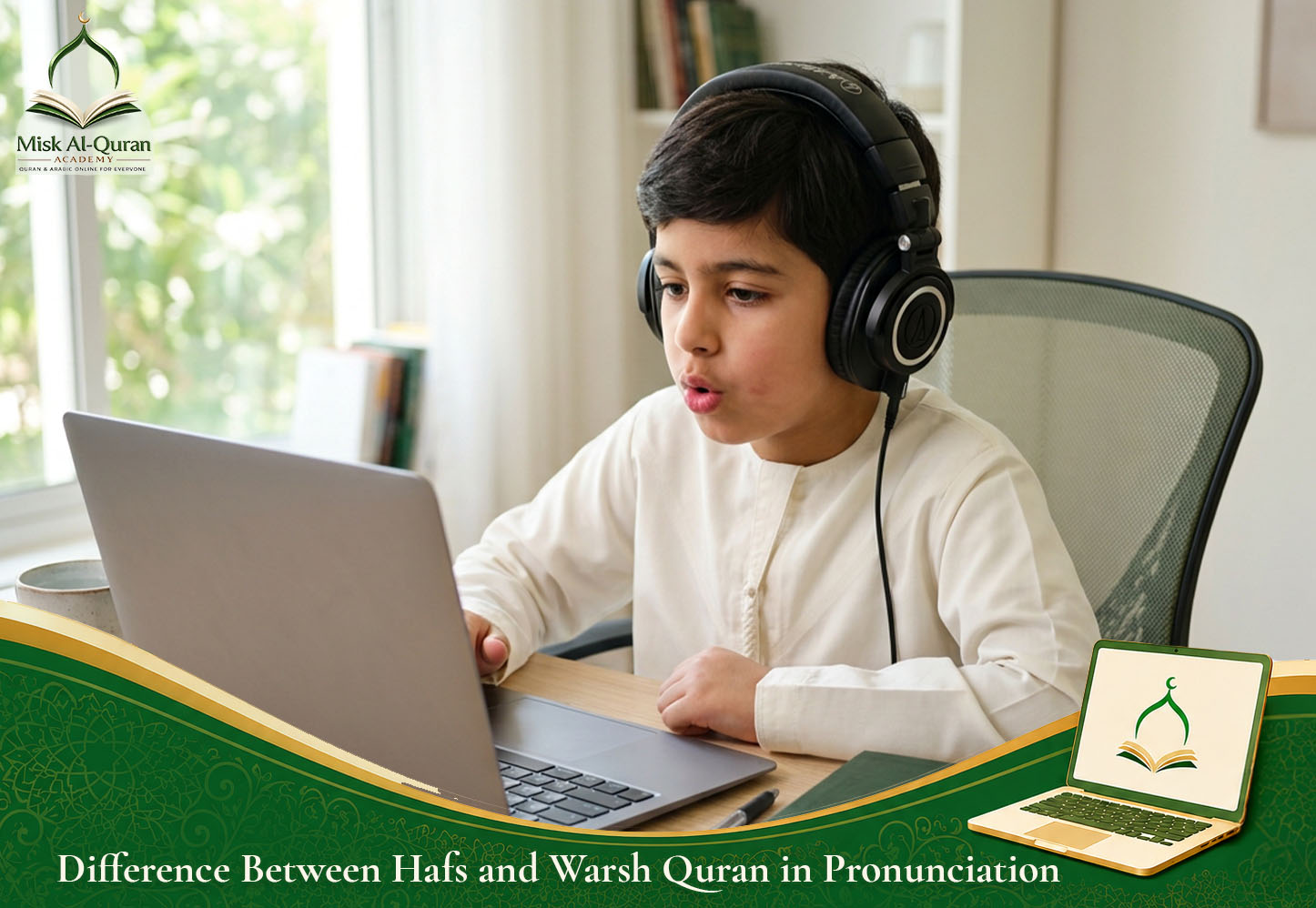
One of the most noticeable aspects of the Difference Between Hafs and Warsh Quran is pronunciation. Although the words of the Quran remain the same, certain letters and sounds are pronounced differently according to each narration’s established rules. Understanding these distinctions can also help students speak Arabic more accurately by improving pronunciation and articulation. For example, students may notice variations in:
- The pronunciation of certain Arabic letters.
- The articulation of Hamzah.
- The application of Imalah.
- The length of specific vowel sounds.
- The rules for stopping and continuing during recitation.
However, these differences are never based on personal preference or regional accents. Instead, every pronunciation has been transmitted through reliable scholarly chains and carefully preserved over many generations.
As a result, students studying with qualified teachers quickly learn that these variations are an essential part of the science of Qira’at rather than signs of different Qurans.
At Misk Online Quran Academy, instructors provide live correction and practical exercises to help students master these pronunciation rules with confidence.
Difference Between Hafs and Warsh Quran in Tajweed Rules
Another important Difference Between Hafs and Warsh Quran involves the application of Tajweed. While the fundamental principles remain the same, each narration includes several unique characteristics that distinguish it from the other.
Madd (Lengthening)
- One of the clearest distinctions involves the rules of Madd.
- Generally, Hafs reads Madd Munfasil with a shorter length. In contrast, Warsh often extends the same Madd for four or five counts.
- Consequently, the rhythm of the recitation sounds different even though the Quranic text remains identical.
Imalah
- Another unique feature found primarily in Warsh is Imalah.
- This rule causes certain words to be pronounced with a sound that falls between “A” and “E.”
- Meanwhile, Hafs usually pronounces those same words without applying Imalah.
Hamzah Rules
- Hamzah’s pronunciation also illustrates the difference between the Hafs and Warsh Quran.
- In many places, Warsh eases or merges the Hamzah according to authentic transmission.
- By comparison, Hafs generally pronounces the Hamzah more clearly and directly.
Rules of Stopping (Waqf)
Stopping rules represent another authentic distinction. When stopping on particular words. For instance, Warsh applies rules such as:
- Naql
- Taqlil
- Imalah
On the other hand, Hafs usually follows simpler stopping patterns, making it easier for many beginners to learn.
Difference Between Hafs and Warsh Quran in Vowelization
Another significant Difference Between Hafs and Warsh Quran involves vowel markings. Sometimes, both narrations use different authentic vowels while following the same Uthmanic script. Even so, these variations never alter the overall meaning of the Quran. Instead, they may:
- Add another grammatical perspective.
- Highlight different shades of meaning.
- Enrich the linguistic beauty of Quranic Arabic.
- Demonstrate the flexibility of authentic recitation.
Therefore, scholars consider these differences complementary rather than contradictory. Students studying advanced Tajweed gradually become familiar with these details through consistent practice and expert guidance.
Difference Between Hafs and Warsh Quran in Word Pronunciation
The Difference Between Hafs and Warsh Quran also appears in the pronunciation of a limited number of Quranic words. Nevertheless, these differences remain authentic and preserve the same message revealed to Prophet Muhammad ﷺ.
Example 1: Surah Al-Fatihah (1:4)
Hafs
مَالِكِ يَوْمِ الدِّينِ
- Transliteration: Māliki Yawmid-Dīn
- Meaning: Master of the Day of Judgment.
Warsh
مَلِكِ يَوْمِ الدِّينِ
- Transliteration: Maliki Yawmid-Dīn
- Meaning: King of the Day of Judgment.
Clearly, both descriptions are true because Allah is both the Master and the King of the Day of Judgment. Thus, these two readings complement one another instead of presenting conflicting meanings.
Example 2: Surah Al-Baqarah (2:125)
Hafs
وَاتَّخِذُوا
Transliteration: Wattakhidhū
Meaning: “And take…”
Warsh
وَاتَّخَذُوا
Transliteration: Wattakhadhū
Meaning: “And they took…”
Although the grammatical perspective differs slightly, both narrations remain authentic. Furthermore, scholars explain that these readings expand the understanding of the verse without affecting its guidance.
Example 3: Surah Al-Baqarah (2:184)
Hafs
مِسْكِينٍ
A needy person.
Warsh
مَسَاكِين
Needy people.
Likewise, this variation reflects linguistic richness rather than theological difference. Therefore, both readings are accepted and interpreted together within the broader framework of Islamic scholarship.
Difference Between Hafs and Warsh Quran in Geographic Distribution
Another interesting difference between the Hafs and Warsh Quran is the regions where each narration is most commonly practiced.
Hafs is widely used in:
- Saudi Arabia
- Egypt
- Jordan
- Turkey
- Pakistan
- India
- Indonesia
- Malaysia
- Most Muslim communities worldwide
As a result, most printed Mushafs, Quran applications, online academies, and memorization programs use the Hafs narration.
Warsh is commonly used in:
- Morocco
- Algeria
- Tunisia
- Mauritania
- Libya
- Senegal
- Mali
- Niger
- Parts of West Africa
Likewise, many mosques and Quran schools in these countries teach children to memorize the Quran according to the Warsh narration.
Ultimately, regional preference does not affect authenticity. Both narrations remain equally respected throughout the Muslim world.
Does the Difference Between Hafs and Warsh Quran Change the Meaning?
One of the most common questions students ask is whether the difference between the Hafs and Warsh Quran changes the meaning of the Quran. Fortunately, the answer is no. Both narrations preserve the same divine revelation, the same beliefs, and the same guidance revealed to the Prophet Muhammad ﷺ.
Instead, the differences belong to the science of Qira’at, which has been carefully preserved by Muslim scholars for centuries. As a result, every authentic narration reflects the same Quran while presenting slight linguistic variations that enrich the Arabic language. Most variations fall into one of these categories:
- Pronunciation without changing the meaning.
- Different grammatical structures that complement one another.
- Slight variations in vowelization.
- Authentic word forms that provide additional linguistic depth.
Therefore, these variations should be viewed as a sign of the Quran’s miraculous preservation rather than a source of confusion.
Why Were Multiple Quran Recitations Revealed?
Many beginners wonder why Allah allowed different authentic recitations. In fact, the wisdom behind the Qira’at demonstrates Allah’s mercy and the flexibility of the Arabic language.
During the lifetime of the Prophet Muhammad ﷺ, Arab tribes spoke different dialects. Therefore, Allah permitted multiple authentic methods of recitation that made learning easier while preserving the exact message of the Quran.
Moreover, these authentic recitations demonstrate:
- The richness of classical Arabic.
- The precision of Quranic preservation.
- Allah’s mercy toward different communities.
- The careful efforts of Muslim scholars throughout history.
Consequently, every authentic Qira’ah serves as evidence that the Quran has been preserved with extraordinary care for more than fourteen centuries.
Which Recitation Should You Learn First?
If you are beginning your Quran journey, you may wonder which narration is the best choice. Fortunately, both Hafs and Warsh are completely authentic. However, your decision should depend on your learning goals, your local community, and the resources available to you.
Choose Hafs If You:
- Are completely new to Quran learning.
- Use popular Quran applications.
- Want access to the widest range of learning materials.
- Plan to memorize using the most common narration.
- Live in countries where Hafs is widely taught.
Because Hafs is the most common narration worldwide, beginners often find it easier to continue their studies without changing learning resources.
Choose Warsh If You:
- Live in Morocco or another North African country.
- Attend a mosque that recites according to Warsh.
- Want to learn the traditional narration of your community.
- Plan to specialize in Qira’at in the future.
Ultimately, there is no superior narration. Rather, both Hafs and Warsh faithfully preserve the words of Allah exactly as they were transmitted from the Prophet Muhammad ﷺ.
Benefits of Learning the Difference Between Hafs and Warsh Quran
Studying the Difference Between Hafs and Warsh Quran provides many valuable benefits beyond learning pronunciation rules. For example, students develop a deeper appreciation for the remarkable preservation of the Quran and the dedication of generations of Muslim scholars. Furthermore, understanding these narrations helps learners:
- Strengthen their confidence in the authenticity of the Quran.
- Improve their Tajweed and pronunciation.
- Appreciate the richness of classical Arabic.
- Recognize the beauty of authentic Quranic recitation.
- Prepare for advanced studies in Qira’at.
- Build stronger listening and memorization skills.
Overall, learning about Hafs and Warsh allows students to approach Quran recitation with greater knowledge and confidence.
How to Learn Hafs and Warsh Correctly?
Reading about the Difference Between Hafs and Warsh Quran is an excellent beginning. However, mastering either narration requires guidance from qualified Quran teachers who can correct pronunciation and Tajweed in real time.
Learn the Fundamentals First
Every student should begin by mastering the essentials. This includes learning the Arabic alphabet, correct pronunciation, basic Tajweed rules, letter recognition, proper articulation points, and developing consistent daily reading practice with qualified teacher guidance.
- Correct Makharij (letter articulation).
- Basic Tajweed rules.
- Proper pronunciation of Arabic letters.
- Common recitation mistakes.
Once students establish a strong foundation, they can distinguish the unique characteristics of each narration more easily.
Practice With Qualified Teachers
Learning with experienced teachers helps students improve much faster. As a result, students avoid developing incorrect recitation habits. Qualified instructors can:
- Correct mistakes immediately.
- Explain Tajweed rules clearly.
- Improve pronunciation step by step.
- Build confidence through continuous feedback.
Listen to Authentic Quran Reciters
Listening regularly is another effective learning method. For example, students can listen to well-known Hafs or Warsh reciters before practicing on their own. This habit helps improve:
- Pronunciation.
- Fluency.
- Tajweed application.
- Listening accuracy.
- Memorization quality.
Practice Every Day
Consistency is one of the keys to successful Quran learning. Even if you practice for only a short time each day, regular revision produces better results than occasional long sessions. Daily practice helps students:
- Retain memorization.
- Improve fluency.
- Increase confidence.
- Apply Tajweed naturally.
Therefore, creating a regular study routine is one of the most effective ways to achieve steady progress.
Learn Hafs and Warsh Quran Recitation with Misk Academy

If you want to understand the Difference Between Hafs and Warsh Quran through practical learning, Misk Online Quran Academy provides structured online classes for children, adults, and new Muslims.
Our qualified teachers guide students step by step while ensuring accurate pronunciation and proper Tajweed according to authentic Islamic scholarship. Our programs include:
- One-to-one live Quran classes.
- Certified male and female Quran teachers.
- Comprehensive Tajweed courses.
- Hafs and Warsh recitation training.
- Quran memorization programs.
- Flexible schedules for all ages.
- Regular progress assessments.
- Interactive online learning from anywhere in the world.
In addition, every lesson is designed to help students build confidence, improve fluency, and develop a lifelong connection with the Quran.
Frequently Asked Questions About the Difference Between Hafs and Warsh Quran
Yes. However, most scholars recommend completing your memorization in one narration before learning another. This approach helps maintain consistency and prevents confusion during revision.
2. Is one narration more authentic than the other?
No. Both Hafs and Warsh are authentic narrations that have been transmitted through reliable chains back to the Prophet Muhammad ﷺ.
3. Why is Hafs more common than Warsh?
Hafs became the most widespread narration because many Muslim countries adopted it for education and printed Mushafs. Meanwhile, Warsh remained the primary narration in several North and West African countries.
4. Can beginners learn Warsh from the beginning?
Yes. If you have a qualified teacher and appropriate learning resources, you can begin with Warsh just as easily as Hafs.
In conclusion, The Difference Between Hafs and Warsh Quran highlights the richness and precision of Quranic recitation rather than any difference in the Quran itself. Although the two narrations differ in pronunciation, Tajweed, vowelization, and certain linguistic features, they preserve the same divine revelation revealed to the Prophet Muhammad ﷺ.
Ultimately, both Hafs and Warsh are authentic, reliable, and accepted by Muslim scholars around the world. Therefore, whichever narration you choose, you are reciting the same Quran with a tradition that has been carefully preserved for generations.
At Misk Online Quran Academy, students receive expert guidance that helps them master authentic Quran recitation with confidence, accuracy, and a deeper appreciation for the beauty of the Quran.