
Online Tajweed Classes with Certified Azhari Teachers
Reading the Quran is one thing. Reciting it the way it was revealed is another. A word read with the wrong makhraj, a madd cut short, a noon saakin rushed past, none of it is obvious to an untrained ear, but it changes the recitation. Our online Tajweed classes at Misk Quran Academy pair students in the US, UK, Canada, and across Europe with Azhari-trained teachers who listen letter by letter, in real time, and correct habits that self-study apps simply cannot catch. Kids building their first foundation and adults fixing years of self-taught habits both start from the same place: a live teacher who actually hears you recite.
Try a Free Trial Class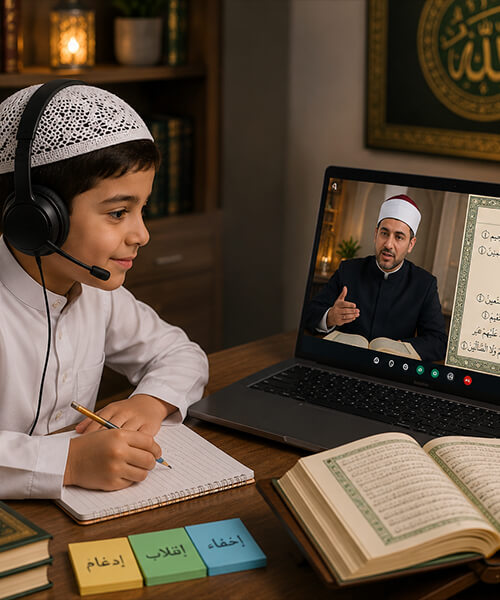
What Is Tajweed and Why It Cannot Be Learned From an App Alone
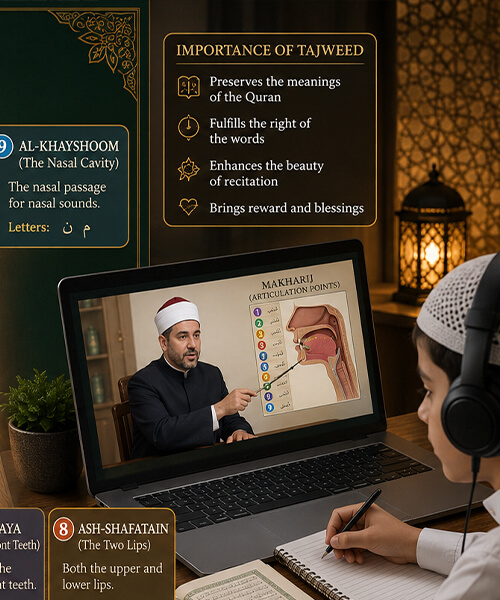
Tajweed is the set of rules that govern exactly how each letter of the Quran should be pronounced, from the correct articulation point in the mouth or throat to the length of every elongation. According to the historical overview of Tajwid as an Islamic recitation science, these rules were practiced during the time of the Prophet Muhammad ﷺ himself and later documented by scholars once Islam spread beyond Arabic speaking regions and pronunciation errors began creeping into recitation.
That history explains why Tajweed resists shortcuts. A pronunciation app can show you a diagram of where a letter is articulated. It cannot listen to your child recite Surah Al-Fatiha and tell you their qalqalah is too soft, or that they are dropping the ghunnah on a noon saakin. Only a live teacher, trained themselves through a real Sanad, can hear the difference and correct it before it becomes a permanent habit.
Why Parents and Adult Students Choose Misk Quran Academy
Azhari-Trained Teachers
Every teacher assigned to our Tajweed program trained through the tradition upheld by Al-Azhar, with a real Sanad of their own, not a general Arabic language background repackaged as recitation coaching.
Truly One on One
No group of eight kids sharing a screen while one recites. Every Tajweed session is private, so mistakes get caught and corrected the moment they happen.
Age-Appropriate Pace
A six year old and a forty year old professional do not learn Tajweed the same way. Lesson pacing, homework, and correction style adjust to the student in front of the teacher.
Consistent Weekly Rhythm
Families across different time zones keep a fixed weekly slot, so Tajweed becomes a steady habit rather than something squeezed in when convenient.
If your household is also working on spoken Arabic comprehension, our online Arabic classes reinforce the same root letters and sounds that Tajweed rules are built around, and the two subjects tend to accelerate each other rather than compete for attention.
How Our Online Tajweed Classes Work
1. Free Trial and Level Check
A short, no obligation session where the teacher listens to a few lines of recitation and identifies exactly which rules need the most attention, whether that is makharij, madd, or noon and meem rules.
2. Personalized Weekly Plan
Based on the trial, your teacher builds a plan that starts with foundational articulation points before layering in more advanced rules like idgham, ikhfa, and qalqalah.
3. Guided Recitation Practice
Each week, the student recites assigned verses aloud while the teacher corrects in real time, repeating problem words until the correction actually sticks rather than fading by the next session.
4. Progress Reviews for Parents
Parents receive regular updates on what has improved and what still needs work, so Tajweed progress is never a guessing game between home and the classroom.
Rules That Trace Back to a Documented Tradition
Tajweed is not a modern teaching method invented for online classrooms. It is a documented Islamic science, refined over centuries by scholars connected to institutions such as Al-Azhar Al-Sharif, which has anchored the study of Quranic recitation in Cairo for over a thousand years. Our teachers are trained within that same lineage, which is why the corrections you receive are not personal opinions about pronunciation. They are rules with a scholarly chain behind them, the same chain that eventually supports formal Ijazah certification for students who choose to continue that far.
Serious students sometimes ask how technical the field has become in recent years. Even recent academic research on evaluating Quranic recitation confirms that Tajweed correction still depends on trained human judgment of articulation points and letter characteristics, not automated pronunciation checks alone. That is exactly why we keep every class one teacher, one student, live.
Who Joins Our Online Tajweed Classes
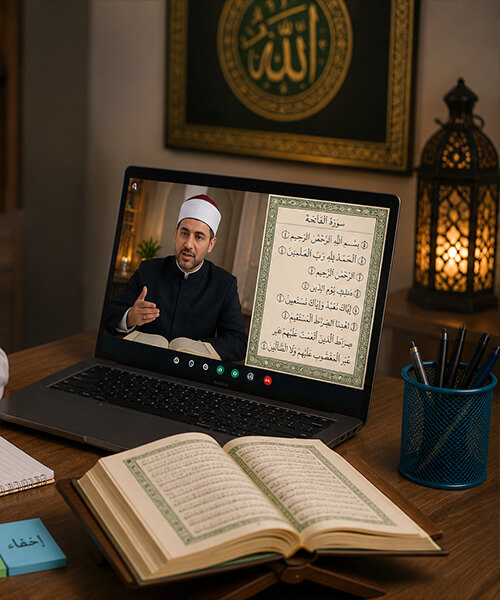
Some families come to us right after finishing the alphabet stage, wanting their child's recitation habits built correctly from the very first surah rather than corrected later. Others are adults, often reverts or lifelong Muslims who never had formal recitation training growing up, who feel embarrassed reciting in the masjid and want that fixed privately before joining a group setting.
A mother in Leeds reached out to us last year because her ten year old had memorized several short surahs at a weekend school but pronounced the heavy letters, the seven letters of tafkheem, almost identically to the light ones. Eight weeks of consistent one on one correction fixed a habit that had gone unnoticed for two years. That is a common pattern. Tajweed problems rarely announce themselves. They just sit there until someone trained enough is actually listening.
Book Your Child's Free Tajweed Trial Class
No commitment, no pressure. Just fifteen minutes with a real teacher who will tell you exactly where the recitation stands.
Book My Free Trial on WhatsApp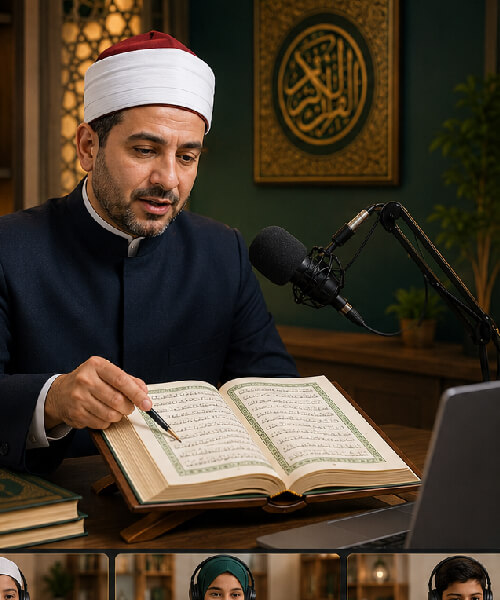
My husband and I both grew up reciting the Quran but never had our pronunciation formally checked. After three months of weekly Tajweed sessions, our teacher caught mistakes in our madd rules that we had been repeating for over twenty years without knowing. It felt humbling, honestly, but also like a relief that someone finally told us.
Parent, online Tajweed classes, adult trackCurious how other students structured their Tajweed journey alongside memorization or Arabic study? Our academy blog shares practical breakdowns from teachers and families who have gone through the same process.
Frequently Asked Questions About Online Tajweed Classes
What age can a child start online Tajweed classes?
Most children start around age five or six, once they can recognize Arabic letters. Younger children can join too, with a lighter, more playful pace focused on sound recognition before formal rules are introduced.
Can adults with no prior Quran education join?
Yes. A large portion of our Tajweed students are adults, including reverts and lifelong Muslims who never had formal recitation training. Classes start from wherever the student currently is, with no judgment attached.
How is online Tajweed different from a self-study app?
An app can show diagrams and play audio, but it cannot listen to your specific recitation and correct it live. Our teachers hear every letter you recite and adjust corrections in real time, which is something automated tools cannot replicate.
Do I need to already know how to read Arabic?
No. Some students begin with Arabic reading fundamentals before layering in Tajweed rules. If needed, this can run alongside our online Arabic classes so both skills build together.
How long until I notice real improvement in recitation?
Most students notice a clear difference within six to ten weeks of consistent weekly sessions, particularly with makharij and the most commonly misapplied rules like noon saakin and tanween.
Does completing Tajweed classes lead toward an Ijazah?
For students who have completed or are close to completing Hifz, strong Tajweed is the required foundation before pursuing an Ijazah with Sanad through our dedicated Ijazah program.