What is Islamic Fiqh is a question many Muslims ask when they begin exploring the deeper meanings of their faith. While Islam provides comprehensive guidance through the Quran and the Sunnah, understanding how these teachings are applied in everyday life requires knowledge of Islamic Fiqh. Moreover, this branch of Islamic knowledge helps Muslims practice their religion correctly by explaining the practical rulings that govern worship, family matters, financial dealings, and social responsibilities.
Unlike general Islamic studies, Islamic jurisprudence focuses on interpreting authentic religious sources and applying them to real-life situations. As a result, Muslims can confidently make decisions that align with Islamic values while adapting to the challenges of modern life. Whether someone wants to learn the correct way to pray, understand Islamic business ethics, or strengthen family relationships, studying Fiqh provides clear and reliable guidance.
At Misk Online Quran Academy, students receive structured lessons that simplify complex topics and make learning both practical and enjoyable. Furthermore, experienced instructors explain the wisdom behind Islamic rulings using authentic evidence from the Quran and the Sunnah, allowing learners to strengthen both their knowledge and their faith.
What Is the Meaning of Islamic Fiqh?
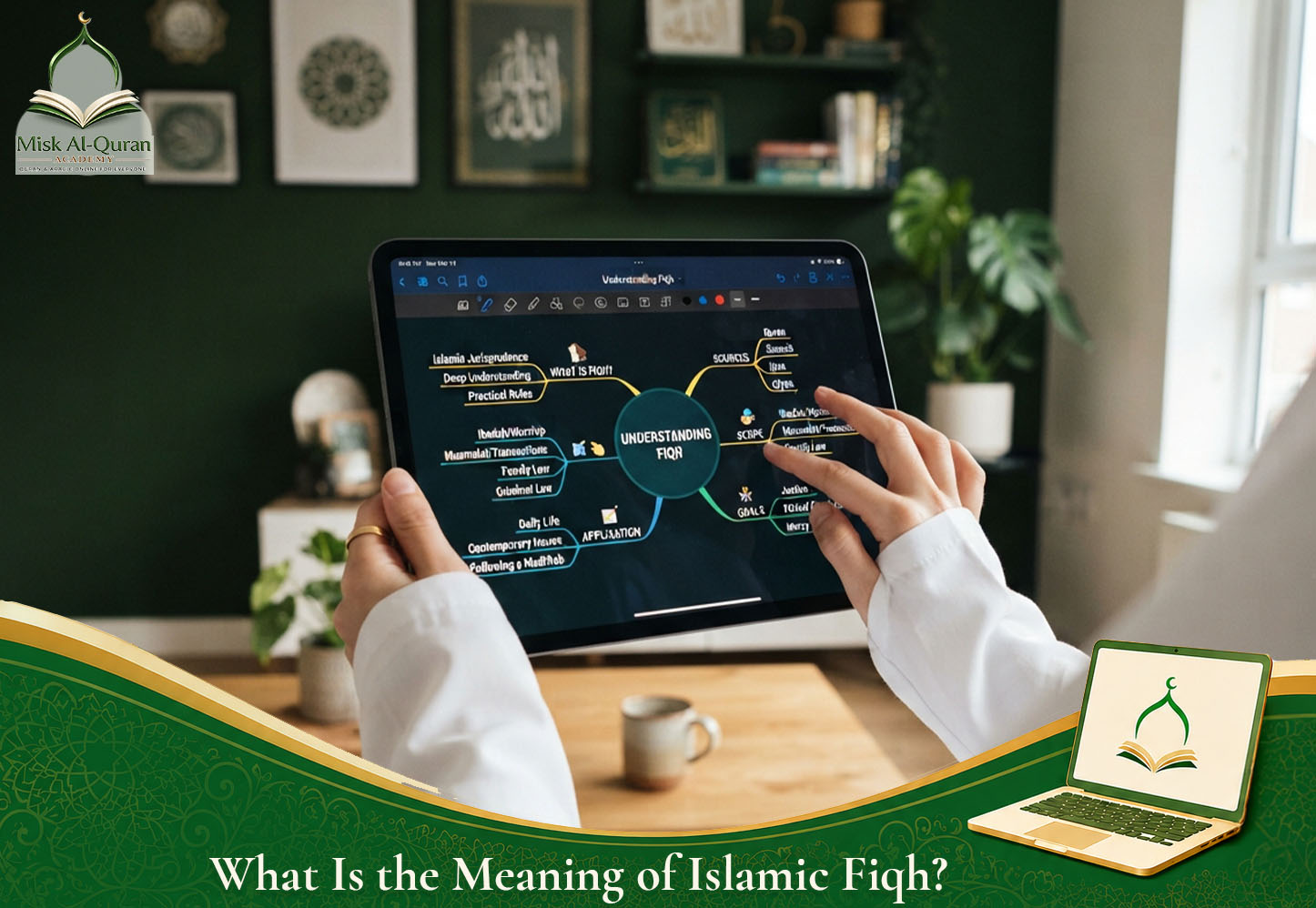
What is Islamic Fiqh? It is the science of understanding the practical rulings of Islam that regulate a Muslim’s daily life. The Arabic word Fiqh literally means “deep understanding” or “comprehension.” In Islamic terminology, however, it refers to the human understanding of Islamic law based on authentic evidence from the Quran and the Sunnah.
Furthermore, scholars derive these rulings through well-established methods that also consider scholarly consensus (Ijma’) and analogical reasoning (Qiyas). This careful process ensures that Islamic rulings remain firmly connected to divine guidance while providing practical solutions for contemporary issues.
Rather than being limited to legal discussions, Islamic Fiqh covers many aspects of life. It explains how Muslims should perform acts of worship, conduct financial transactions, maintain family relationships, fulfill social responsibilities, and uphold ethical values. Therefore, learning Fiqh enables believers to transform Islamic teachings into meaningful daily actions.
Another unique feature of the science of Fiqh is its balance between fixed principles and practical flexibility. While the foundations of Islam never change, qualified scholars can address new situations by applying established legal principles to modern circumstances. Consequently, Muslims continue to benefit from timeless Islamic guidance regardless of changes in society or technology.
At Misk Online Quran Academy, students explore these principles through interactive online classes designed for beginners and advanced learners alike. Each lesson combines authentic knowledge with practical examples, making it easier to understand and apply Islamic rulings with confidence.
Start Your Quran Learning Journey with Misk Online Quran Academy
Begin your Quran learning journey with Misk Online Quran Academy, where students of all ages benefit from structured online Quran classes tailored to their individual level and learning needs.
Whether your goal is to improve Quran recitation, master Tajweed rules, or begin memorizing the Holy Quran, our experienced and qualified teachers provide clear step-by-step guidance through personalized one-to-one lessons. Each session is designed to help learners understand, practice, and improve with confidence and consistency.
With flexible scheduling, interactive teaching methods, and a supportive online environment, Misk Online Quran Academy makes it easier to stay committed and motivated. Students can learn comfortably from home while making steady progress in their Quran studies at their own pace.

Why Is Islamic Fiqh Important?
Studying Islamic Fiqh is essential because it enables Muslims to practice their religion with knowledge instead of assumptions. Moreover, understanding authentic Islamic rulings helps believers avoid common misunderstandings and strengthens their ability to distinguish between religious teachings and cultural traditions.
One of the greatest benefits of learning Fiqh is improving the quality of worship. Muslims gain a clear understanding of purification, prayer, fasting, Zakat, and Hajj according to authentic evidence. As a result, they perform these acts of worship with greater confidence and sincerity.
In addition, Islamic jurisprudence promotes justice and ethical behavior in everyday life. It teaches honesty in business, fairness in financial transactions, kindness within families, and respect for the rights of others. These values contribute to stronger communities built upon trust, compassion, and accountability.
Learning Islamic legal rulings also helps Muslims respond wisely to modern challenges. From digital business transactions to medical ethics and family issues, qualified scholars continue to provide guidance rooted in the Quran and the Sunnah. Therefore, studying Fiqh allows believers to navigate contemporary life without compromising their Islamic principles.
At Misk Online Quran Academy, students develop both theoretical knowledge and practical understanding through comprehensive lessons that connect classical Islamic scholarship with the realities of modern living.
The Difference Between Sharia and Islamic Fiqh
Many people assume that Sharia and Islamic Fiqh have the same meaning. However, understanding the distinction between them is one of the first steps toward appreciating the depth of Islamic scholarship.
Sharia refers to the complete divine guidance revealed by Allah through the Quran and the Sunnah of Prophet Muhammad ﷺ. It represents the perfect and unchanging foundation of Islam, covering beliefs, worship, morality, and human interactions.
Islamic Fiqh, on the other hand, is the scholarly effort to understand and apply those divine teachings in practical situations. Qualified scholars carefully study the Quran, authentic Hadith, scholarly consensus, and analogical reasoning before deriving legal rulings. Consequently, differences of opinion may arise regarding secondary issues, while the fundamental principles of Islam remain unchanged.
For example, scholars may hold different opinions concerning certain details of worship or financial contracts. Nevertheless, these differences reflect the richness of Islamic jurisprudence rather than contradiction. Every recognized opinion is based on sincere scholarly effort and respect for authentic Islamic evidence.
Understanding this distinction helps Muslims appreciate the wisdom, flexibility, and depth of Islamic scholarship while strengthening their confidence in the guidance provided by authentic religious knowledge.
The Main Sources of Islamic Fiqh
To gain a deeper understanding of Islamic Fiqh, it is essential to know the sources from which its rulings are derived. Unlike human-made legal systems, Islamic jurisprudence is firmly rooted in authentic religious evidence. Moreover, every ruling is based on a structured methodology developed by qualified scholars to ensure accuracy, fairness, and consistency. This process protects Islamic teachings while allowing them to remain relevant in different times and circumstances.
The primary sources of Islamic Fiqh are the Quran, the Sunnah, scholarly consensus (Ijma’), and analogical reasoning (Qiyas). Together, these sources provide a comprehensive framework for addressing both traditional and contemporary issues.
The Holy Quran
The Holy Quran is the first and most authoritative source of Islamic guidance. It contains Allah’s direct revelation and establishes the core principles that govern a Muslim’s faith, worship, and daily conduct.
Furthermore, the Quran introduces fundamental rulings regarding prayer, fasting, charity, marriage, inheritance, justice, and ethical behavior. Although many verses present general principles, they create the foundation upon which scholars build detailed legal rulings. Every branch of Islamic jurisprudence ultimately traces back to the teachings of the Quran.
The Sunnah of the Prophet Muhammad ﷺ
The Sunnah includes the sayings, actions, and approvals of the Prophet Muhammad ﷺ. It serves as the practical explanation of the Quran and demonstrates how Muslims should apply Allah’s commands in real life.
For example, while the Quran instructs Muslims to establish Salah, the Sunnah explains the exact method of performing each prayer, including its conditions, movements, and recitations. Without the Sunnah, many acts of worship could not be practiced correctly.
Ijma’ (Scholarly Consensus)
Ijma’ refers to the unanimous agreement of qualified Muslim scholars on a particular ruling after the time of the Prophet ﷺ.
In addition, scholarly consensus helps preserve unity within the Muslim community by providing reliable guidance on issues where agreement has been established. It also prevents confusion by reinforcing rulings supported by generations of respected scholars.
Qiyas (Analogical Reasoning)
As society continues to evolve, new issues emerge that are not explicitly mentioned in the Quran or the Sunnah. Therefore, scholars use Qiyas to compare new situations with existing rulings that share the same underlying reason or principle.
For instance, many modern financial transactions or medical developments require careful analysis. Through analogical reasoning, scholars determine appropriate rulings while remaining faithful to authentic Islamic teachings.
Together, these four sources demonstrate the balance between preserving divine guidance and addressing contemporary challenges with wisdom and integrity.
The Four Major Schools of Islamic Fiqh

One of the most fascinating aspects of Islamic jurisprudence is the development of its major schools of thought. Although these schools occasionally differ in secondary legal opinions, they all rely on the same authentic sources and share the same objective: helping Muslims understand and practice Islam correctly. Just as students benefit from the best online Quran classes for kids to build strong Islamic foundations from an early age, learning about the schools of Fiqh helps deepen religious understanding throughout life. For learners who want to go further, take a look at our Islamic classes for kids.
Learning about these schools also highlights the diversity and flexibility within Islamic scholarship while reinforcing the unity of the Muslim Ummah.
Hanafi School
Founded by Imam Abu Hanifa, the Hanafi school is the oldest and one of the most widely followed schools of Islamic law. It is known for combining textual evidence with careful reasoning when deriving legal rulings.
Today, the Hanafi school is followed by millions of Muslims across countries such as Turkey, Pakistan, India, Bangladesh, and many parts of Central Asia.
Maliki School
The Maliki school was established by Imam Malik ibn Anas, one of the greatest scholars of Madinah. Moreover, this school gives considerable weight to the established practices of the people of Madinah, viewing them as a reflection of the Prophet’s teachings.
It remains influential throughout North Africa, West Africa, and several regions of the Arabian Peninsula.
Shafi’i School
Imam Al-Shafi’i developed a highly organized methodology for deriving Islamic rulings, making significant contributions to the science of legal principles.
Consequently, the Shafi’i school became widely respected for balancing textual evidence with systematic legal reasoning. It is commonly practiced in Egypt, Indonesia, Malaysia, Yemen, and East Africa.
Hanbali School
Founded by Imam Ahmad ibn Hanbal, this school places strong emphasis on authentic narrations from the Quran and the Sunnah.
Although it is the smallest of the four major Sunni schools, it has had a profound influence on Islamic scholarship and is widely followed in Saudi Arabia and neighboring countries.
Despite their methodological differences, all four schools remain committed to preserving authentic Islamic teachings and guiding Muslims toward righteous living.
Branches of Islamic Fiqh
Many people assume that Islamic Fiqh focuses only on worship. However, this comprehensive science addresses nearly every aspect of a Muslim’s personal, family, and social life. Scholars generally organize Fiqh into several branches to simplify its study and application. Among these topics are the rulings that explain how to perform Umrah correctly, ensuring that Muslims complete this sacred journey according to the Quran and the Sunnah. If this is an area you’d like to explore in more depth, check out our Islamic studies classes.
Fiqh of Worship (Ibadat)
This branch explains the rulings that strengthen a Muslim’s relationship with Allah. It includes topics such as:
- Purification (Taharah)
- Prayer (Salah)
- Fasting (Sawm)
- Zakat
- Hajj and Umrah
- Supplications (Dua)
Mastering these subjects enables Muslims to perform their acts of worship correctly and sincerely.
Family Fiqh
Islam places great importance on building healthy families. Therefore, this branch discusses legal rulings related to:
- Marriage
- Divorce
- Child custody
- Family rights
- Financial maintenance
- Inheritance
These rulings aim to establish justice, compassion, and mutual respect within the family.
Financial Fiqh
Economic activities play an important role in everyday life. Consequently, Islamic jurisprudence provides ethical guidelines for financial dealings while protecting the rights of all parties. This area includes:
- Buying and selling
- Contracts
- Partnerships
- Investments
- Islamic banking
- Business ethics
- Debt management
Judicial and Criminal Fiqh
Another branch addresses legal procedures, evidence, justice, and conflict resolution. Furthermore, it emphasizes fairness, accountability, and the protection of society while ensuring that individual rights are respected.
Social and Ethical Fiqh
Islamic teachings extend beyond legal rulings to include moral character and community relationships. This branch discusses:
- Honesty
- Respect for parents
- Kindness toward neighbors
- Social responsibility
- Environmental care
- Charity
- Community service
Together, these branches illustrate that Islamic Fiqh is not merely a legal discipline but a complete framework for living according to Islamic values.
How does Islamic Fiqh shape everyday life?
Studying Islamic Fiqh helps Muslims understand that Islam is not limited to the mosque or acts of worship. Instead, it offers practical guidance that influences daily decisions, personal relationships, and professional responsibilities.
From the moment a Muslim begins the day, Islamic rulings provide direction on matters such as cleanliness, prayer, honesty, kindness, financial responsibility, and respect for others. Moreover, these teachings encourage believers to combine worship with the Quran and self-reflection, allowing them to strengthen both their faith and character.
Whether someone is managing a business, raising children, pursuing an education, or interacting with neighbors, Islamic principles help them make ethical decisions based on authentic religious guidance. As a result, Fiqh becomes a practical tool for building a life rooted in faith, integrity, and compassion.
At Misk Online Quran Academy, students also discover the benefits of reciting the Quran, alongside learning how Islamic rulings can be applied in modern life without compromising the timeless teachings of the Quran and the Sunnah.
Common Misconceptions About Islamic Fiqh
As people begin exploring Islamic Fiqh, they often encounter misconceptions that create confusion about its purpose and scope. However, understanding the facts helps learners appreciate the value of this important Islamic science.
Furthermore, scholars encourage Muslims to seek knowledge during the best time to learn Quran, when focus and consistency make both Quranic and Fiqh studies more effective. This balanced approach enables learners to apply Islamic teachings correctly in their daily lives.
Islamic Fiqh Is Not the Same as Sharia
One of the most common misconceptions is that Islamic Fiqh and Sharia are identical. While they are closely connected, they are not the same. Sharia represents Allah’s complete and perfect guidance revealed through the Quran and the Sunnah. Islamic Fiqh, on the other hand, is the scholarly understanding and application of those divine teachings to practical situations.
Therefore, Sharia remains constant and unchanging, while certain Fiqh rulings may vary because scholars analyze evidence using different legal methodologies. These scholarly differences demonstrate flexibility rather than contradiction.
Fiqh Is Not Only for Scholars
Another misunderstanding is that studying Fiqh is only necessary for Islamic scholars. In reality, every Muslim benefits from learning the basic rulings related to worship, family life, and daily interactions. Even a foundational knowledge of Islamic jurisprudence helps believers practice their religion correctly and avoid common mistakes.
Different Opinions Reflect Scholarly Effort
Some people become confused when they discover that scholars occasionally hold different opinions on specific issues. Nevertheless, these differences usually concern secondary matters rather than the essential beliefs of Islam.
Each recognized opinion is supported by evidence from the Quran, the Sunnah, and established legal principles. This diversity demonstrates the richness of Islamic scholarship and provides flexibility for Muslims living in different cultures and circumstances.
Islamic Fiqh Continues to Address Modern Issues

A common misconception is that Islamic Fiqh only deals with historical matters. On the contrary, scholars continue to apply established legal principles to contemporary topics such as digital commerce, medical ethics, artificial intelligence, environmental responsibility, and international finance.
This ability to address modern challenges while remaining faithful to authentic Islamic teachings highlights the timeless relevance of Islamic jurisprudence.
How to Start Learning Islamic Fiqh?
After gaining a basic understanding of Islamic Fiqh, many students wonder how they can continue their learning journey. Fortunately, studying Fiqh has become more accessible than ever through structured online courses, qualified teachers, and authentic educational resources.
Begin with Essential Topics
Every learner should first focus on the foundational rulings that are part of everyday Islamic practice. These include:
- Purification (Taharah)
- Prayer (Salah)
- Fasting (Sawm)
- Zakat
- Basic Islamic manners
- Daily supplications
Furthermore, mastering these subjects creates a solid foundation for understanding more advanced areas of Islamic jurisprudence.
Learn from Qualified Teachers
Studying with knowledgeable instructors helps students understand authentic rulings while avoiding misinformation. In addition, experienced teachers explain complex concepts using practical examples, making lessons easier to understand and remember.
At Misk Online Quran Academy, students receive step-by-step guidance from qualified instructors who present Islamic knowledge in a clear, engaging, and structured manner.
Study Gradually
Islamic knowledge is best acquired over time rather than rushed. Therefore, learners should focus on understanding each topic thoroughly before moving on to the next. A gradual learning approach builds confidence and strengthens long-term comprehension.
Apply Knowledge in Daily Life
The true purpose of learning Fiqh is not simply acquiring information but practicing Islam correctly. Whether performing Salah, conducting business honestly, maintaining family relationships, or helping others, applying Islamic rulings transforms knowledge into meaningful action.
Stay Consistent
Consistency plays a major role in successful learning. Consequently, setting aside regular study time each week allows students to review previous lessons, ask questions, and steadily increase their understanding without becoming overwhelmed.
Why Choose Misk Online Quran Academy to Study Islamic Fiqh?
Selecting a trusted learning platform is essential for anyone who wants to develop a strong understanding of Islamic Fiqh. A structured curriculum, qualified instructors, and continuous academic support make the learning experience both effective and enjoyable.
At Misk Online Quran Academy, we are dedicated to helping students gain authentic Islamic knowledge through interactive online classes that combine traditional scholarship with modern teaching methods.
Qualified Islamic Teachers
Our instructors possess extensive knowledge of the Quran, the Sunnah, and Islamic jurisprudence. Moreover, they explain difficult concepts in simple language, allowing students from all backgrounds to understand and benefit from every lesson.
Comprehensive Curriculum
Our Fiqh courses cover the essential areas every Muslim should understand, including:
- Purification and cleanliness
- Prayer and worship
- Fasting during Ramadan
- Zakat and charity
- Hajj and Umrah
- Family matters
- Business ethics
- Contemporary Islamic issues
- Daily Islamic rulings
This balanced curriculum equips students with practical knowledge they can apply throughout their lives.
Interactive Online Classes
Learning online should be engaging as well as informative. Therefore, our classes include live discussions, practical examples, revision sessions, and opportunities for students to ask questions directly to their instructors.
This interactive approach helps learners remain motivated while developing a deeper understanding of Islamic teachings.
Flexible Scheduling
Students from different countries have different routines and responsibilities. For this reason, Misk Online Quran Academy offers flexible class schedules that make learning convenient for children, adults, university students, and working professionals.
Personalized Learning Experience
Every student progresses at a different pace. Our instructors provide individual guidance, constructive feedback, and regular progress assessments to ensure that each learner continues improving with confidence.
Supportive Learning Environment
At Misk Online Quran Academy, we believe that a positive educational environment encourages long-term success. Our teachers create respectful and motivating classrooms where students feel comfortable asking questions, participating in discussions, and strengthening their understanding of Islam.
Tips for Mastering Islamic Fiqh
Developing a strong understanding of Islamic Fiqh requires more than reading books or attending occasional lessons. Instead, it is a continuous journey that combines sincere intentions, regular study, and practical application. Moreover, students who remain consistent in their learning often gain a deeper appreciation of Islam and become more confident in applying Islamic rulings to their daily lives. The following tips can help you build a solid foundation and continue progressing with confidence.
Study with a Sincere Intention
Every act of worship begins with sincerity, and seeking Islamic knowledge is no different. Therefore, make the intention to learn for the sake of Allah and to improve your worship and character. A sincere mindset keeps you motivated and reminds you that gaining knowledge is one of the most rewarding acts in Islam.
Follow a Structured Learning Plan
Learning random topics without a clear plan can lead to confusion. Instead, study Islamic Fiqh in a logical order, beginning with the essentials before moving to more advanced subjects. A well-organized study plan should include:
- Purification (Taharah)
- Prayer (Salah)
- Fasting (Sawm)
- Zakat
- Hajj and Umrah
- Family rulings
- Business ethics
- Contemporary Islamic issues
Studying these topics step by step helps learners build confidence while strengthening their understanding over time.
Learn from Authentic Sources
Reliable Islamic knowledge should always come from qualified scholars and trusted educational institutions. Furthermore, authentic teachers explain the evidence behind each ruling, allowing students to understand not only what Muslims should do but also why those rulings exist.
At Misk Online Quran Academy, every lesson is based on the Quran, the Sunnah, and recognized scholarly opinions, ensuring that students receive accurate and trustworthy guidance.
Review Your Lessons Regularly
Consistent revision plays an important role in retaining knowledge. Consequently, reviewing previous lessons each week helps reinforce important concepts and prevents forgetting. Even spending a short amount of time revising can significantly improve long-term understanding.
Ask Questions Whenever Needed
No learner should hesitate to ask questions. After all, clarification is an essential part of education. Asking thoughtful questions helps students understand complex topics more clearly while allowing instructors to provide practical explanations and authentic evidence.
Apply Knowledge in Everyday Life
Knowledge becomes truly valuable when it influences behavior. Therefore, try to implement what you learn in your worship, family relationships, financial dealings, and interactions with others. Applying Islamic teachings strengthens faith while making learning more meaningful and rewarding.
Frequently Asked Questions About What Is Islamic Fiqh
If you are still exploring what Islamic Fiqh is, the following questions and answers will help clarify some of the most important concepts for beginners and anyone seeking a deeper understanding of Islamic jurisprudence.
Is learning Islamic Fiqh important for every Muslim?
Yes. Every Muslim should learn the basic rulings related to worship, purification, and daily responsibilities. Understanding these principles helps believers practice Islam correctly and make informed decisions based on authentic Islamic teachings.
Does Islamic Fiqh change over time?
The core principles of Islam remain unchanged because they are based on the Quran and the Sunnah. However, scholars may issue new rulings for modern situations by applying established legal principles to contemporary issues while remaining faithful to authentic Islamic sources.
How long does it take to learn Islamic Fiqh?
Learning Fiqh is a lifelong journey. Beginners can understand the essential rulings within a relatively short time through structured study, while advanced topics require continued learning, regular revision, and guidance from qualified scholars.
Can I study Islamic Fiqh online?
Absolutely. Many students now choose online learning because it offers flexibility, interactive lessons, and access to experienced teachers. At Misk Online Quran Academy, students can study Islamic Fiqh through comprehensive online courses designed for different ages and knowledge levels.
In conclusion, understanding what Islamic Fiqh is is essential for every Muslim who wants to practice Islam with knowledge and confidence. Islamic Fiqh provides practical guidance for worship, daily life, family matters, ethics, and financial dealings based on the Quran and the Sunnah.
Learning Fiqh through qualified teachers helps students apply authentic Islamic teachings correctly while avoiding common misunderstandings. At Misk Online Quran Academy, we offer structured online courses taught by experienced instructors in a supportive learning environment. Join us today to strengthen your understanding of Islamic Fiqh, enrich your worship, and build a closer connection with Allah through authentic Islamic knowledge.