How to Make Wudu is an essential topic for every Muslim because wudu is the key to Salah and one of the most important acts of purification in Islam. Learning the correct method according to the Quran and the authentic Sunnah helps ensure that your worship is valid and complete.
Whether you are a beginner or reviewing your knowledge, understanding each step can help you avoid common mistakes. At Misk Online Quran Academy, students learn the correct rulings of wudu through authentic Islamic teachings, making it easier to perform this act of worship with confidence and sincerity every day. For learners who want to go further, take a look at our Islamic studies classes.
Why Is Wudu Essential in Islam?
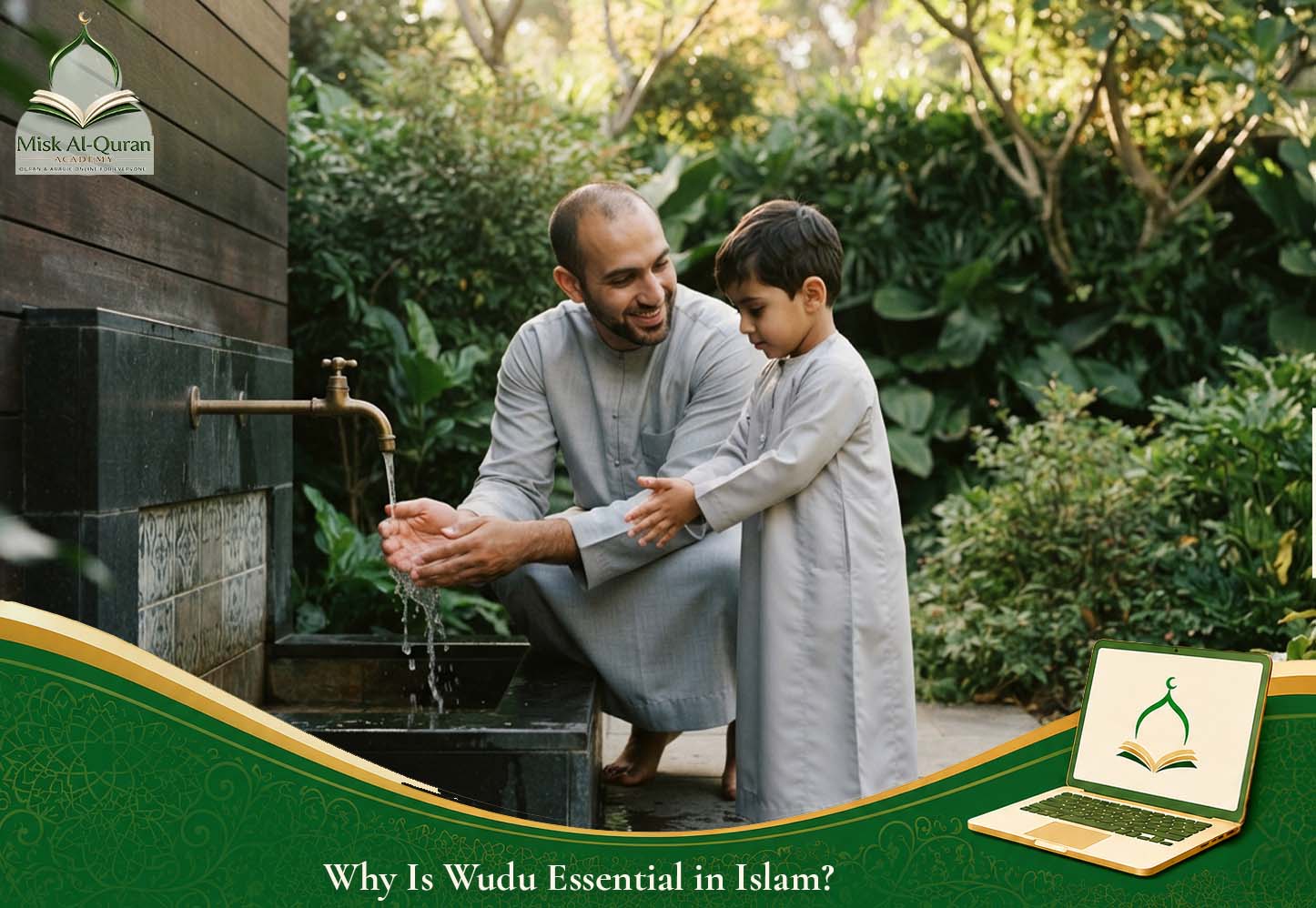
Wudu occupies a unique place in Islamic worship because it combines physical cleanliness with spiritual preparation. Every time a Muslim performs wudu, they are responding to Allah’s command and preparing themselves to stand before Him with humility. Allah says:
“O you who believe! When you rise to perform prayer, wash your faces and your hands up to the elbows, wipe over your heads, and wash your feet up to the ankles.”
(Surah Al-Ma’idah 5:6)
The Prophet ﷺ also said:
“Allah does not accept the prayer of anyone who breaks his wudu until he performs wudu.”
(Sahih al-Bukhari and Sahih Muslim)
These texts clearly establish that purification is a prerequisite for Salah. Learning the correct method is therefore an obligation upon every Muslim who prays. Following the rules to learn Quran helps students build a strong foundation for accurate recitation and memorization.
Start Your Quran Learning Journey with Misk Online Quran Academy
Take the first step in your Quran learning journey with Misk Online Quran Academy, where learners of all ages enjoy professional online Quran classes designed to match their skills and learning goals.
Whether you want to enhance your Quran recitation, learn Tajweed correctly, or memorize the Holy Quran, our qualified teachers offer personalized one-on-one instruction and clear guidance at every stage. With flexible class schedules, interactive online sessions, and a supportive learning experience, Misk Online Quran Academy helps you build confidence, stay motivated, and make steady progress from the comfort of your home.

What Is Wudu?
Wudu is the prescribed purification using pure water on specific parts of the body while intending to worship Allah. It removes minor ritual impurity and prepares a Muslim for acts of worship that require purification, especially Salah.
Unlike ordinary washing, wudu is an act of worship. Every step is performed because Allah commanded it and because His Messenger ﷺ demonstrated it. For this reason, Muslims should avoid introducing personal changes or innovations into the process.
The purpose of wudu extends beyond physical cleanliness. It reminds believers to approach Allah with sincerity, discipline, and respect while also encouraging daily hygiene and self-care.
Preparing Before Wudu
Before beginning wudu, prepare properly by following a few important steps. These simple actions help ensure your purification is correct and valid.
Make the Intention
The intention (niyyah) is formed in the heart. There is no authentic supplication to be spoken aloud for making the intention. A Muslim simply decides internally that they are performing wudu for the sake of Allah. For learners who want to go further, take a look at the meaning of supplication.
Use Pure Water
The water should be pure and safe to use. Islam encourages moderation, so Muslims should avoid wasting water even if plenty is available.
The Prophet ﷺ performed complete wudu using only a small amount of water, teaching the Ummah that cleanliness does not require excess.
Remove Anything That Blocks Water
Water must reach every required part of the body. Anything that forms a waterproof barrier over the skin or nails should be removed before beginning wudu. Examples include:
- Thick nail polish
- Waterproof paint
- Heavy glue
- Wax-like substances covering the skin
If anything blocks water from reaching the skin, the wudu is not valid. Remove all barriers before starting your purification.
Say “Bismillah”
Begin your wudu by saying “Bismillah” (In the Name of Allah), following the Sunnah of the Prophet ﷺ before starting purification.
Bismillah
(In the Name of Allah)
Many scholars considered this Sunnah, while others regarded it as highly emphasized due to the narrations concerning it.
Step 1: Wash Both Hands
Begin by washing both hands three times. This Sunnah removes any impurities that may be present and prepares the hands for the rest of the purification. The washing should include the palms, the backs of the hands, the fingers, and the spaces between the fingers.
Although washing the hands at the beginning is recommended, careful washing also promotes good hygiene before touching the mouth and nose. Every online Quran teacher should encourage students to learn and practice these basic acts of purification correctly before studying other acts of worship.
Step 2: Rinse the Mouth and Nose
The next step is rinsing the mouth (madmadah) and cleaning the nose (istinshaq and istinthar). Place water into the mouth, move it around thoroughly, and spit it out. Then gently inhale water into the nostrils before expelling it.
The Sunnah is to repeat this process three times. Cleaning these areas removes impurities and follows the exact example of the Prophet ﷺ. It also contributes to daily personal hygiene while fulfilling an act of worship. One of the important benefits of learning the Quran online is that students can learn practical acts of worship like wudu through clear lessons from qualified teachers.
Step 3: Wash the Entire Face
Wash the entire face three times, making sure water reaches every part from the hairline to the chin and from ear to ear. The boundaries of the face extend:
- From the normal hairline to the bottom of the chin.
- From one ear to the other.
Every visible part of the face must receive water. For those with a light beard through which the skin is visible, water must reach the skin underneath. If the beard is thick, washing the outer surface is sufficient, while running the fingers through it is recommended as part of the Sunnah.
This step fulfills one of the major obligations mentioned directly in the Quran and should never be rushed. Understanding the Role of Tajweed also helps Muslims appreciate the correct pronunciation of Quranic verses that discuss purification and other acts of worship.
Step 4: Wash the Arms Up to the Elbows
After washing the face, wash the right arm first from the fingertips up to and including the elbow three times. Then repeat the same process for the left arm.
It is important to ensure that water reaches every part of the arm, including the elbows, as they are included in the obligation mentioned in the Quran. Rings, watches, or bracelets that prevent water from reaching the skin should be moved or removed temporarily.
The Sunnah is to begin with the right side before the left, following the practice of the Prophet ﷺ. Washing the arms thoroughly while avoiding excessive use of water reflects both obedience and moderation, two important principles in Islam. Students enrolled in an online Quran Hifz course should also learn the rulings of purification because correct worship begins with authentic Islamic knowledge.
Step 5: Wipe the Head and Ears
Unlike the previous steps, the head is not washed but wiped once with wet hands. The authentic method is to wet both hands, place them at the front of the head, move them to the back of the head, and then return them to the starting point.
After wiping the head, use the remaining moisture on the hands to wipe the ears. Insert the index fingers gently into the inner part of the ears while wiping the outer part with the thumbs.
The ears are considered part of the head, which is why they are wiped rather than washed. This step should only be performed once, as this is the established Sunnah of the Prophet ﷺ. Many Muslims who know how to speak Arabic also study the meanings of Islamic terms, helping them understand acts of worship such as wudu more deeply alongside their language learning.
Step 6: Wash the Feet Up to the Ankles
The final step is washing the feet. Begin with the right foot, washing it completely up to and including the ankle three times, then repeat the process with the left foot.
Special attention should be given to the heels, the soles, and the spaces between the toes. These areas are often overlooked, which can lead to an incomplete wudu. The Prophet ﷺ warned against neglecting the heels, emphasizing the importance of washing every required part properly.
If a person wears footwear that qualifies for wiping over according to Islamic rulings, such as leather socks or certain conditions of khuffs, the rules of wiping may apply. Otherwise, the feet must be washed completely.
The Correct Order of Wudu
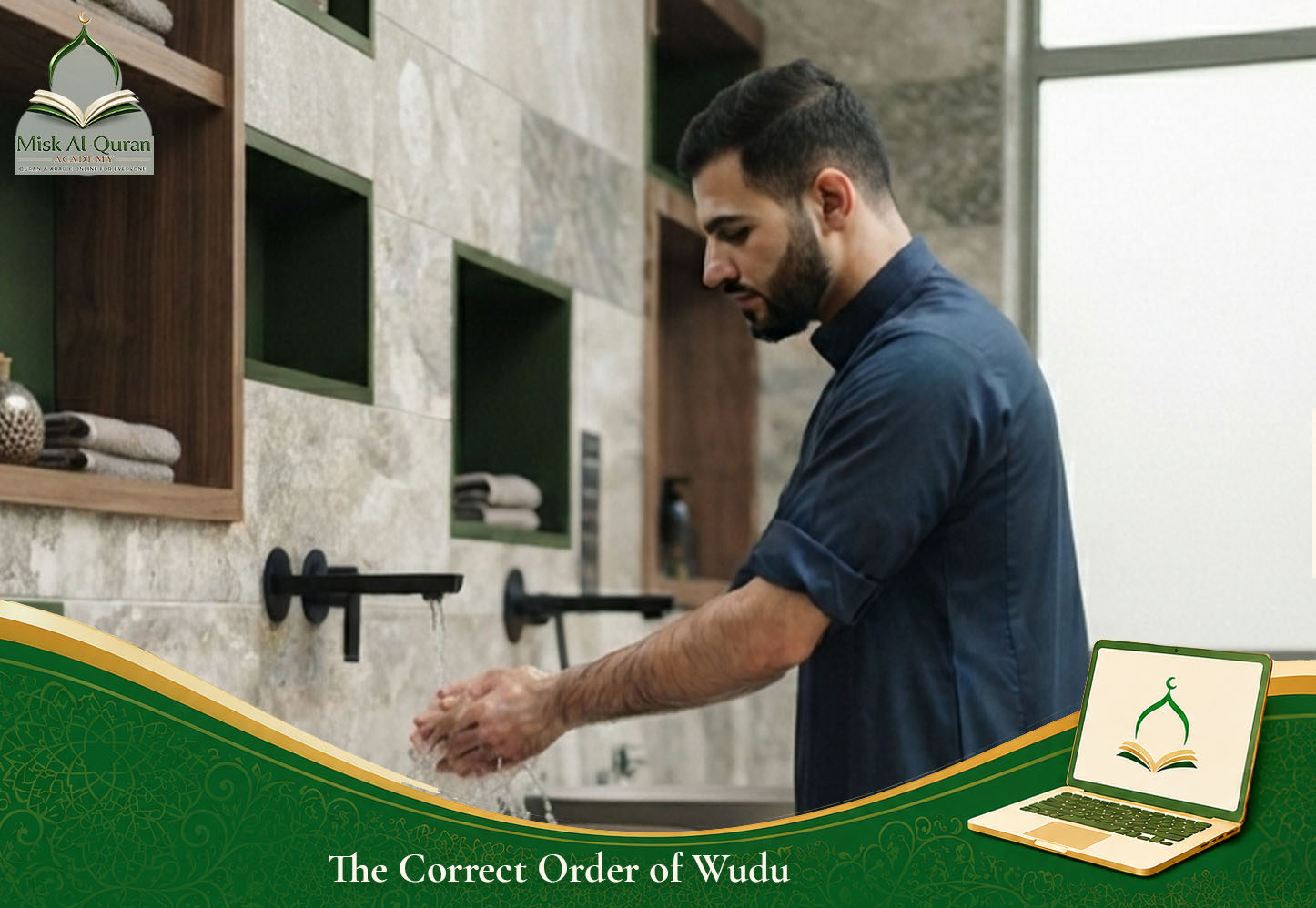
The sequence of the acts of wudu is not optional. Allah mentioned the order clearly in Surah Al-Ma’idah, and the Prophet ﷺ consistently followed this sequence throughout his life. The correct order is:
- Make the intention.
- Say “Bismillah.”
- Wash both hands.
- Rinse the mouth and nose.
- Wash the face.
- Wash the arms up to the elbows.
- Wipe the head and ears.
- Wash the feet up to the ankles.
Following this order ensures that the wudu is performed according to the Quran and the authentic Sunnah. Working with an online Quran tutor provides personalized lessons that match every student’s learning pace.
Maintain the Correct Order Without Long Breaks
When you perform wudu, complete every step without taking long breaks. Move from one step to the next in the order taught by the Prophet ﷺ.
If you stop for a long time without a valid reason and the washed body parts become dry under normal conditions, many scholars say you should start your wudu again. For this reason, try to finish wudu in one continuous process.
When you complete wudu calmly and without unnecessary delays, you follow the example of the Prophet ﷺ and give this act of worship the attention it deserves. Understanding supplication meaning encourages Muslims to strengthen their connection with Allah through sincere prayers.
The Obligatory Acts of Wudu
Every Muslim should know the essential parts of wudu. These acts make wudu valid, so you should never leave them out intentionally. The obligatory acts are:
- Make the intention in your heart.
- Wash the entire face.
- Wash both arms up to and including the elbows.
- Wipe the entire head.
- Wash both feet up to and including the ankles.
- Follow the correct order of the steps.
- Complete all the steps without long interruptions.
Knowing these obligations helps you understand the difference between what Islam requires and what the Sunnah recommends.
The Sunnahs of Wudu
The Prophet ﷺ also taught several recommended actions that make wudu more complete and increase its reward. Although these actions are not obligatory, following them brings extra blessings and helps Muslims imitate the Prophet ﷺ. The Sunnahs of wudu include:
- Say “Bismillah” before you begin.
- Wash both hands at the start.
- Rinse the mouth and nose well.
- Wash the face, arms, and feet three times.
- Begin with the right side before the left.
- Run your fingers through a thick beard.
- Clean between the fingers and toes.
- Use water wisely and avoid wasting it.
- Recite the authentic supplication after finishing wudu.
Following these Sunnahs shows love for the Prophet ﷺ and a sincere desire to follow his guidance in daily worship. Joining Quran classes for kids helps children learn the Quran in a structured and enjoyable way.
The Supplication After Wudu
After completing wudu, recite the authentic supplication taught by the Prophet ﷺ to seek Allah’s blessings and increase your reward.
Ashhadu an la ilaha illa Allah wahdahu la sharika lah, wa ashhadu anna Muhammadan ‘abduhu wa rasuluh.
You may also say:
Allahumma aj’alni min at-tawwabin, waj’alni min al-mutatahhirin.
The Prophet ﷺ told his companions that Allah gives a great reward to the person who says this supplication with sincerity after wudu. He also said that Allah opens the gates of Paradise for that person, who may then enter through any gate they choose.
At Misk Online Quran Academy, students learn authentic daily adhkar, including the supplications for wudu and Salah. Qualified teachers explain their meanings and virtues, helping students apply the Sunnah correctly in their everyday lives.
What Invalidates Wudu?

Knowing what breaks wudu is just as important as learning the correct way to perform it. Every Muslim should understand the main nullifiers of wudu to ensure that every prayer begins with proper purification. The most common nullifiers of wudu are:
- Anything that comes out of the front or back private parts, such as urine, stool, or wind.
- Deep sleep that causes a person to lose awareness.
- Loss of consciousness because of fainting, insanity, or intoxication.
- Eating camel meat, according to the stronger opinion supported by authentic hadith.
Scholars have different opinions about a few other issues, such as touching one’s spouse or touching the private parts directly. If you are unsure about these matters, consult a qualified scholar who follows the Quran and the authentic Sunnah.
If any of these nullifiers occur, perform a new wudu before praying or carrying out any act of worship that requires ritual purity.
Common Mistakes During Wudu
Many Muslims perform wudu every day, but simple mistakes can affect its completeness. Learning these common errors helps you perform wudu correctly and follow the Sunnah more closely.
Rushing Through Wudu
Many people hurry through wudu without making sure water reaches every required part of the body. Take your time and complete each step carefully. Since wudu is an act of worship, it deserves your full attention and care.
Missing Small Areas
Small areas often remain dry, especially around the elbows, ankles, heels, and between the fingers and toes. Check every required limb before moving to the next step. Even a small dry spot can make wudu incomplete if it is part of an obligatory area.
Forgetting the Heels and Toes
The Prophet ﷺ warned Muslims not to neglect their heels during wudu. Make sure water reaches every required area to complete your purification correctly.
- Between all the toes.
- The heels.
- Around both ankles.
- Every visible part of the feet.
Using Too Much Water
Islam encourages moderation in every aspect of life, including purification. The Prophet ﷺ completed his wudu with a small amount of water and taught Muslims to avoid waste. Use enough water to wash each limb properly, but do not use more than necessary. Saving water follows the Sunnah and shows gratitude for Allah’s blessings.
Wiping the Head Incorrectly
Some people wipe only a small section of the head or repeat the wiping several times. The Sunnah is simple. Wipe the entire head once with wet hands, then wipe both ears using the remaining moisture. Following this method ensures that your wudu matches the practice of the Prophet ﷺ.
The Spiritual Benefits of Wudu
Wudu cleans the body, but its greatest benefit reaches the heart. Every time a Muslim performs wudu, they prepare themselves to stand before Allah with humility and sincerity. This daily act reminds believers to keep both their bodies and their hearts pure.
The Prophet ﷺ taught that Allah forgives many sins during wudu. As a believer washes each limb, sins committed by that limb fall away by Allah’s mercy. This beautiful reward encourages Muslims to perform wudu with care rather than treating it as a routine habit.
Regular wudu also strengthens self-discipline, mindfulness, patience, and consistency. Since Muslims repeat it several times each day, it becomes a constant reminder to renew both physical cleanliness and spiritual devotion. Understanding the rights of the Quran reminds every Muslim of the importance of reciting, respecting, and applying its guidance in daily life.
The Virtues of Wudu in the Sunnah
The Quran and the authentic Sunnah highlight many rewards for Muslims who maintain wudu and perform this act of purification with sincerity and care. The Prophet ﷺ said:
“When a Muslim servant performs wudu and washes his face, every sin that he committed with his eyes leaves with the water or with the last drop of water.”
(Sahih Muslim)
The hadith continues by explaining that the sins of the hands and feet also fall away until the believer finishes wudu free from many sins. The Prophet ﷺ also said:
Here is a smoother, more natural rewrite:
“On the Day of Resurrection, my followers will be recognized by their radiant faces, hands, and feet as a result of performing wudu.”
(Sahih al-Bukhari and Sahih Muslim)These authentic hadiths highlight the great virtue of wudu and encourage every Muslim to perform it with sincerity, care, and the hope of attaining Allah’s mercy, forgiveness, and abundant reward.
Practical Tips to Improve Your Wudu
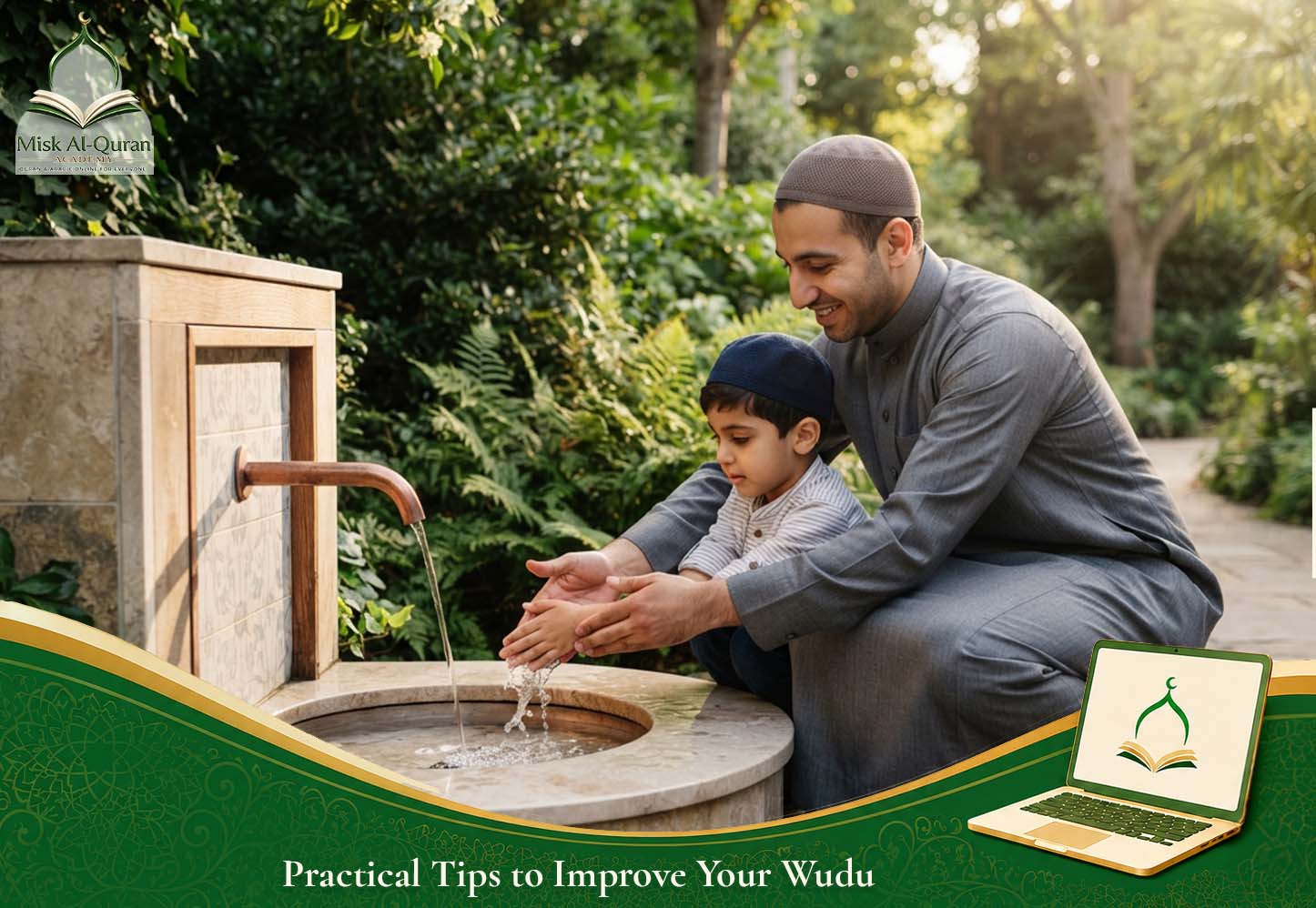
Simple habits can help you perform wudu correctly every time. Follow these practical tips to improve your purification, avoid common mistakes, and follow the Sunnah with confidence. Learning Quran for kids becomes easier through interactive lessons designed for young learners.
- Learn the correct method from authentic Islamic sources.
- Complete every step slowly and carefully.
- Make sure water reaches every required area.
- Avoid distractions while performing wudu.
- Use water wisely and avoid waste.
- Reflect on the meaning of purification before every prayer.
- Teach children the correct method by practicing with them regularly.
- Review the rulings of wudu occasionally to correct any mistakes.
At Misk Online Quran Academy, students learn the practical rulings of purification alongside Quran recitation and essential Islamic knowledge. Qualified teachers explain each step with authentic evidence from the Quran and Sunnah, helping learners build confidence in their daily worship.
This approach enables Muslims of all ages to strengthen their understanding of Islam while performing acts of worship correctly and with greater sincerity. Exploring facts about Islam helps learners gain a deeper understanding of the religion and its teachings.
Frequently Asked Questions
The section answers common questions that were not covered in the article, helping readers better understand the topic and clear up any remaining doubts.
Can I dry myself with a towel after wudu?
Yes. You may use a towel or cloth after finishing wudu. Most scholars agree that Islam allows this because no authentic hadith forbids drying the body. You may also let the water dry naturally if you prefer. Both choices are acceptable.
Can I perform wudu before the prayer time starts?
Yes. You can perform wudu before the time for Salah begins. Your wudu stays valid until something breaks it. If you remain in a state of purification, you do not need to repeat wudu when the prayer time arrives.
Can one wudu be used for more than one prayer?
Yes. One wudu is enough for several obligatory and voluntary prayers as long as nothing breaks it. The Prophet ﷺ sometimes prayed more than one prayer with the same wudu. Although many Muslims like to renew their wudu before each prayer, doing so is recommended rather than required.
In conclusion, learning the correct way to perform wudu is an important step toward improving your daily worship and following the Sunnah of the Prophet ﷺ.
By practicing each step carefully and understanding its purpose, you can ensure your purification is valid, and your Salah begins with confidence. Consistent attention to proper wudu promotes cleanliness and strengthens your relationship with Allah through sincere obedience and preparation for prayer.