Online Noorani Qaida Classes for Kids provide a practical starting point for children who want to recognize Arabic letters, understand their sounds, and prepare for reading the Holy Quran. For many parents, choosing the right learning method is an important decision. They want their children to develop correct pronunciation without feeling overwhelmed by unfamiliar Arabic sounds and reading rules.
However, learning to read the Quran involves more than recognizing letters. Children also need to understand how letters connect, how vowel marks change pronunciation, and how individual sounds form complete words. Therefore, a structured learning approach can make this journey easier and more enjoyable.
With online lessons, children can practise essential reading skills through guided instruction from home. Moreover, parents can follow their child’s learning journey and encourage regular practice between lessons.
This guide explains what children learn in Noorani Qaida, why the learning process matters, which challenges beginners commonly face, and how parents can choose an appropriate learning environment. It also explores what to consider when evaluating Misk Online Quran Academy as an option for online Quran education.
Why Kids Need Online Noorani Qaida Classes?
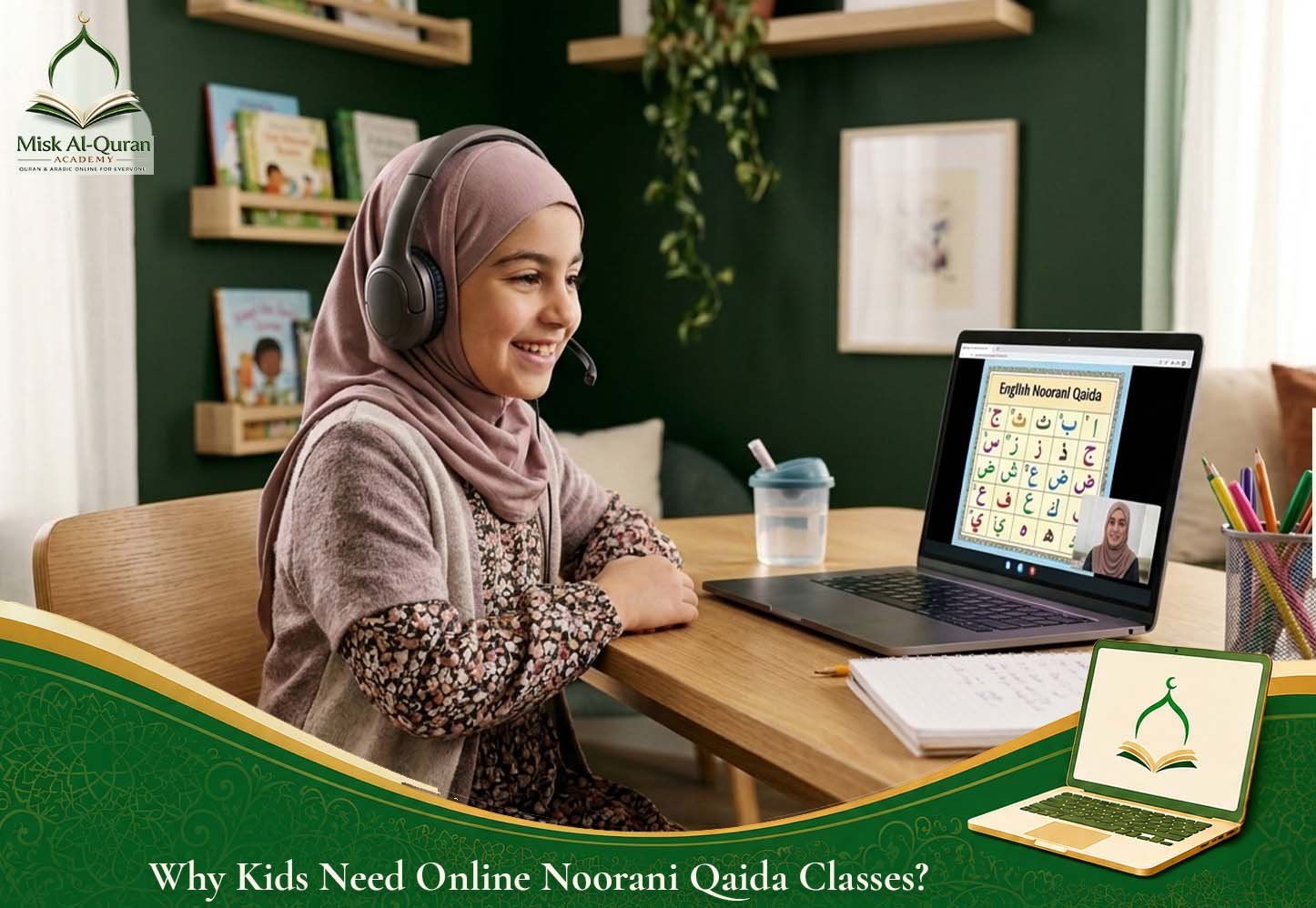
Noorani Qaida is a beginner-level learning book designed to introduce students to Arabic letters, pronunciation, and basic reading rules. It provides a foundation for children who have not previously studied Arabic or learned to read the Quran.
Instead of asking beginners to read complete Quranic verses immediately, Noorani Qaida introduces essential skills gradually. Children first recognize individual letters and their sounds. Afterward, they learn how letters connect and how different vowel marks affect pronunciation.
This gradual approach is especially helpful for young learners because it divides a challenging subject into smaller learning steps.
How Do Noorani Qaida Classes for Kids Build Early Quran Reading Skills?
Learning Noorani Qaida helps children develop several important abilities:
- Letter recognition: Identifying Arabic letters by their shapes and names.
- Sound recognition: Understanding the different sounds associated with Arabic letters.
- Letter connection: Recognizing how letters appear when joined together.
- Vowel recognition: Understanding how Fatha, Kasra, and Damma affect pronunciation.
- Basic reading: Combining learned letters and sounds to read simple Arabic words.
These skills work together to prepare children for reading Quranic text. For example, a child who recognizes the letter ب may still need practice understanding how it sounds with different vowel marks. Similarly, recognizing individual letters does not automatically mean the child can read connected Arabic words.
Therefore, online noorani qaida classes for kids should focus on both recognition and practical reading rather than memorizing letter names alone.
Why Children Need Noorani Qaida Before Reading the Quran?
Starting with an appropriate foundation can prevent several common reading difficulties. Children who begin reading Quranic text without understanding Arabic letters may struggle with unfamiliar combinations and pronunciation. In contrast, learning the basic rules first gives them an opportunity to understand what they are reading.
Furthermore, early instruction helps children become familiar with the differences between similar Arabic sounds.
For instance, the letters س and ص may look familiar to beginners, but their pronunciation is different. A child needs repeated listening and correction to distinguish between them. Noorani Qaida introduces these differences before children move toward more advanced Quran reading.
Start Your Quran Learning Journey with Misk Online Quran Academy
Begin your Quran learning journey with Misk Online Quran Academy, where students of all ages benefit from structured online Quran classes tailored to their individual level and learning needs.
Whether your goal is to improve Quran recitation, master Tajweed rules, or begin memorising the Holy Quran, our experienced and qualified teachers provide clear step-by-step guidance through personalised one-to-one lessons. Each session is designed to help learners understand, practice, and improve with confidence and consistency.
With flexible scheduling, interactive teaching methods, and a supportive online environment, Misk Online Quran Academy makes it easier to stay committed and motivated. Students can learn comfortably from home while making steady progress in their Quran studies at their own pace.

Why Choose Online Noorani Qaida Classes for Kids?
Traditional Quran learning often takes place at mosques, Islamic centers, or local educational institutions. Although these options remain valuable, online learning offers another way for families to organize their children’s Quran education.
Through online noorani qaida classes for kids, children can attend lessons without travelling to another location. This arrangement may be particularly useful for families living far from Quran teachers or those managing busy school schedules.
Nevertheless, the effectiveness of online learning depends on lesson quality, teacher guidance, and the child’s participation.
Learning Quran at Home Through Online Noorani Qaida Classes
A familiar learning environment can help children feel comfortable when beginning a new subject. At home, children can attend their lessons in a quiet space with their learning materials nearby. Parents can also remain available if their child needs technical assistance or encouragement.
In addition, learning from home removes the need for regular travel. This can make Quran education easier to organize around school, family activities, and other responsibilities. However, parents should prepare a suitable learning area before each lesson. A helpful learning environment includes:
- A quiet room with limited distractions.
- A comfortable chair and suitable desk.
- A tablet, laptop, or computer.
- A stable internet connection.
- A copy of the Noorani Qaida book.
- Headphones or a suitable audio setup when needed.
These simple arrangements can help children concentrate on the teacher’s instructions.
Flexible Scheduling for Online Noorani Qaida Classes for Kids
Children already have several responsibilities, including school attendance, homework, family activities, and rest. Consequently, adding Quran lessons requires a realistic schedule.
Online learning can make scheduling easier because families may be able to arrange lesson times around their existing commitments, depending on the academy’s available timetable.
For example, some children may feel more attentive after completing their schoolwork. Others may prefer learning during quieter morning or weekend hours. The important point is to choose a time when the child is comfortable and able to concentrate.
Online noorani qaida classes for kids should become a consistent part of the child’s routine rather than another source of pressure.
Individual Attention in Online Noorani Qaida Lessons
Children do not all learn at the same speed. One student may recognize Arabic letters quickly, while another may need additional practice with pronunciation. Individual attention can help teachers identify these differences.
During a one-to-one lesson, the teacher can listen carefully to the child’s recitation, notice pronunciation difficulties, and provide corrections according to the learner’s needs.
For example, if a child repeatedly confuses two similar letters, the teacher can focus on their sounds before introducing additional material.
This approach also gives children opportunities to ask questions without worrying about keeping up with a larger group.
What Do Children Learn in Online Noorani Qaida Classes for Kids?
A structured Noorani Qaida course introduces reading skills in a logical order. Each new lesson builds on previously learned information, allowing children to develop confidence gradually.
Although teaching sequences may vary slightly between instructors and learning materials, the following topics represent important parts of beginner Arabic reading education.
Arabic Letters and Sounds in Noorani Qaida Classes
The Arabic alphabet is the starting point of Noorani Qaida. Children learn to identify letters, recognize their written shapes, and associate them with their correct sounds.
The teacher may introduce a small group of letters at a time rather than asking beginners to memorize everything immediately. For example, students practise identifying letters such as:
- Alif (ا)
- Baa (ب)
- Taa (ت)
- Thaa (ث)
- Jeem (ج)
- Haa (ح)
- Khaa (خ)
After learning each group, children can revise the letters through listening, repetition, and recognition exercises.
Importantly, recognizing a letter visually is different from pronouncing it correctly. Therefore, students need opportunities to listen to accurate examples and repeat them.
Learning Single Arabic Letters in Online Noorani Qaida Classes
At the beginning, children practise individual letters without combining them into words. This stage helps them become familiar with the alphabet and distinguish between letters that have similar shapes.
For example, the letters ب، ت، and ث share a similar basic shape but differ in their dots. Beginners need to notice these visual differences before moving forward.
Teachers can support recognition by showing letters on a screen, asking children to identify them, and repeating difficult examples.
Recognizing Joined Arabic Letters in Noorani Qaida
Arabic letters change their appearance depending on their position within a word. A letter may have an initial, medial, final, or isolated form. Understanding these variations is essential for reading connected Arabic text.
For this reason, online noorani qaida classes for kids should include practical exercises that show how letters connect.
Children can begin with simple combinations of two letters. Later, they can practise longer combinations and recognize familiar patterns.
For instance, a child who already recognizes ب and ت individually needs to learn how their shapes appear when connected to other letters.
Gradually, these exercises help children move from identifying isolated symbols to reading connected words.
Fatha, Kasra, and Damma in Noorani Qaida Lessons
After becoming familiar with Arabic letters, children begin learning short vowel marks. These marks influence how letters are pronounced and help beginners understand the sounds within Arabic words.
The three basic short vowels include:
| Vowel | Arabic mark | Basic pronunciation |
|---|---|---|
| Fatha | َ | Short a sound |
| Kasra | ِ | Short i sound |
| Damma | ُ | Short u sound |
For example, children learn that adding different vowel marks to the same letter changes its pronunciation.
The teacher can demonstrate each sound, ask the student to repeat it, and provide corrections when necessary.
This stage is important because children begin understanding that Arabic reading depends on both letters and their accompanying marks.
Understanding Long Vowels in Online Noorani Qaida Classes
Long vowels introduce children to sounds that are extended compared with short vowels.
The basic long vowel letters are:
- Alif (ا)
- Waw (و)
- Yaa (ي)
Children learn how these letters work with appropriate vowel patterns to produce longer sounds. For example, a long vowel may extend the sound of the preceding letter.
Students need to recognize this difference rather than reading every vowel combination with the same duration. Regular listening and repetition help beginners become more comfortable with these patterns.
Learning Sukoon in Noorani Qaida Classes for Kids
Sukoon (ْ) indicates that a letter does not carry a short vowel. Children need to understand how a letter with Sukoon connects with the preceding sound.
This concept can initially feel unfamiliar because beginners may expect every Arabic letter to carry a vowel.
Teachers can make the idea easier by presenting short examples and encouraging children to read slowly before increasing their speed.
Understanding Tashdeed in Noorani Qaida Lessons
Tashdeed (ّ) indicates that a letter is doubled in pronunciation. Instead of treating the letter as an ordinary single sound, children learn to pronounce it with the appropriate emphasis.
For example, students need to understand the difference between a letter carrying a normal vowel and the same letter carrying Tashdeed.
This distinction becomes important when children begin reading words and Quranic passages containing doubled letters.
Recognizing Tanween in Noorani Qaida Classes
Tanween is another important topic in beginner Arabic reading.
It appears through three forms:
- Fathatain (ً)
- Kasratain (ٍ)
- Dammatain (ٌ)
Children learn to recognize these marks and understand the additional nasal sound associated with them. At this stage, teachers should use clear examples and allow students enough time to practise.
Introducing Tanween alongside previously learned vowel rules helps children understand how different reading marks work together.
How Online Noorani Qaida Classes for Kids Prepare Children for Quran Reading?
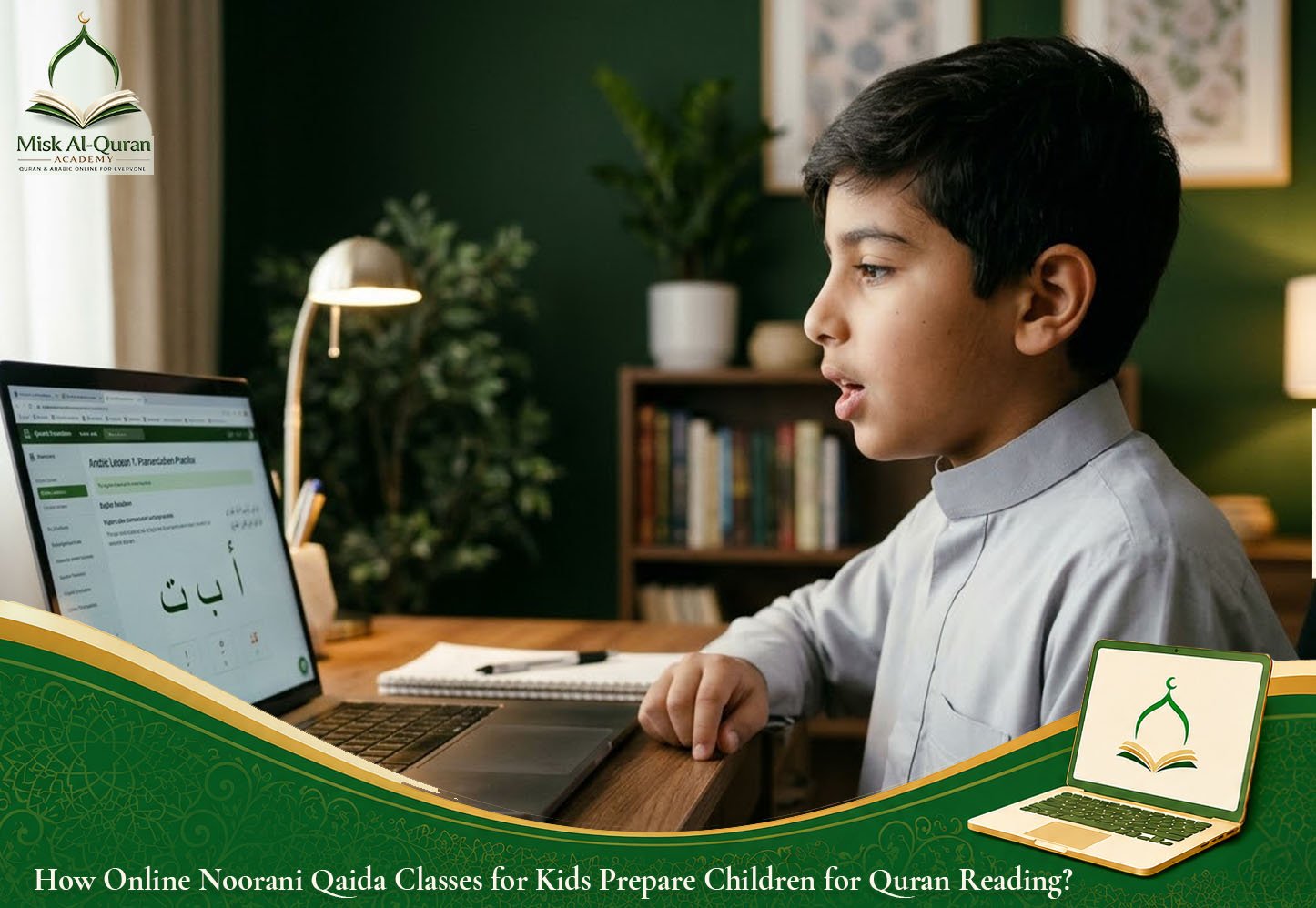
Learning Noorani Qaida is not the final destination. Instead, it prepares children for the next stage of Quran education.
Once children understand basic Arabic letters, vowel marks, and connected reading patterns, they can gradually begin practising Quranic text.
However, moving to the next level should depend on actual reading ability rather than simply completing a certain number of lessons.
Moving from Noorani Qaida to Nazra Quran
Nazra Quran refers to reading the Quran directly from its written text. Before beginning this stage, children should demonstrate several basic abilities:
- Recognizing Arabic letters in different positions.
- Reading connected letters correctly.
- Understanding common vowel marks.
- Applying basic reading patterns.
- Pronouncing familiar combinations with reasonable accuracy.
The teacher can then introduce suitable Quranic passages according to the child’s ability. Shorter and more familiar passages may provide a comfortable starting point.
Nevertheless, children should continue revising Noorani Qaida rules whenever they encounter difficulties during Quran reading.
Parents can also support their children’s broader Islamic education through namaz salah classes online, alongside their Quran reading lessons.
Building a Foundation for Tajweed Through Noorani Qaida
Tajweed teaches the rules that guide correct Quran recitation. It includes subjects such as articulation points, letter characteristics, elongation, and different recitation rules.
Children who have developed basic reading skills may find it easier to understand introductory Tajweed concepts. However, knowing how to read Noorani Qaida does not mean that a child has mastered Tajweed.
Both stages require proper instruction, listening, practice, and correction. Therefore, online noorani qaida classes for kids should be viewed as the beginning of a longer educational journey.
How Misk Online Quran Academy Supports Children’s Quran Learning?
Choosing an appropriate learning provider is an important part of organizing a child’s Quran education. Parents often compare different academies because they want an educational environment that matches their child’s age, current reading ability, and learning needs.
Misk Online Quran Academy is the academy targeted in this guide for families exploring online Quran education.
When considering an academy, parents should look beyond its website description and understand how lessons are organized, how teachers communicate with children, and how learning progress is reviewed.
Understanding the Teaching Approach at Misk Online Quran Academy
Before enrolling, parents should become familiar with the academy’s actual teaching arrangements. Some important questions include:
- How are beginner students assessed?
- What learning materials are used?
- How does the teacher correct pronunciation?
- Can parents receive updates about learning progress?
- What lesson schedules are available?
- How can parents communicate with the academy?
These questions help families understand whether the educational arrangement matches their expectations.
Misk Online Quran Academy can be considered as one option when researching online Quran learning. However, parents should confirm the available courses, teaching arrangements, and enrollment conditions directly with the academy.
Families living in Australia can also explore online quran classes Australia when researching suitable online Quran learning options.
What Do Parents Should Check Before Choosing Misk Online Quran Academy?
A course description may explain what children are expected to learn. Nevertheless, parents also need to understand how those skills are taught.
For example, a course may mention Arabic letters and vowel marks, but families should ask whether children receive enough pronunciation practice.
Similarly, a course may include live lessons, but parents should understand how the teacher checks whether the child has understood each topic.
A clear explanation of the teaching process is more useful than broad promises about quick results. The right choice should reflect the child’s educational needs rather than advertising language alone.
How to Choose the Best Online Noorani Qaida Classes for Kids?
Selecting an online Quran course requires more than comparing prices or lesson schedules. Parents should consider the teacher’s approach, course organization, communication arrangements, and the child’s comfort during learning. The following factors can help families make a more informed decision.
Checking Teachers’ Experience in Teaching Noorani Qaida
Teaching young beginners requires patience and an understanding of how children develop reading skills. A teacher should be able to explain Arabic sounds clearly, recognize common pronunciation mistakes, and adjust the lesson according to the child’s ability.
Parents can ask about the teacher’s educational background and experience teaching young Quran learners. It is also useful to understand whether lessons include opportunities for children to practise independently.
Some parents may prefer lessons with a female quran tutor when choosing a suitable teacher for their children.
Finding a Structured Noorani Qaida Curriculum for Children
A structured curriculum helps parents understand what their children are learning. Before choosing a course, check whether its lessons cover:
- Arabic letter recognition.
- Correct letter pronunciation.
- Joined letter forms.
- Short and long vowels.
- Sukoon and Tashdeed.
- Tanween.
- Basic reading exercises.
- Preparation for Quran reading.
The order of these topics should be suitable for beginners. Moreover, teachers should review earlier lessons before introducing more difficult material.
Monitoring Children’s Progress in Online Quran Classes
Children may understand a topic during a lesson but struggle to remember it afterward. Therefore, progress monitoring should involve more than counting completed lessons.
Parents can ask whether teachers assess pronunciation, reading accuracy, and the ability to apply previously learned rules. Regular feedback also helps families identify areas that need additional practice.
Parents can also learn about the Common Challenges in Online Quran Journey to better understand difficulties that may affect children’s learning progress.
Choosing Comfortable Online Noorani Qaida Lessons for Young Learners
An effective learning arrangement should encourage children to participate. If a child feels nervous, confused, or overwhelmed, parents should discuss the situation with the teacher.
A suitable teaching approach gives children enough time to answer questions, repeat sounds, and correct mistakes. Furthermore, positive encouragement can help beginners remain interested in their lessons.
Comparing Online Noorani Qaida Course Details Before Enrollment
Before selecting Misk Online Quran Academy or another provider, parents should confirm the practical details. These may include lesson duration, weekly frequency, available schedules, fees, cancellation policies, and whether a trial lesson is offered.
Do not assume that every academy provides identical arrangements. Comparing these details makes it easier to choose a course that suits the family’s expectations and budget.
Families in the United Kingdom can also explore Online Quran Classes England when comparing online Quran learning options.
Common Mistakes Children Make in Online Noorani Qaida Classes
Learning Arabic reading involves several new skills. As a result, beginners may make mistakes while developing their pronunciation and reading confidence.
These difficulties are a normal part of the learning process. The important thing is to recognize them early and provide suitable guidance.
Confusing Arabic Letters with Similar Shapes
Some Arabic letters share similar basic shapes but differ in their dots. For example, ب، ت، and ث may initially appear confusing to young learners.
Children should practise identifying the dots and recognizing each letter independently. Visual exercises, repetition, and short recognition activities can help strengthen this skill.
Correcting Arabic Pronunciation Mistakes During Noorani Qaida Lessons
Arabic includes sounds that may not exist in a child’s first language. For example, ح and ه have different articulation characteristics. Similarly, س and ص should not be pronounced identically.
Simply memorizing letter names will not solve these difficulties. Children need to hear accurate examples, observe how sounds are produced, and receive feedback during practice.
Avoiding Fast Reading Before Understanding Noorani Qaida Rules
Some beginners try to increase their reading speed before developing accuracy. However, rushing can reinforce incorrect pronunciation and make later correction more difficult.
A better approach is to begin slowly, focus on each sound, and increase reading speed only when the child becomes more comfortable.
Improving Reading Skills Through Regular Noorani Qaida Revision
Children may remember a new topic during a lesson but forget parts of it after several days. This often happens when revision is irregular.
Short review sessions help children retain earlier information and connect it with newly learned material. For example, a child learning joined letters can spend a few minutes reviewing the alphabet before starting the new exercise.
How Can Parents Support Children in Online Noorani Qaida Classes?

Parents do not need advanced Arabic knowledge to support their children’s learning. Their main responsibility is to create a positive routine, encourage practice, and communicate with the teacher when difficulties appear.
Creating a Daily Routine for Noorani Qaida Practice
Choose a regular time for Quran practice. A short daily session may be easier for children to maintain than an occasional long session.
For example, parents can organize a brief revision period after homework or before another regular family activity.The routine should remain flexible enough to accommodate the child’s energy and school responsibilities.
Helping Children Practise Noorani Qaida at Home
Children benefit when parents show interest in what they are learning. Ask your child to read a familiar letter combination or explain a rule from the latest lesson.
However, avoid turning every practice session into an examination. If the child makes a mistake, encourage another attempt rather than expressing frustration. Positive communication can make Quran learning feel like a rewarding family activity.
Using Revision to Improve Noorani Qaida Reading Skills
Parents sometimes believe that children should learn something new every day. In reality, reviewing previous lessons is equally important.
A child may need several practice sessions before becoming comfortable with a particular Arabic sound. Therefore, allow sufficient time for revision before moving forward.
Communicating With Teachers About Children’s Learning Difficulties
If your child repeatedly struggles with a particular topic, inform the teacher. For example, you may notice that your child recognizes letters but cannot pronounce certain sounds correctly.
Sharing these observations can help the teacher decide whether additional exercises or a slower teaching pace would be useful.
How to Make Online Noorani Qaida Classes Enjoyable for Kids?
Children are more likely to participate when learning activities match their age and attention span. Although the educational goal remains correct Quran reading, lessons do not need to feel unnecessarily difficult. A supportive environment can make the learning process more comfortable.
Using Short Activities During Noorani Qaida Lessons
Young learners may struggle to concentrate during long activities. Instead, divide practice into smaller tasks. For example:
- Spend a few minutes recognizing Arabic letters.
- Practise selected letter sounds.
- Review previously learned vowel marks.
- Read a short exercise from the current lesson.
These activities help children focus on one learning objective at a time.
Encouraging Children Through Small Learning Achievements
Progress does not always involve completing an entire lesson. A child may successfully recognize a difficult letter or pronounce a sound more accurately than before.
Parents should acknowledge these improvements. A simple compliment or encouraging comment can help children recognize their own progress.
Connecting Everyday Activities With Arabic Letter Learning
Parents can encourage recognition by asking children to identify familiar Arabic letters outside their lessons. For example, they may look at Arabic words in a children’s book or identify letters on a Quran learning card.
These activities should remain simple and enjoyable. Their purpose is to reinforce recognition, not replace structured instruction.
What Is the Best Age to Start Online Noorani Qaida Classes for Kids?
There is no single age at which every child must begin Noorani Qaida. Some children show interest in Arabic letters at an early age, while others need more time before they can concentrate on a structured lesson. Instead of focusing entirely on age, parents should consider the child’s readiness.
Online Noorani Qaida Classes for Children Aged Four to Six
Some children between four and six years old may be ready for introductory Arabic learning. At this stage, they often benefit from short activities, repetition, visual materials, and gentle encouragement.
However, attention spans differ considerably between children. Parents should avoid expecting a young beginner to sit through lessons designed for older students.
Starting Noorani Qaida Classes at an Older Age
Older children can also begin learning Noorani Qaida without having studied Arabic previously. They may understand explanations more easily because they have developed stronger language and concentration skills.
Nevertheless, older beginners still need sufficient pronunciation practice and revision. The learning pace should depend on their current ability rather than their age alone.
Signs Your Child Is Ready for Noorani Qaida Lessons
- Listen to simple instructions.
- Recognize basic shapes or symbols.
- Repeat sounds after another person.
- Participate in a short learning activity.
- Show interest in letters or Quran learning.
These are general indicators rather than strict requirements. Parents can discuss their child’s readiness with a suitable teacher before choosing a course.
How Long Do Online Noorani Qaida Classes for Kids Take to Complete?
The time required to complete Noorani Qaida differs from one child to another. Some learners understand basic letter recognition quickly, while others need more time to develop accurate pronunciation and reading confidence. Several factors influence the learning process:
- 1. Previous knowledge: Children who already recognize Arabic letters may progress through introductory lessons more comfortably.
- 2. Lesson frequency: Regular instruction provides more opportunities to practise and receive feedback.
- 3. Daily revision: Reviewing lessons between classes helps reinforce previously learned information.
- 4. Pronunciation difficulties: Some children require additional attention to distinguish similar Arabic sounds.
- 5. Individual learning pace: Attention, memory, and reading development differ among young learners.
Therefore, parents should focus on measurable learning progress instead of expecting every child to finish within a fixed period.
Completing the book is useful, but understanding its reading rules is more important.
What Equipment Is Needed for Online Noorani Qaida Classes for Kids?
One advantage of online Quran learning is that families generally need only a few basic items to participate. Before beginning lessons, parents should prepare the following:
| Equipment | Purpose |
|---|---|
| Laptop or tablet | Joining live lessons |
| Stable internet | Maintaining communication |
| Headphones | Hearing pronunciation clearly |
| Microphone | Allowing the child to read aloud |
| Noorani Qaida book | Following the lesson material |
| Quiet learning space | Reducing distractions |
Parents should also check the camera and microphone before the lesson begins.
Additionally, keeping the learning device at a comfortable height can make it easier for children to follow the teacher’s screen.
What Should Parents Know Before Enrolling?
Choosing an online Quran learning provider is easier when parents understand what to expect. Before making a decision about Misk Online Quran Academy, consider asking these questions.t.
How Does the Teacher Assess My Child’s Noorani Qaida Level?
A beginner may recognize some Arabic letters without understanding their pronunciation. Another child may already know the alphabet but struggle with vowel marks. An initial assessment can help identify these differences and determine an appropriate starting point.
What Happens If My Child Misses an Online Quran Lesson?
Family schedules can change unexpectedly because of school activities, illness, or other commitments. Parents should understand the academy’s attendance and missed-lesson policies before enrollment. This helps avoid confusion and makes it easier to maintain a consistent learning routine.
How Can I Know When My Child Is Ready for the Next Quran Learning Level?
Parents should ask how teachers evaluate reading ability. Understanding the assessment process helps families know whether their children can apply previously learned rules independently. Moving forward should depend on demonstrated skills rather than lesson completion alone.
How Much Noorani Qaida Practice Does My Child Need at Home?
The appropriate amount of practice depends on the child’s age, concentration, and current reading level. Parents should ask the teacher for realistic revision recommendations.
A manageable routine is generally easier to maintain than demanding daily assignments that leave children frustrated.
Frequently Asked Questions About Online Noorani Qaida Classes for Kids
This section answers common questions parents may have about online Noorani Qaida classes for kids, helping them understand the learning process and choose the right classes for their children.
Should Children Memorize Arabic Letter Names or Learn Their Sounds First?
Children should become familiar with both letter names and sounds. Recognizing a letter by name helps identification, while understanding its sound supports correct reading. Parents should ask teachers to include both skills in beginner lessons.
Can a Child Learn Noorani Qaida Without Speaking Arabic at Home?
Yes. Children do not need to speak Arabic as their first language to begin learning Noorani Qaida. They can develop reading skills through clear demonstrations, repeated listening, pronunciation practice, and structured lessons.
What Should Parents Do If Their Child Becomes Bored During Quran Lessons?
Parents should discuss the difficulty with the teacher and consider whether lesson length, timing, or teaching activities need adjustment. Shorter practice sessions and positive encouragement may help restore the child’s interest.
Is Completing Noorani Qaida Enough to Guarantee Correct Quran Recitation?
No. Completing Noorani Qaida provides an important reading foundation, but accurate Quran recitation requires further practice and appropriate instruction. Children may need additional Tajweed lessons to understand and apply Quranic pronunciation rules.
Conclusion
Learning to read the Quran begins with understanding Arabic letters, recognizing their sounds, and applying basic reading rules. Noorani Qaida provides an organized starting point for developing these essential skills.
With consistent guidance, suitable lessons, and regular revision, children can gradually move from recognizing individual letters to reading connected Arabic words and Quranic passages.
Online noorani qaida classes for kids also give families an opportunity to organize Quran education around their daily routines while allowing children to learn from home.
Nevertheless, successful learning depends on more than choosing an online course. Children need patient instruction, sufficient pronunciation practice, encouragement, and time to develop their reading abilities.
Misk Online Quran Academy is an option parents can explore when researching online Quran education. Before enrolling, review its available courses, teaching arrangements, schedules, and enrollment conditions to determine whether they meet your child’s needs.
Give your child the opportunity to begin learning Arabic step by step. With a suitable educational environment and continued encouragement, every new letter can become another step toward reading the Holy Quran with greater confidence.