Pillars of Islam for kids are an essential starting point for helping young Muslims understand their religion, develop a strong Islamic identity, and build a meaningful relationship with Allah. For Muslim parents, teaching these five foundations is about much more than helping children memorize religious terms. Instead, it means showing them how Islamic beliefs influence everyday choices, worship, family relationships, and interactions with others.
The five pillars of Islam are Shahada, Salah, Zakat, Sawm, and Hajj. Each one represents an important part of a Muslim’s religious life. Although children may not be ready to understand every religious detail immediately, parents can introduce these concepts gradually through stories, conversations, daily routines, and practical activities.
Moreover, children learn more effectively when they see their parents practicing what they teach. Watching a family pray together, share with people in need, and celebrate Ramadan helps young learners connect religious knowledge with real experiences.
For families living in Western countries, providing consistent Islamic education at home can also help children maintain a connection with their faith while growing up in different cultural environments. With suitable guidance and support from Misk Online Quran Academy, parents can introduce Islamic teachings through structured, child-friendly learning experiences.
Why Are the 5 Pillars Important for Kids?
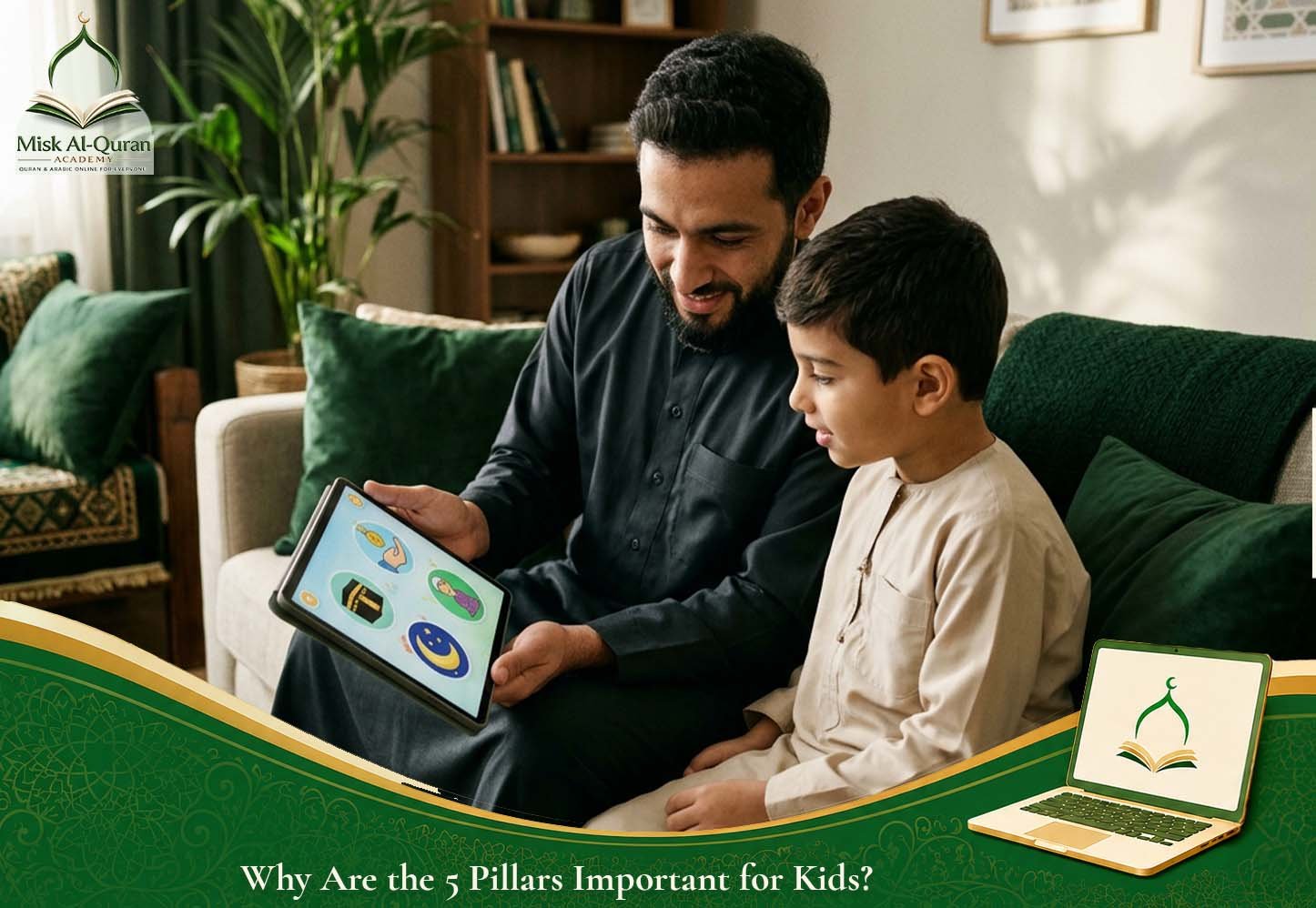
The five pillars are the fundamental acts of worship that establish the foundation of a Muslim’s religious life. They explain how Muslims express their faith, maintain their relationship with Allah, support others, practice self-discipline, and connect with the worldwide Muslim community.
Before exploring each pillar separately, children should learn their names and basic meanings.
| Pillar | Arabic Name | Simple Meaning for Children |
|---|---|---|
| First | Shahada | Believing in Allah and His Messenger |
| Second | Salah | Praying five times every day |
| Third | Zakat | Giving to people who need help |
| Fourth | Sawm | Fasting during Ramadan |
| Fifth | Hajj | Visiting the Kaaba in Makkah for pilgrimage when able |
These five foundations work together to shape a Muslim’s beliefs and actions. For example, Shahada establishes the foundation of faith, while Salah helps children remember Allah throughout the day. Similarly, Zakat encourages generosity, Sawm develops self-control, and Hajj teaches unity among Muslims.
Parents should explain that these pillars are not simply five separate lessons to memorize. Rather, each one carries values that children can gradually apply in their daily lives.
Start Your Quran Learning Journey with Misk Online Quran Academy
Begin your Quran learning journey with Misk Online Quran Academy, where students of all ages benefit from structured online Quran classes tailored to their individual level and learning needs.
Whether your goal is to improve Quran recitation, master Tajweed rules, or begin memorizing the Holy Quran, our experienced and qualified teachers provide clear step-by-step guidance through personalized one-to-one lessons. Each session is designed to help learners understand, practice, and improve with confidence and consistency.
With flexible scheduling, interactive teaching methods, and a supportive online environment, Misk Online Quran Academy makes it easier to stay committed and motivated. Students can learn comfortably from home while making steady progress in their Quran studies at their own pace.

1. Shahada: The First of the 5 Pillars of Islam for Kids
Shahada is the declaration of faith and the foundation upon which the other pillars stand. It consists of two parts:
أَشْهَدُ أَنْ لَا إِلَٰهَ إِلَّا اللَّهُ وَأَشْهَدُ أَنَّ مُحَمَّدًا رَسُولُ اللَّهِ.
Ashhadu an la ilaha illa Allah, wa ashhadu anna Muhammadan rasul Allah.
This means I bear witness that there is no god worthy of worship except Allah, and I bear witness that Muhammad is the Messenger of Allah.
For young children, the first step is helping them become familiar with these words. As they grow, parents can gradually explain their meaning and why Muslims believe in Allah and follow the teachings of Prophet Muhammad ﷺ.
How to Teach Shahada as Part of Islamic Lessons for Kids?
Children between the ages of three and six can begin by listening to the declaration and repeating it with their parents. At this stage, simple explanations are more effective than complicated theological discussions.
For example, parents can explain:
- Allah created everything around us.
- Allah knows what we do and hears our prayers.
- Muslims worship Allah alone.
- Prophet Muhammad ﷺ taught Muslims how to worship Allah and live according to His guidance.
As children become older, parents can introduce more detailed conversations about faith, worship, honesty, and following the Sunnah.
Connect Shahada With Stories of the Prophets
Stories make religious concepts easier for children to understand. Instead of asking a child to memorize the meaning of Shahada without context, parents can explain how the prophets called people to worship Allah alone.
The story of Prophet Ibrahim (AS), for example, provides an opportunity to discuss why Muslims worship only Allah and reject the worship of idols.
Parents can also ask simple questions after storytelling:
- Who created the world?
- Why do Muslims worship Allah?
- Who taught us how to pray?
- What can we learn from Prophet Ibrahim (AS)?
These conversations encourage children to think about their beliefs rather than simply repeat information.
2. Salah: Teaching Kids the Importance of Daily Prayer
Salah is the second pillar and one of the most visible forms of worship in a Muslim’s daily life. Muslims perform five obligatory prayers: Fajr, Dhuhr, Asr, Maghrib, and Isha.
For children, learning Salah should be a gradual process. They first observe their parents praying, then become familiar with the movements and recitations before developing the ability to perform the prayer independently.
The Prophet Muhammad ﷺ instructed parents to teach their children to pray from the age of seven, as reported in Sunan Abi Dawud, Hadith 495. This guidance highlights the importance of introducing prayer during childhood and helping children develop a regular worship routine.
A Practical Age-Based Framework for Teaching Salah to Kids
Every child develops differently. Therefore, parents should consider their child’s understanding, attention span, and ability to follow instructions.
The following framework can help families organize their teaching:
| Age | Learning Goal | Suggested Activity |
|---|---|---|
| 3–5 years | Becoming familiar with prayer | Allow children to imitate prayer movements |
| 6–7 years | Learning basic recitations | Introduce Al-Fatiha and short surahs |
| 8–9 years | Understanding prayer steps | Practice performing Salah with guidance |
| 10 years and above | Developing consistency | Encourage independent prayer and regular revision |
This framework is a learning guide rather than a strict developmental rule. Some children may need more time to memorize the recitations, while others may understand the movements quickly.
How to Teach Kids Salah Without Making It a Chore
Children usually learn through observation. Consequently, parents who perform their prayers consistently provide a practical example that children can follow. Consider these simple strategies:
- Pray together: Invite your child to stand beside you during family prayer.
- Create a prayer space: Prepare a clean, comfortable area where children can practice.
- Use visual reminders: Display the five daily prayer names in a visible place.
- Teach short surahs: Begin with Al-Fatiha and other short chapters used in Salah.
- Encourage progress: Appreciate your child’s efforts instead of expecting immediate perfection.
Parents looking for additional practical guidance can explore how to teach kids salah for more ideas on introducing prayer routines and helping children become familiar with its steps.
Learning the movements alone is not enough. Children also need to understand what they are saying during prayer. Explaining the meaning of common phrases, such as Allahu Akbar and Subhana Rabbiyal Azeem, makes the experience more meaningful.
The Role of Quran Learning in Improving Children’s Salah
Quran recitation is an important part of performing Salah correctly. Therefore, children benefit from learning Arabic letters, pronunciation, and short surahs alongside their prayer lessons.
For beginners, online noorani qaida classes for kids can provide a learning path for recognizing Arabic letters, understanding their sounds, and developing basic reading skills.
Misk Online Quran Academy can be an option for parents seeking structured online Quran education for their children. Learning with a qualified teacher may help children practice recitation, receive corrections, and develop their reading skills gradually.
3. Zakat: One of the Five Pillars of Islam for Kids
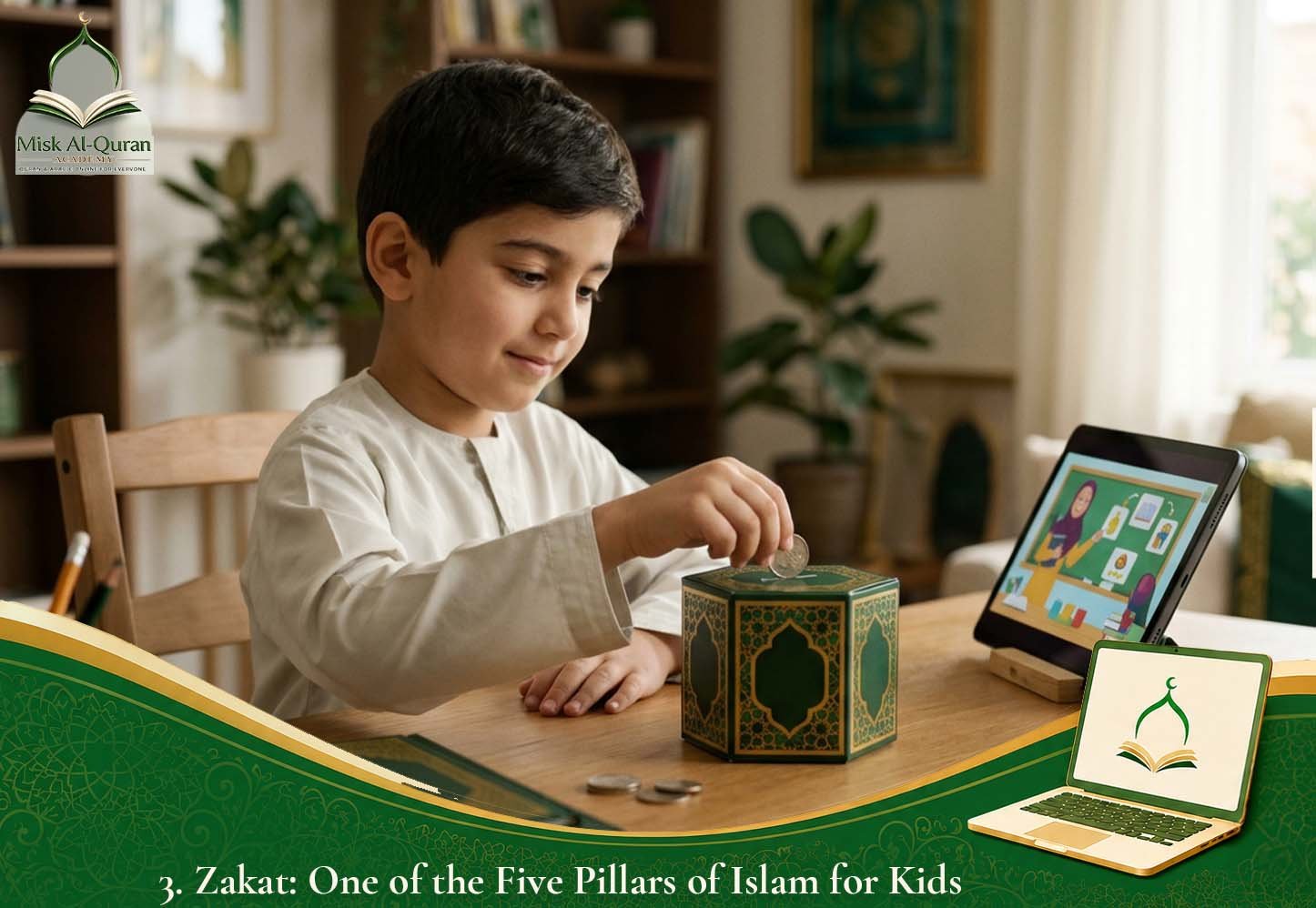
Zakat is the third pillar of Islam. It is an obligatory form of giving that requires eligible Muslims to distribute a prescribed portion of qualifying wealth to specific categories of recipients.
For certain types of wealth, the standard Zakat rate is 2.5%, provided the applicable conditions are met. These include reaching the Nisab threshold and completing the required lunar year when applicable.
Children are not generally financially responsible for paying Zakat in the same way as eligible adults. However, parents can introduce the meaning of Zakat early by explaining that Muslims should care for people experiencing poverty and financial difficulties.
Teaching Zakat as one of the pillars of Islam for kids helps develop generosity, compassion, and awareness of other people’s needs. It also shows children that Islam encourages believers to support others through practical actions.
Practical Ways to Teach Zakat as Part of the Pillars of Islam for Kids
Young learners understand abstract religious concepts more easily when they experience them through familiar activities. Parents can use simple examples to explain why Muslims give and how charitable actions benefit their communities.
Here are three practical methods to introduce Zakat to children.
1. Teach the Pillars of Islam for Kids Through a Three-Jar Saving Activity
For children between five and ten years old, parents can divide their pocket money into three containers:
- Spending: Money children can use for small personal purchases.
- Saving: Money they keep for a future goal.
- Giving: Money they set aside to help others.
The giving jar is a simple educational activity inspired by the Islamic value of generosity. However, it should not be confused with the formal calculation or payment of obligatory Zakat.
Parents can help children choose a charitable cause and explain how their contribution may benefit someone else. This activity makes one of the important pillars of Islam easier to understand for kids through everyday experience.
2. Explain Zakat and the Pillars of Islam for Kids Through Islamic Occasions
Ramadan and Eid provide excellent opportunities to discuss charity and helping others. During these occasions, parents can explain Zakat al-Fitr, which is a separate obligation associated with the end of Ramadan.
Children can participate in preparing the family’s contribution and learn why Muslims give it. Parents should also explain the differences between:
- Zakat: The obligatory payment due on qualifying wealth when its conditions are met.
- Zakat al-Fitr: A separate obligation connected with the end of Ramadan.
- Sadaqah: Voluntary charity that Muslims give to help others.
These conversations help children understand the different forms of giving and recognize how generosity is reflected in Islamic teachings.
3. Help Children Practice the Values of the Pillars of Islam for Kids Through Food Donations
Another useful activity is allowing children to select suitable non-perishable food items for a family donation.
For example, parents can take their children grocery shopping and ask them to choose a few items for people who need assistance. They can then explain why sharing food is a meaningful way to support others.
This small experience teaches children that generosity involves practical action, not simply kind words. It also connects the lesson of Zakat with the broader values behind the pillars of Islam for kids, including compassion, responsibility, and care for the community.
Explaining Zakat Through Simple Questions
| Question | Child-Friendly Explanation |
|---|---|
| What is Zakat? | A required way for eligible Muslims to share part of their wealth |
| Why do Muslims give Zakat? | To obey Allah and support people in need |
| Who receives Zakat? | People who belong to the eligible categories mentioned in Islamic teachings |
| When is Zakat paid? | When the required conditions are fulfilled |
Through these activities, children begin to understand that wealth comes with responsibilities and that helping others is an important part of Islamic character.
4. Sawm: Explaining Ramadan Fasting to Children
Sawm, or fasting, is the fourth pillar of Islam. Muslims fast during the month of Ramadan by abstaining from food, drink, and other things that invalidate the fast from dawn until sunset.
Ramadan offers children a unique opportunity to experience the spiritual atmosphere of Islamic worship. Even when they are too young to fast, they can participate in family activities and learn about the purpose of fasting.
Children are not required to fast before reaching puberty. However, parents may introduce age-appropriate activities when children are physically ready and interested.
For example, some families allow older children to experience a short voluntary fast under parental supervision. This should never become a source of pressure or harm, particularly for young children or those with health concerns.
What Can Kids Learn From Sawm and Ramadan?
The benefits of introducing Ramadan activities extend beyond understanding why Muslims avoid food and drink during daylight hours.
Fasting provides opportunities to discuss several important values:
1. Gratitude
Children become more aware of everyday blessings, including food, clean water, and the comfort of having a meal whenever they need one.
2. Empathy
Learning about people who experience hunger helps children understand why Muslims should care about those facing difficult circumstances.
3. Self-Control
Ramadan encourages Muslims to control their behavior, avoid harmful actions, and develop patience.
4. Spiritual Awareness
Children learn that worship is not limited to physical actions. It also involves intentions, good manners, and remembering Allah.
5. Family Connection
Preparing Suhoor, sharing Iftar, and attending suitable Ramadan activities create meaningful memories that strengthen family relationships.
How to Make Ramadan Special for Children?
Families living in Western countries may find it challenging to maintain a visible Islamic atmosphere when schools and communities follow different cultural traditions. Nevertheless, parents can create a welcoming Ramadan environment at home through simple activities.
- Decorate the house with Ramadan lanterns and calendars.
- Let children help prepare simple Iftar dishes.
- Read short Islamic stories before bedtime.
- Create a Ramadan charity box.
- Set family Quran-reading goals.
- Explain the meaning of Laylat al-Qadr.
- Celebrate Eid with family gatherings and thoughtful activities.
Additionally, parents can use Ramadan as an opportunity to introduce children to Quranic stories and short surahs.
The key is to make the month meaningful without turning religious activities into exhausting tasks.
5. Hajj: Helping Children Understand the Fifth Pillar of Islam
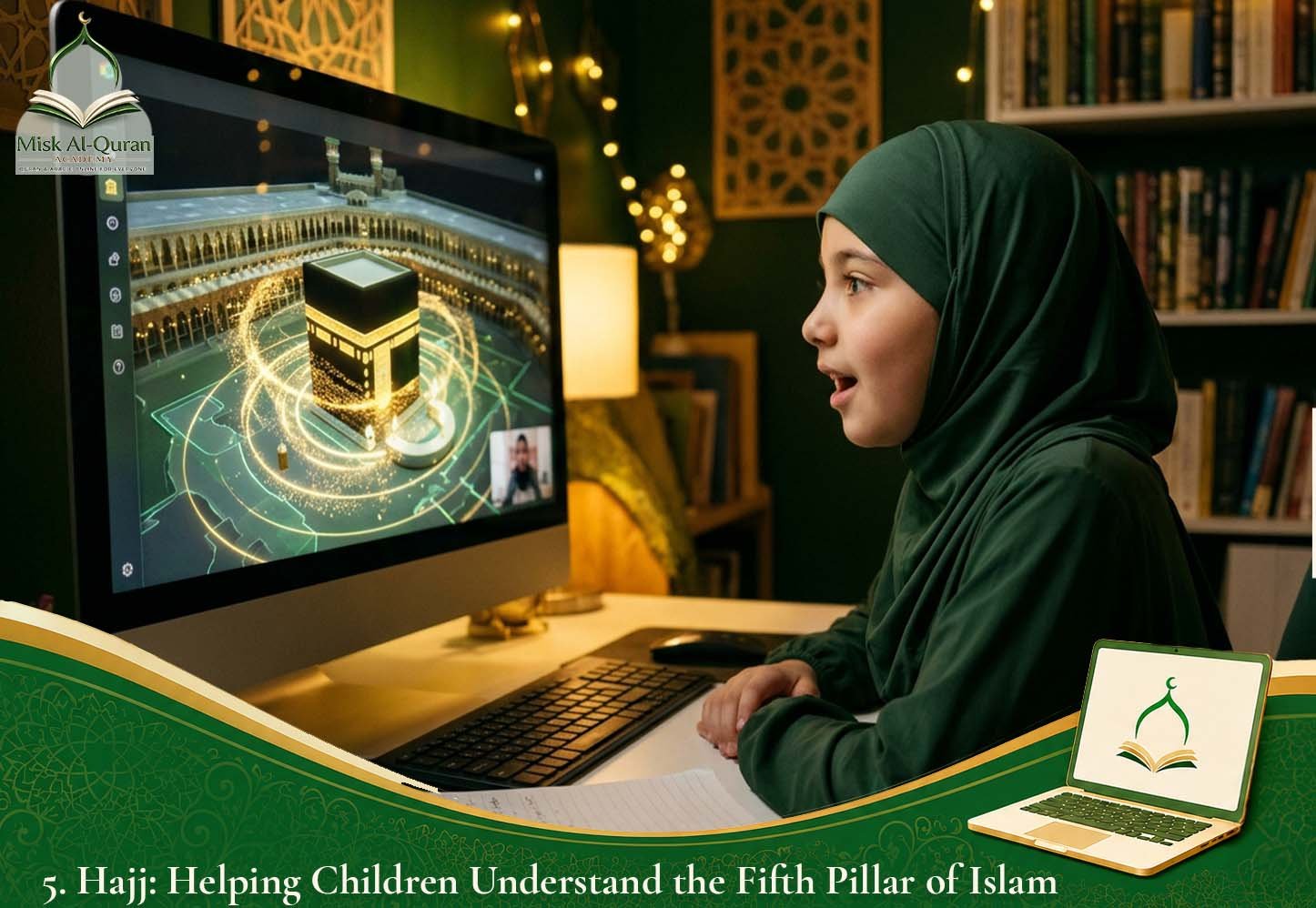
Hajj is the fifth pillar of Islam. It is the pilgrimage to Makkah that eligible Muslims must perform once in their lifetime if they have the physical and financial ability to do so.
Although most children will not be required to perform Hajj until adulthood, learning about this pillar helps them understand the unity of the Muslim Ummah.
Every year, Muslims from different countries, languages, and backgrounds gather in Makkah to perform the same acts of worship. This provides a powerful example of equality, devotion, and belonging.
Hajj is also closely connected to the story of Prophet Ibrahim (AS), his wife Hajar (AS), and their son Ismail (AS).
How to Explain Hajj to Children Who Have Never Visited Makkah?
Children can learn about pilgrimage even if their families have never traveled to Saudi Arabia.
Parents can use several educational activities to make the subject easier to understand.
| Teaching Activity | What Children Learn |
|---|---|
| Watching educational Hajj videos | The appearance of the Kaaba and the main pilgrimage rituals |
| Looking at pictures of Makkah | The location and importance of the holy city |
| Reading the story of Ibrahim (AS) | The historical and religious background of Hajj |
| Learning about Hajar (AS) | Patience, trust in Allah, and perseverance |
| Discussing the global Muslim community | Muslims share the same faith despite their differences |
Explain the Main Hajj Rituals in Simple Language
Parents can introduce the main rituals using short explanations suitable for their child’s age.
- Ihram: A special state of worship that pilgrims enter before performing Hajj.
- Tawaf: Walking around the Kaaba seven times.
- Sa’i: Walking between Safa and Marwah seven times.
- Standing at Arafat: A central part of Hajj when pilgrims gather in the plain of Arafat to worship Allah and make supplications.
- Rami al-Jamarat: The ritual of throwing pebbles at designated pillars.
Visual explanations are particularly useful because children may find it difficult to imagine these activities through words alone.
Connecting Hajj With Quran Learning at Home
The Quran contains stories and references that help children understand the background of Hajj and the importance of Makkah.
Parents can introduce selected verses, explain their meanings, and connect them with the pilgrimage rituals.
For example, reading about Prophet Ibrahim (AS) and his family gives children a better understanding of why Hajj is an important act of worship.
Regular Quran reading also helps young learners become familiar with the Arabic words and religious concepts they encounter during Islamic lessons.
How to Teach the 5 Pillars of Islam for Kids at Home?
Teaching the pillars of Islam for kids does not require parents to organize complicated lessons every day. Instead, consistent learning through ordinary family activities can make Islamic education easier and more enjoyable.
A child who hears about Salah during prayer time, learns about charity while helping others, and discusses Ramadan during family meals gradually develops a practical understanding of Islam.
To make learning the five pillars more organized and engaging, parents can follow these simple steps.
1. Introduce One of the 5 Pillars of Islam for Kids at a Time
Avoid presenting too much information in a single lesson. Start with Shahada, explain its meaning in simple language, and then gradually introduce the other four pillars: Salah, Zakat, Sawm, and Hajj.
After each lesson, revisit previous topics through short conversations or simple questions. This approach helps children understand each pillar before moving to the next one and makes remembering Islamic teachings easier.
2. Use Stories and Visual Materials to Explain the Pillars of Islam for Kids
Children often learn more effectively through pictures, illustrated books, educational videos, and storytelling. These materials can make religious concepts easier to understand and remember.
For example, parents can create a colorful chart displaying the five pillars, their names, and simple explanations. They can also use age-appropriate stories to explain the importance of prayer, helping others, fasting, and visiting Makkah for Hajj.
3. Connect the 5 Pillars of Islam for Kids With Everyday Life
Practical experiences help children understand how Islamic teachings relate to their daily routines. Rather than limiting lessons to memorization, parents can introduce examples from ordinary family activities. For instance, you can:
- Shahada: Explain how the declaration of faith represents a Muslim’s belief in Allah and His Messenger.
- Salah: Connect the five daily prayers with the family’s daily schedule.
- Zakat: Discuss helping people in need and sharing with others.
- Sawm: Explain fasting while preparing for Ramadan.
- Hajj: Introduce the pilgrimage to Makkah during Dhul-Hijjah.
These everyday connections help children recognize the meaning of each pillar beyond its name.
4. Encourage Questions About the 5 Pillars of Islam for Kids
Children naturally ask questions about Allah, worship, and religious practices as they develop their understanding of Islam.
Rather than dismissing difficult questions, parents should respond patiently and provide explanations appropriate to their child’s age and level of understanding.
If they do not know an answer, they can consult a reliable Islamic teacher or educational source. Encouraging curiosity creates a comfortable learning environment where children feel confident discussing their faith.
5. Make Learning the Pillars of Islam for Kids Interactive
Short quizzes, matching games, coloring activities, and simple worksheets can reinforce children’s religious knowledge without making lessons feel repetitive.
For instance, parents can write the names of the five pillars on separate cards and prepare another set containing their meanings. Children can then match each pillar with its correct explanation.
Other useful activities include:
- Arranging the five pillars in the correct order.
- Coloring pictures related to Islamic practices.
- Answering simple questions about each pillar.
- Creating a weekly Islamic learning chart.
These interactive activities turn memorization into an enjoyable experience and help children remember the five pillars more confidently.
Why Is Structured Islamic Education Important for Kids?
Teaching religion at home creates a valuable foundation. However, some children benefit from additional instruction when they need help understanding Quran recitation, Islamic terminology, or the practical details of worship.
Structured Islamic education provides an organized learning path that allows children to progress from basic knowledge to a deeper understanding of their faith.
For non-Arabic-speaking families, this support can be particularly useful because children may need additional practice with Arabic pronunciation and Quranic vocabulary.
Learning Through an Online Islamic School for Kids
An organized online learning environment may help children study Islamic subjects while maintaining a routine that fits their family’s schedule. Parents can explore an online Islamic school for kids to understand the available educational options and identify a suitable approach for their children.
The most important consideration is whether the lessons match the child’s age, current knowledge, and learning needs.
The Role of Online Quran Classes in Children’s Education
Online learning offers families another way to introduce Quran and Islamic studies without requiring daily travel to a physical classroom.
For example, zoom quran classes may be worth exploring when parents want to understand how live online lessons can support Quran reading and recitation practice.
Before enrolling, families should review the available courses, teaching methods, teachers’ qualifications, lesson structure, and scheduling options.
Learning With Misk Online Quran Academy
Misk Online Quran Academy is an option parents can explore when looking for online Quran and Islamic education for children.
A structured learning environment can help young students approach Islamic subjects in an organized way, while guided lessons may provide opportunities to ask questions and practice what they have learned.
Parents who are considering a male Quran teacher can review the relevant teaching options and confirm the available arrangements directly with the academy.
Most importantly, online education should complement the Islamic environment at home rather than replace parental guidance and everyday religious practice.
Mistakes to Avoid When Teaching Kids the 5 Pillars
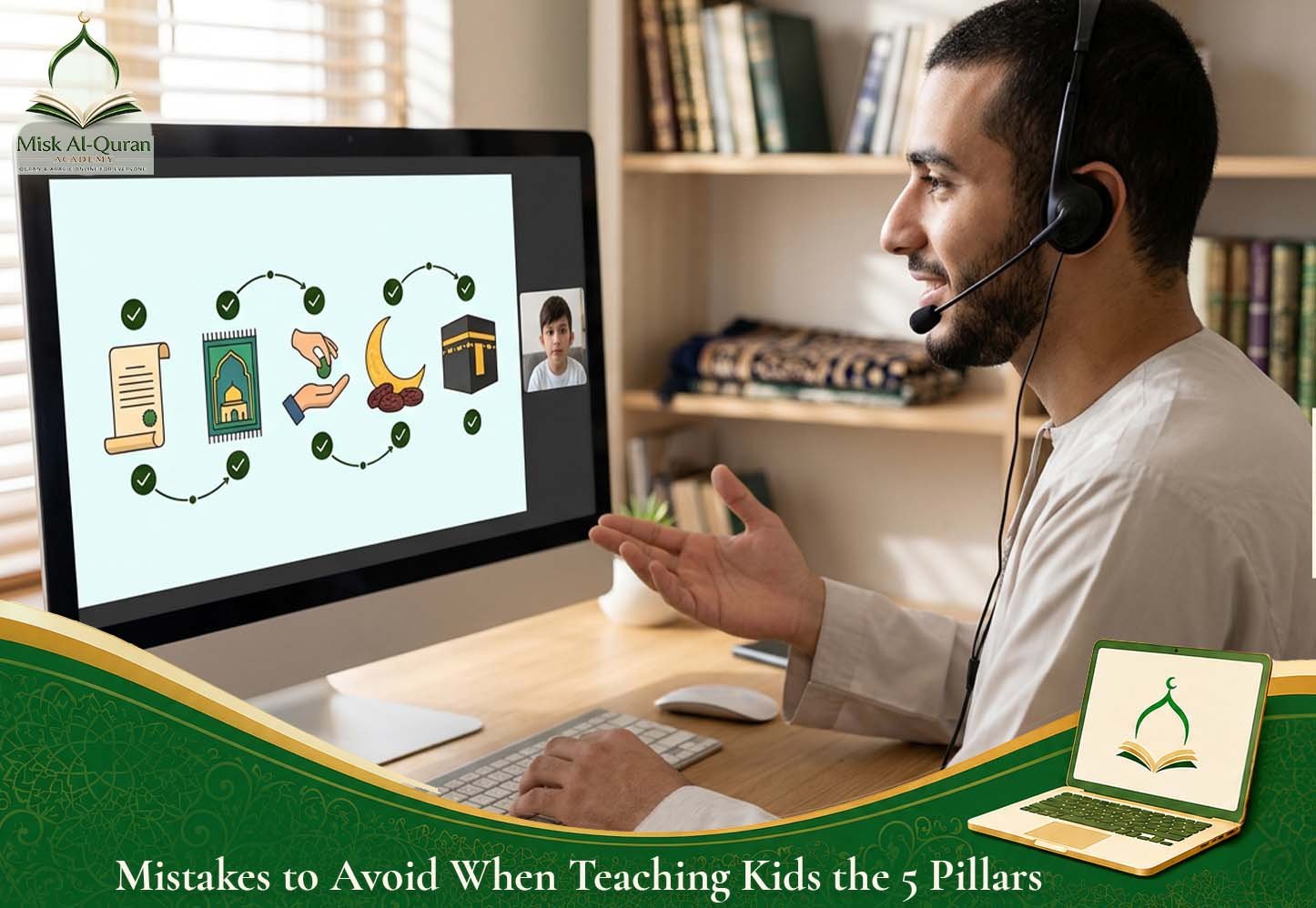
Although parents want their children to develop a strong religious foundation, the teaching approach matters just as much as the information itself. Some common mistakes can make Islamic learning unnecessarily difficult.
1. Expecting Children to Memorize Everything Immediately
Children need time to understand religious concepts. Therefore, avoid expecting them to remember all five pillars and their details after one lesson. Short, repeated sessions are generally more suitable for young learners.
2. Using Complicated Religious Language
Long explanations may confuse children, especially when they are learning about unfamiliar terms. Instead, introduce one idea at a time and use examples from their daily experiences.
3. Turning Worship Into a Punishment
Religious education should encourage love, understanding, and a positive connection with Allah. Using constant criticism or pressure may make children associate worship with fear rather than understanding.
4. Teaching Information Without Practical Examples
Children may memorize that Zakat involves giving money, but they need practical examples to understand generosity. Similarly, learning the names of the prayers is only the beginning of understanding Salah.
5. Ignoring the Child’s Individual Learning Pace
Some children learn through listening, while others respond better to visual activities or practical demonstrations. Parents should adjust their approach according to the child’s age, interests, and learning needs.
Frequently Asked Questions About the 5 Pillars of Islam for Kids
This section answers common questions parents ask about teaching the 5 Pillars of Islam for Kids, helping children understand their meanings and practice them in everyday life.
1. Do Children Need to Memorize the Arabic Names of All Five Pillars?
Learning the Arabic names is beneficial because these terms are commonly used in Islamic education. However, children should also understand their meanings in a language they know. Parents can introduce the Arabic terms gradually and practice them through simple games and repetition.
2. Can Non-Muslim Schools Support a Child’s Islamic Education?
Schools may teach general religious or cultural topics, but parents remain responsible for ensuring their children receive an accurate understanding of their own religious beliefs. Families can supplement school education with Quran lessons, Islamic books, and age-appropriate discussions at home.
3. How Can Parents Respond When Children Ask Difficult Questions About Faith?
Parents should listen carefully, avoid dismissing the question, and provide an honest explanation appropriate to the child’s age. If the question requires specialized religious knowledge, consulting a qualified Islamic teacher is a sensible approach.
4. What Should Parents Do If Their Child Loses Interest in Islamic Lessons?
Try changing the learning method rather than increasing pressure. Shorter sessions, interactive activities, stories, and practical examples may help restore interest. It is also useful to discover whether the child finds the material too difficult, repetitive, or unsuitable for their age.
Conclusion
The five pillars of Islam provide children with an essential introduction to Muslim beliefs and practices. Shahada establishes the foundation of faith, Salah develops a connection with Allah, Zakat teaches generosity, Sawm encourages patience and self-control, and Hajj introduces the unity of the Muslim Ummah.
For parents, the most effective approach is to combine clear explanations with practical experiences. Children do not need to understand every religious detail immediately. Instead, they need patient guidance, positive examples, and opportunities to learn as they grow.
By making Islamic education part of everyday family life and seeking suitable educational support when necessary, parents can help their children develop a meaningful and lasting connection with their faith.