female quran tutor services can help you learn Quran recitation, improve pronunciation, and study Tajweed through lessons tailored to your experience and learning goals. Whether you are a beginner, a parent seeking lessons for your child, or an adult returning to Quran study, choosing the right teacher can make your learning journey more structured and comfortable.
However, finding a suitable tutor involves more than choosing someone who can recite the Quran correctly. You also need a teaching approach that matches your level, a schedule you can maintain, and clear feedback that helps you recognize and correct mistakes. For many learners, studying with a female teacher also provides a preferred learning environment.
Misk Online Quran Academy offers an option for learners interested in online Quran education. Before choosing a course, it helps to understand what a qualified teacher should provide, how online lessons work, and which learning approach suits your needs.
This guide explains the main considerations so you can make an informed decision and approach your Quran studies with realistic expectations.
What Does a Female Quran Tutor Teach?
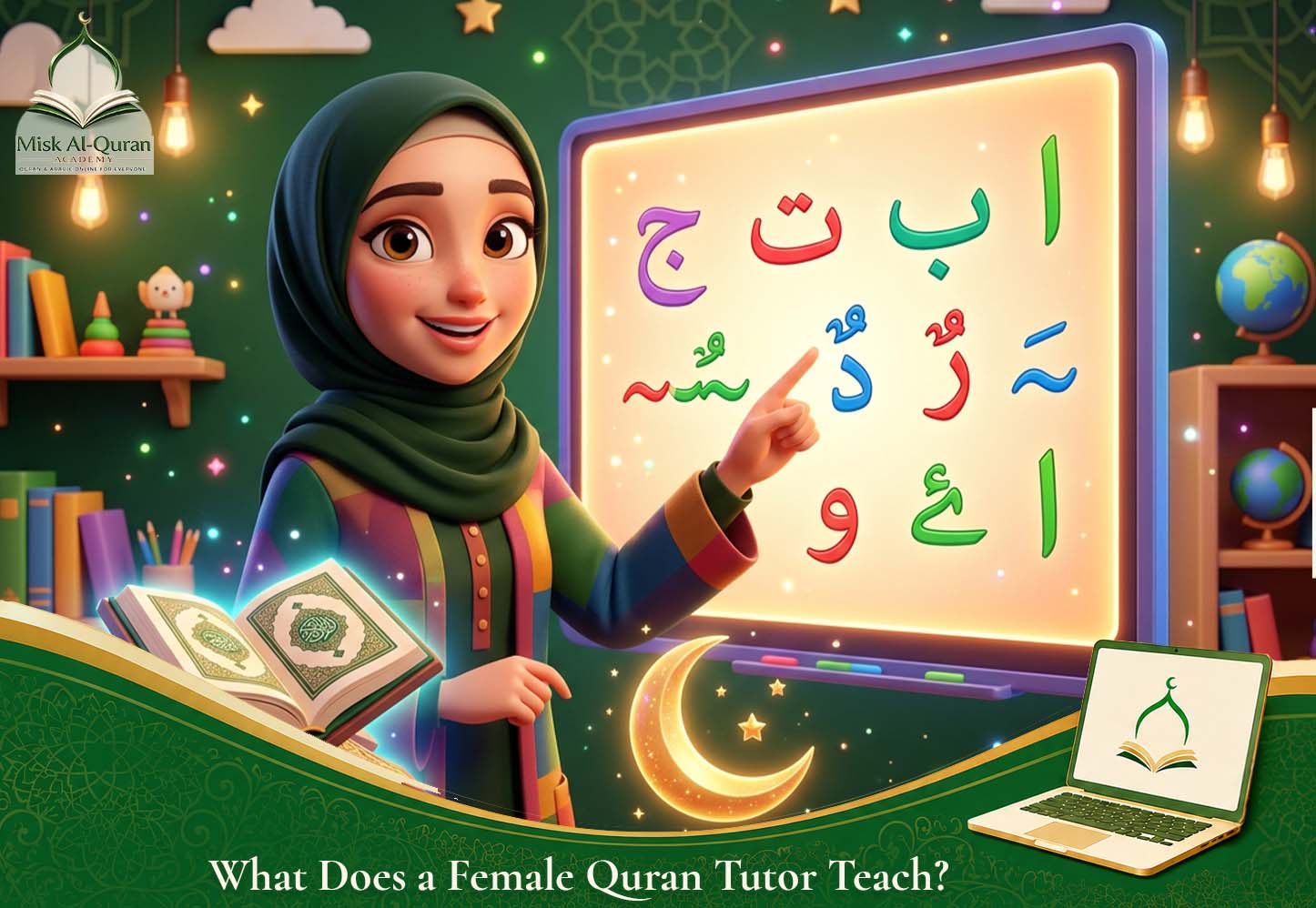
A female Quran tutor is a teacher who helps students learn Quran reading, recitation, memorisation, or Tajweed. Depending on her qualifications and teaching experience, she may work with beginners who need to recognize Arabic letters or advanced learners who want to refine their recitation.
Unlike a general language lesson, Quran instruction requires attention to the correct pronunciation of Arabic letters and the rules governing recitation. Therefore, students benefit from a teacher who understands these requirements and can explain them clearly.
Online instruction also makes it possible to study from home without travelling to a physical learning centre. In addition, individual lessons can give students more opportunities to ask questions, repeat difficult passages, and receive feedback. A suitable tutor may help you work toward several goals:
- Learning to recognise and pronounce Arabic letters correctly.
- Connecting letters and reading Quranic words with greater confidence.
- Applying essential Tajweed rules during recitation.
- Correcting recurring pronunciation mistakes.
- Memorising selected surahs through structured practice.
- Reviewing previously learned passages to improve consistency.
Nevertheless, these goals require different approaches. Someone learning the Arabic alphabet needs a different starting point from a student who already reads fluently but struggles with advanced Tajweed.
For that reason, the first step should be identifying your current level and deciding what you want to achieve.
Start Your Quran Learning Journey with Misk Online Quran Academy
Begin your Quran learning journey with Misk Online Quran Academy, where students of all ages benefit from structured online Quran classes tailored to their individual level and learning needs.
Whether your goal is to improve Quran recitation, master Tajweed rules, or begin memorising the Holy Quran, our experienced and qualified teachers provide clear step-by-step guidance through personalised one-to-one lessons. Each session is designed to help learners understand, practice, and improve with confidence and consistency.
With flexible scheduling, interactive teaching methods, and a supportive online environment, Misk Online Quran Academy makes it easier to stay committed and motivated. Students can learn comfortably from home while making steady progress in their Quran studies at their own pace.

Benefits of Learning Quran With a Female Teacher
Students choose female teachers for different reasons. Some prefer a female instructor for personal comfort, while others value individual attention or want to arrange lessons for a daughter or another female family member. The decision ultimately depends on your preferences, learning objectives, and the qualifications of the available teachers.
1. A Comfortable Learning Environment
For students who feel more comfortable studying with a woman, a female Quran tutor can offer a preferred setting for asking questions and discussing learning difficulties.
This can be particularly helpful when a student feels hesitant about making pronunciation mistakes in front of another person. A respectful and encouraging teacher can help the learner understand that mistakes are a normal part of developing a new skill.
However, comfort also depends on the teacher’s personality and teaching style. A good instructor listens carefully, responds patiently, and explains corrections without making the student feel embarrassed.
2. Individual Attention During Lessons
Private lessons allow the teacher to concentrate on one student’s progress instead of dividing attention among several learners. For example, if you repeatedly confuse two Arabic letters, your tutor can isolate their sounds, demonstrate the correct articulation, and ask you to practise them in different words.
Likewise, if you already pronounce individual letters correctly but struggle when reading longer passages, the lesson can focus on fluency and the application of Tajweed rules. As a result, the learning process becomes more relevant to your actual difficulties rather than following a fixed pace designed for a group.
3. A Learning Plan That Matches Your Level
Not every student needs the same curriculum. A complete beginner may need to start with Arabic letters, while an intermediate learner might benefit from guided recitation and regular error correction. Similarly, someone who has memorized several surahs may need more time for revision than for learning new passages.
An effective female Quran tutor should therefore help establish realistic goals, identify areas requiring attention, and adjust the lessons as your skills develop.
4. Flexible Study From Home
Online Quran Teachers Learning The Quran Made Easy lessons can reduce the time and travel involved in attending in-person classes. This arrangement may be particularly useful for adults with work commitments, parents managing family responsibilities, and students living far from suitable teachers.
Moreover, remote learning allows students to arrange lessons around their existing routines, provided the teacher offers compatible times. Still, flexibility does not remove the need for regular practice. Progress depends on the quality of instruction, the difficulty of the material, and the time you dedicate to reviewing each lesson.
How a Female Quran Tutor Teaches Quran With Tajweed
A female quran tutor teaches Tajweed by helping students understand pronunciation rules and apply them during Quran recitation. These rules cover Arabic letter articulation, letter characteristics, and specific pronunciation requirements that vary according to context.
Learning Tajweed requires more than memorising definitions. Instead, students need practical demonstrations, repeated recitation, and corrections that help them recognise and improve their mistakes.
Understanding Makharij al-Huruf With a Female Quran Tutor
Makharij al-Huruf refers to the articulation points from which Arabic letters are pronounced. Some Arabic letters may sound similar to learners unfamiliar with the language. However, their articulation points or characteristics can differ, making careful listening and practice essential.
A female quran tutor may ask you to pronounce a particular letter separately before practising it within a word. Afterwards, you can read short phrases containing that letter and gradually move to longer passages. This process helps identify specific errors instead of treating every pronunciation difficulty as a general reading problem.
Learning Arabic Letter Characteristics During Quran Lessons
In addition to articulation points, students need to understand the characteristics that distinguish Arabic letters. These characteristics affect how letters are produced and perceived during recitation. A teacher can demonstrate the differences, explain the relevant rules, and provide examples for repeated practice.
For beginners, it is usually helpful to learn these concepts gradually rather than attempting to memorise every rule at once. As your understanding improves, you can apply the rules while reading increasingly challenging passages.
Applying Common Tajweed Rules With a Female Quran Tutor
- Noon sakinah and tanween: Learning the rules that determine how these sounds are recited in different contexts.
- Meem sakinah: Understanding its relevant pronunciation rules.
- Ghunnah: Practising the nasal sound required in specific recitation situations.
- Madd: Recognizing elongation rules and applying the appropriate duration.
- Qalqalah: Learning how certain letters are pronounced with their characteristic sound when the rule applies.
- Waqf and ibtida: Understanding where to stop and how to resume recitation appropriately.
Your teacher should introduce these subjects according to your existing knowledge. Furthermore, connecting each rule to Quranic examples helps you recognize and apply it during reading.
Correcting Recitation Mistakes With a Female Quran Tutor
Correction is one of the most useful parts of individual Quran instruction. For instance, a student might understand a Tajweed rule but forget to apply it while reading a longer passage. Another learner may pronounce a letter correctly in isolation but struggle when it appears beside another letter.
During online lessons, zoom quran classes can provide a way for students and teachers to communicate remotely, provided the academy uses Zoom for its sessions.
In these situations, the teacher can identify the problem, demonstrate the correct recitation, and ask the student to repeat the relevant words. Over time, regular feedback helps learners recognise patterns in their mistakes and work on them more deliberately.
Qualifications and Teaching Skills to Consider

A teacher’s suitability should be evaluated through relevant knowledge, teaching ability, communication, and the quality of feedback provided during lessons. Although qualifications matter, they are only one part of the decision. A knowledgeable instructor must also be able to explain difficult concepts at a level the student can understand.
Quran Recitation and Tajweed Knowledge
Start by asking about the teacher’s experience in Quran recitation and Tajweed. If you have a particular goal, such as improving pronunciation or preparing for an advanced recitation course, check whether her expertise matches that goal. You can also ask how she approaches common errors and whether she provides practical correction during lessons.
If you are seeking formal certification or an Ijazah pathway, verify the instructor’s relevant qualifications and the specific requirements of that program. General Quran teaching experience does not automatically establish eligibility to issue an Ijazah.
Experience Teaching Your Age Group
Teaching methods often differ according to a student’s age and experience. Children may benefit from short activities, repetition, and simple explanations. Adults, meanwhile, may prefer direct feedback, clear learning objectives, and lessons that fit around their responsibilities. An experienced teacher should understand these differences and adapt the lesson accordingly.
For younger learners, an online Islamic school for kids may also be worth exploring when families want Quran instruction alongside broader Islamic learning. Check the available subjects and teaching arrangements before choosing a program.
Clear Explanations and Useful Feedback
A good tutor does not simply tell you that a pronunciation is incorrect. Instead, she explains what needs to change and gives you a practical way to practise it. For example, she might demonstrate the difference between two letters, ask you to repeat them, and then check whether you can pronounce them correctly in a Quranic word. Furthermore, useful feedback should identify both progress and remaining difficulties. This makes it easier to understand what to practise between lessons.
A Realistic Approach to Progress
Be cautious of promises that guarantee complete fluency, perfect recitation, or memorisation within a fixed period regardless of your starting level. Learning takes different amounts of time depending on your previous experience, lesson frequency, practice habits, and learning goals. Instead, look for a teacher who can explain the next steps, assess your progress, and adjust the plan when necessary.
How Does a Female Quran Tutor Help Beginners Learn Quran Reading?
Beginners often need a structured introduction before they can read Quranic passages confidently. Starting with advanced Tajweed rules too early may create confusion, particularly when the student is still learning to recognise Arabic letters. Therefore, the initial lessons should establish the foundations required for accurate reading.
Learning the Arabic Alphabet With a Female Quran Tutor
Students who cannot yet recognise Arabic letters need to learn their shapes, sounds, and positions within words. Arabic letters can change shape depending on their position. Consequently, beginners should practise recognizing letters in different forms rather than memorizing only their isolated shapes. A tutor can introduce a manageable number of letters at a time and review previously learned material before moving forward.
Moving From Letters to Quranic Words
Once students recognise the letters, they can begin practising vowel marks and simple combinations. At this stage, the teacher should check whether the learner can connect the sounds correctly instead of relying entirely on memorization. Gradually, practice can move from individual letters to syllables, words, and short Quranic passages.
Building Confidence Through Repetition
New learners may need to repeat the same words or verses several times before reading them comfortably. However, repetition should include correction. Repeating a mistake without understanding it can make the error more difficult to change later. A supportive instructor helps the student slow down, identify the problem, and try again. With consistent practice, beginners can build a foundation for reading more accurately and studying Tajweed in greater detail.
How does a Female Quran Tutor Teach Children and Adults?
A suitable lesson structure depends on the learner’s age, concentration, previous knowledge, and reasons for studying. Although the main principles of correct recitation remain consistent, the way a teacher presents them should reflect the student’s needs.
Quran Lessons for Children
Children often benefit from clear instructions, short learning activities, and regular encouragement. A female quran tutor teaching children may divide a lesson into several parts, such as reviewing previous material, practising a new concept, and reciting a short passage.
Parents can support this process by establishing a regular practice routine at home. Nevertheless, the amount of practice should remain appropriate for the child’s age and attention span. Useful teaching approaches may include:
- Practising a small number of letters or words at a time.
- Reviewing earlier lessons before introducing new material.
- Using simple examples to explain pronunciation.
- Encouraging children to ask questions when they feel confused.
- Setting manageable memorisation goals.
- Sharing progress with parents when appropriate.
Quran Lessons for Adult Learners
Adults may return to Quran study after years away from formal lessons. Others may already read Arabic but want to correct longstanding pronunciation mistakes. In either case, the teacher should assess the student’s current ability instead of assuming that age determines the appropriate level.
For example, an adult who reads fluently may need targeted Tajweed instruction rather than a complete beginner’s course. Conversely, someone unfamiliar with Arabic may need to start with the alphabet.
Adults can also benefit from lessons that account for work schedules, family responsibilities, and available study time. Those who want to improve their daily worship may additionally explore namaz salah classes online to study prayer-related guidance separately from Quran recitation. A practical plan should define a manageable goal for each session and identify what the learner should review before the next lesson.
Lessons for Intermediate and Advanced Students
Students with established reading skills may want to refine their recitation, strengthen memorisation, or study more advanced subjects. At this level, the teacher can concentrate on recurring mistakes, more detailed Tajweed application, and the consistency of recitation across longer passages.
Depending on the student’s objectives and the teacher’s qualifications, lessons may also include structured memorisation or additional Quranic studies. However, advanced learning should build on a reliable foundation. Correcting fundamental pronunciation problems first can make later study more productive.
How to Choose Between a Female Quran Tutor and a Male Quran Teacher?
Choosing a teacher involves personal preferences, learning objectives, and the instructor’s qualifications. Some students specifically prefer a female teacher, while others are comfortable learning with either a male or female instructor. A male quran teacher may also be suitable for learners whose preferences and circumstances align with that arrangement. Regardless of the teacher’s gender, consider the following factors:
- Relevant knowledge: Confirm experience in Quran recitation and the Tajweed subjects you want to study.
- Teaching approach: Look for clear explanations and practical correction.
- Personal comfort: Choose an instructor with whom you can ask questions openly.
- Lesson availability: Make sure the schedule fits your routine.
- Learning objectives: Confirm that the course addresses your current level and goals.
- Progress assessment: Ask how the teacher identifies strengths and areas requiring improvement.
How to Prepare for Online Quran Lessons With a Female Quran Tutor
Preparation can make online lessons more focused, especially when you have limited time available. Fortunately, you do not need an elaborate setup to begin. A quiet place, a reliable internet connection, and the materials recommended by your teacher are often sufficient.
Before the Lesson
- Keep your Quran or assigned learning material ready.
- Check your internet connection, microphone, and audio settings.
- Review the previous lesson’s notes or corrections.
- Write down questions about rules or words you find difficult.
- Choose a location where you can listen and recite without unnecessary interruptions.
If you use a digital Quran, ensure that the text is easy to read on your device.
During the Lesson
Listen carefully to the teacher’s demonstration before repeating a passage. When receiving a correction, focus on the specific sound or rule involved. If necessary, ask the teacher to repeat the example or explain the difference in another way. Additionally, avoid rushing through a passage simply to finish it. Accurate, attentive practice is more useful than speed when you are still correcting basic mistakes.
After the Lesson
Review the material while the explanations are still familiar. You can divide your practice into short sessions instead of trying to complete everything at once. For example, you might review a pronunciation rule first and then apply it to a few words from the assigned passage. Before the next lesson, note any difficulties that remain. This allows your tutor to spend more time on areas that need attention.
How to Make Steady Progress With a Female Quran Tutor?
Progress depends on a combination of suitable instruction, regular practice, and realistic expectations. Even an excellent teacher cannot replace the time required to develop accurate pronunciation and reliable recitation habits. On the other hand, practising without feedback may allow mistakes to continue unnoticed.
Establish a Manageable Routine
Choose a practice schedule that fits your daily responsibilities. A short, consistent routine may be easier to maintain than occasional long sessions. However, the appropriate duration depends on your circumstances and the material you are learning. Discuss your available time with your tutor so that the assigned practice remains realistic.
Review Earlier Lessons Regularly
Learning a new rule does not mean you can apply it consistently in every passage. Therefore, revisit previously learned material alongside new lessons. This is particularly useful for memorisation, where regular revision helps you maintain earlier progress. If you repeatedly forget a rule, ask your teacher to identify whether you need a clearer explanation, more examples, or additional practice.
Track Specific Learning Goals
Instead of measuring progress only by the number of pages read, monitor the skills you are developing. You might record whether you can recognise particular letters, apply a Tajweed rule correctly, or recite a memorised passage with fewer corrections. These observations provide a clearer picture of your strengths and remaining difficulties.
Communicate Openly With Your Teacher
If a lesson moves too quickly, a rule remains confusing, or the practice load feels unrealistic, explain the problem. A responsive teacher should consider your feedback and make reasonable adjustments when appropriate.
Likewise, let your tutor know when a particular goal becomes more important, such as improving fluency before beginning a memorisation plan. With clear communication and regular review, you can make your lessons more relevant to your needs.
A Practical Checklist Before Enrolling

Before making a decision, compare the available teaching arrangements against your priorities rather than relying on a single feature. The following checklist can help you evaluate whether a teacher or academy is suitable.
- Qualifications: Does the teacher have relevant Quran recitation and Tajweed knowledge?
- Teaching experience: Has she worked with students at your level and age?
- Learning goals: Can she explain how the lessons will address your specific needs?
- Correction methods: Does she provide clear feedback instead of simply asking you to repeat passages?
- Communication: Can you ask questions comfortably and understand the explanations?
- Scheduling: Do the available lesson times fit your routine?
- Progress review: Is there a clear way to identify improvements and remaining difficulties?
- Course suitability: Does the proposed course match your current abilities and future goals?
You should also ask about any practical requirements before enrolling, including the learning platform and any materials you may need.
When considering Misk Online Quran Academy, use these points to guide your questions and compare the available arrangements with your expectations.
Ultimately, the right choice is the one that combines appropriate teaching expertise, a comfortable learning environment, and a realistic plan for developing your recitation skills.
Frequently Asked Questions About a Female Quran Tutor
This FAQ section answers common questions about choosing a female Quran tutor, online lessons, Tajweed, and learning options for different ages.
1. Can I change my Quran tutor if the teaching approach does not suit me?
You can ask the academy about its teacher-change policy before enrolling. If the teaching style does not meet your needs, explain the issue and ask whether another instructor or lesson arrangement is available.
2. What equipment do I need for online Quran lessons?
Most online lessons require a device with a camera or microphone, a stable internet connection, and access to the platform used by the teacher. Headphones and a quiet study space can also help you hear pronunciation clearly.
3. Should I take notes during a Quran recitation lesson?
Yes, brief notes can help you remember corrections, unfamiliar Tajweed rules, and passages that require extra practice. However, listening carefully and practising the recitation should remain your priorities during the session.
4. What should I do if I feel nervous about reciting aloud?
Tell your teacher that you feel uncomfortable and ask to begin with short passages at a manageable pace. Repeated practice in a respectful learning environment can help you become more comfortable with reciting and receiving corrections.
In conclusion, choosing a female quran tutor is a personal decision that should reflect your learning goals, preferred teaching environment, and current level of recitation.
Before enrolling, consider the instructor’s qualifications, the structure of the lessons, and the support available between sessions. In addition, establish a realistic practice routine so that you can reinforce what you learn and recognize your progress over time.
Misk Online Quran Academy is an option to explore if you are looking for online Quran instruction. Review its available courses and teaching arrangements, ask the questions that matter to you, and determine whether the proposed learning experience fits your expectations.
With appropriate guidance, consistent practice, and clear goals, you can work toward more accurate Quran recitation and a stronger understanding of Tajweed at a pace that suits your circumstances.