Online quran classes vs local madrasa is an important comparison for parents who want to choose the most suitable Quran learning environment for their children. Both options can support Quran reading, memorization, Tajweed, and regular practice, but they differ in flexibility, teacher interaction, class structure, convenience, and learning experience. Understanding these differences can help families make a decision based on educational needs rather than assumptions.
For families exploring online learning, Misk Online Quran Academy can be considered alongside other available programs. Parents should look at teacher qualifications, curriculum, lesson duration, scheduling, individual attention, progress tracking, and communication with families before making a decision. At the same time, a local madrasa should be evaluated according to its teachers, class size, learning environment, daily routine, and the amount of individual support students receive.
The best choice depends on the student’s age, personality, schedule, learning goals, and family circumstances. A careful comparison of online quran classes vs local madrasa can help parents identify which environment is more likely to provide consistent practice, accurate Quran reading, effective Tajweed instruction, and sustainable long-term progress.
Online quran classes vs local madrasa: What Is the Main Difference?
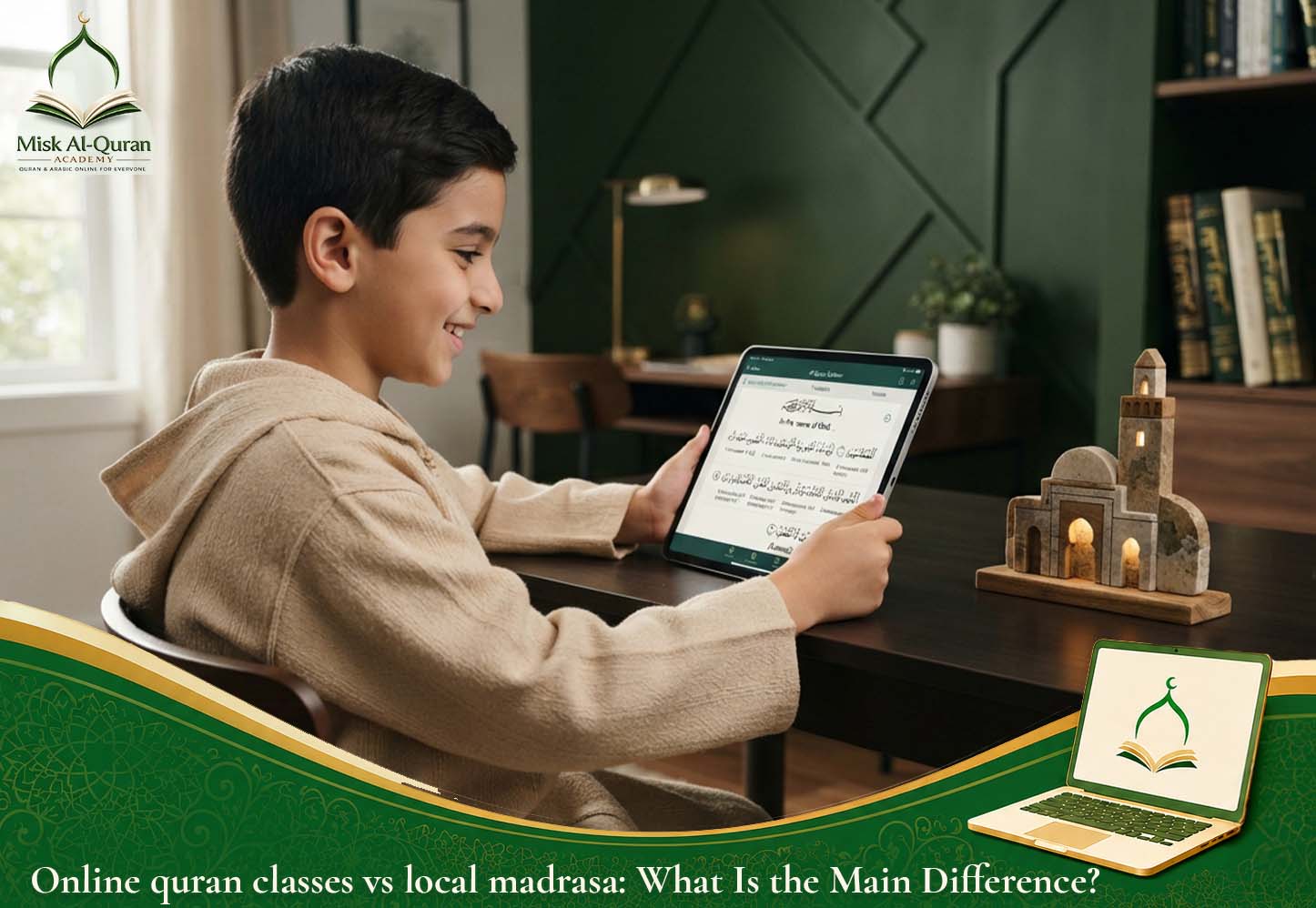
The most obvious difference is the learning environment. Online Quran education takes place through an internet-connected device, usually with a teacher communicating with the student through a live lesson. A local madrasa, on the other hand, requires the student to travel to a physical location and study alongside other learners.
However, the difference goes beyond location.
Online learning can provide a highly personalized experience. Depending on the program, the student may receive individual instruction, immediate correction, and a lesson schedule designed around personal availability. Consequently, learners who need flexibility or extra attention may find this approach particularly convenient.
A madrasa offers a physical educational environment. Students see their teacher in person, interact with classmates, and become part of a local learning community. This environment can be especially helpful for children who respond positively to group routines and social interaction.
Neither model should automatically be considered superior. The quality of the teacher, curriculum, communication, supervision, and consistency can make a greater difference than whether the lesson happens online or inside a classroom.
Start Your Quran Learning Journey with Misk Online Quran Academy
Begin your Quran learning journey with Misk Online Quran Academy, where students of all ages benefit from structured online Quran classes tailored to their individual level and learning needs.
Whether your goal is to improve Quran recitation, master Tajweed rules, or begin memorizing the Holy Quran, our experienced and qualified teachers provide clear step-by-step guidance through personalized one-to-one lessons. Each session is designed to help learners understand, practice, and improve with confidence and consistency.
With flexible scheduling, interactive teaching methods, and a supportive online environment, Misk Online Quran Academy makes it easier to stay committed and motivated. Students can learn comfortably from home while making steady progress in their Quran studies at their own pace.

Quran Classes vs Local Madrasa for Individual Attention
Individual attention is one of the strongest reasons families consider online Quran education. In a private lesson, the teacher can focus on one student’s reading, pronunciation, memorization, and specific weaknesses.
For Quran learning, this matters considerably. A student may repeatedly make the same mistake without realizing it. If the teacher has limited time with each learner, that error might not receive enough attention. In contrast, a focused lesson allows the teacher to listen carefully and correct mistakes as they occur.
This can be particularly useful for beginners. A student learning Arabic letters or basic Quran reading may need repeated explanations before a concept becomes comfortable. Similarly, someone studying Tajweed may need several examples before being able to apply a rule independently.
A local madrasa can still provide excellent individual guidance, especially when class sizes are small. However, larger groups naturally make it harder for one teacher to spend equal time with every student.
Therefore, when comparing online quran classes vs. a local madrasa, parents should not ask only whether a teacher is qualified. They should also ask how much actual teaching time the student receives.
How Class Size Influences Quran Learning?
Class size affects the amount of interaction available during every lesson. In a small classroom, students can ask questions, read aloud, and receive corrections more frequently. In a crowded class, however, each learner may have to wait for their turn.
Online programs can sometimes reduce this problem through private or semi-private sessions. As a result, students who struggle with confidence, pronunciation, or memorization may progress more comfortably.
Still, class size is not the only factor. A skilled teacher can manage a group effectively when the curriculum is well organized. Likewise, a private online class will not automatically produce good results if the teacher lacks teaching experience or the student does not practice consistently.
The best approach is to evaluate the complete learning experience rather than focusing on one feature.
Flexibility and Daily Scheduling
Modern family schedules can be complicated. Children have school, homework, sports, family activities, and sometimes several extracurricular commitments. Adults may have work responsibilities that make traditional lesson times difficult.
A local madrasa normally follows a fixed timetable. Students are expected to arrive at a particular time, which can create a useful routine. At the same time, that structure may become difficult when school finishes late or when transportation is unavailable.
Online lessons can offer greater scheduling flexibility. Depending on the academy and teacher, families may be able to choose morning, afternoon, evening, or weekend sessions. This makes Quran study easier to integrate into an existing routine.
For example, a working parent may prefer a lesson after dinner. A university student may need a weekend schedule. A child may benefit from studying shortly after school while the day’s lessons are still fresh.
Consequently, flexibility can become more than a convenience. It can directly influence consistency.
Online Quran Classes vs Local Madrasa for Consistent Learning
Quran learning is a long-term process. Whether the goal is accurate recitation, Tajweed, memorization, or Islamic studies, progress usually depends on regular practice. For students who need personalized guidance, working with experienced online Quran teachers can make regular practice easier to organize and maintain.
A highly convenient program is useful only if the student attends consistently. Conversely, a traditional program can be very effective when the schedule fits the learner’s life. Families looking for structured instruction may also compare different options, including an online Quran academy UK, before choosing a program that matches their educational and scheduling needs.
Parents should therefore consider which option makes regular attendance easier. If traveling to a madrasa repeatedly creates stress, online lessons may remove an important obstacle. If a child needs the physical routine of leaving home and joining a class, a local madrasa may provide stronger external motivation. At the same time, understanding the Benefits of Online Quran Learning can help parents assess whether online education offers practical advantages for their family’s routine.
The right schedule is the one that the student can maintain for months rather than something that looks ideal for only a few weeks. Consistency also becomes easier when parents understand whether online education provides a secure and suitable environment, especially when considering is online quran learning safe for kids.
Online Quran Classes vs Local Madrasa: Travel and Time
Transportation is an often-overlooked part of Quran education. A lesson itself may last thirty or sixty minutes, but reaching a madrasa can add considerable time to the overall commitment.
For families living close to a suitable madrasa, this may not be a problem. However, students who live in rural areas, busy cities, or places with limited Quran education options may spend significant time traveling.
Online learning eliminates the daily journey. The student can prepare the study area, connect to the lesson, and begin without leaving home. This convenience can also give learners more time for additional Quran activities, such as listening to recitation and discovering the benefits of listening to quran.
This can be especially helpful for parents who have to accompany younger children. Instead of organizing transportation several times each week, they can remain nearby while the lesson takes place.
Furthermore, online education can connect learners with teachers who are not available in their immediate area. This expands the number of potential teachers and teaching styles a student can consider. For advanced learners, online study may also provide access to specialized instruction and guidance about how to get ijazah online.
Online Quran Classes vs Local Madrasa: Choosing the Right Teacher
The teacher is arguably one of the most important factors in Quran education. A convenient schedule cannot compensate for poor instruction, while an excellent teacher can make a major difference in motivation and progress.
In a local madrasa, families often choose from teachers available in their community. This can be an advantage because parents may already know the teacher or receive recommendations from relatives and neighbors.
Online learning can broaden the selection. Students may have access to teachers from different backgrounds and teaching specialties. Families can therefore look for someone who matches the student’s age, level, personality, and goals.
When evaluating a teacher, consider more than qualifications. Pay attention to communication skills, patience, pronunciation correction, lesson organization, and the ability to explain difficult concepts in a simple way. For students interested in advanced Quranic studies, it can also be useful to understand what qiraat is in the quran and whether the teacher has relevant knowledge or experience.
A good Quran teacher should also understand that learners progress at different speeds. One child may memorize quickly but struggle with pronunciation, while another may read accurately but require more time to memorize.
Choosing a Quran Teacher for Children and Adults
Beginners need teachers who are patient and systematic. Children often benefit from lessons that combine repetition, encouragement, and age-appropriate activities. Adults may prefer a more direct teaching style that respects their existing knowledge and focuses on practical improvement.
Students working on memorization need consistent revision and clear progress tracking. Those studying Tajweed need detailed correction and repeated practice.
Therefore, teacher-student compatibility should be part of the decision. A technically qualified teacher may not be the best match for every learner.
This is one reason a trial lesson can be valuable. It allows the student and family to observe how communication works before committing to a long-term program.
Online Quran Classes vs Local Madrasa: Parent Involvement
Parents naturally want to know how their children are progressing. However, the way parents supervise lessons can differ considerably between the two models.
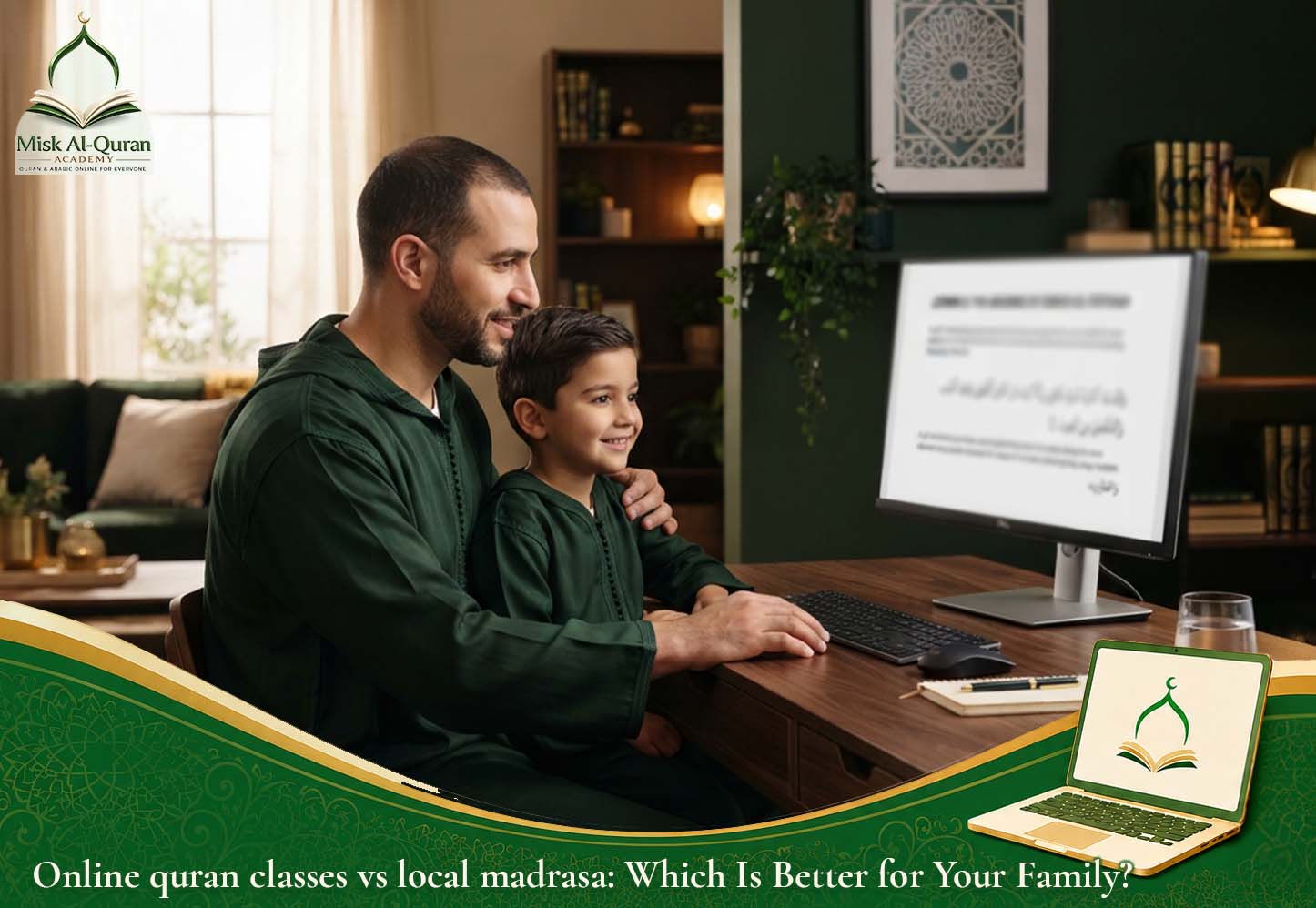
With online education, parents can keep the child at home and remain nearby during the lesson. Younger students may benefit from this additional sense of security. Parents can also communicate with the teacher more easily about attendance, homework, revision, and areas requiring attention.
A local madrasa provides physical separation from the home environment. That can be beneficial because children sometimes concentrate better when parents are not present. At the same time, parents need to rely more heavily on communication with the teacher to understand what happens during lessons.
Neither arrangement is automatically better. Some children need parental encouragement nearby, while others become more independent when they study outside the home.
For younger learners, parents should establish a quiet study area, ensure the internet connection works properly, and remain available when assistance is needed.
Technology and the Online Learning Environment
Technology is an obvious part of online Quran education. Students need a reliable internet connection, an appropriate device, headphones or speakers, and a quiet place to study. These requirements are manageable for many families, but they should not be ignored.
A poor connection can interrupt a lesson. Background noise can make recitation difficult to hear. A small screen may be uncomfortable for extended sessions. Likewise, distractions from games, notifications, or unrelated websites can reduce concentration. For this reason, parents should create a dedicated learning environment.
The device should be positioned comfortably, the Quran should be easy to read, and unnecessary applications should be closed. Additionally, younger children may need help learning how to use the platform correctly. When technology is organized properly, it becomes a tool rather than a distraction.
Community and Social Interaction
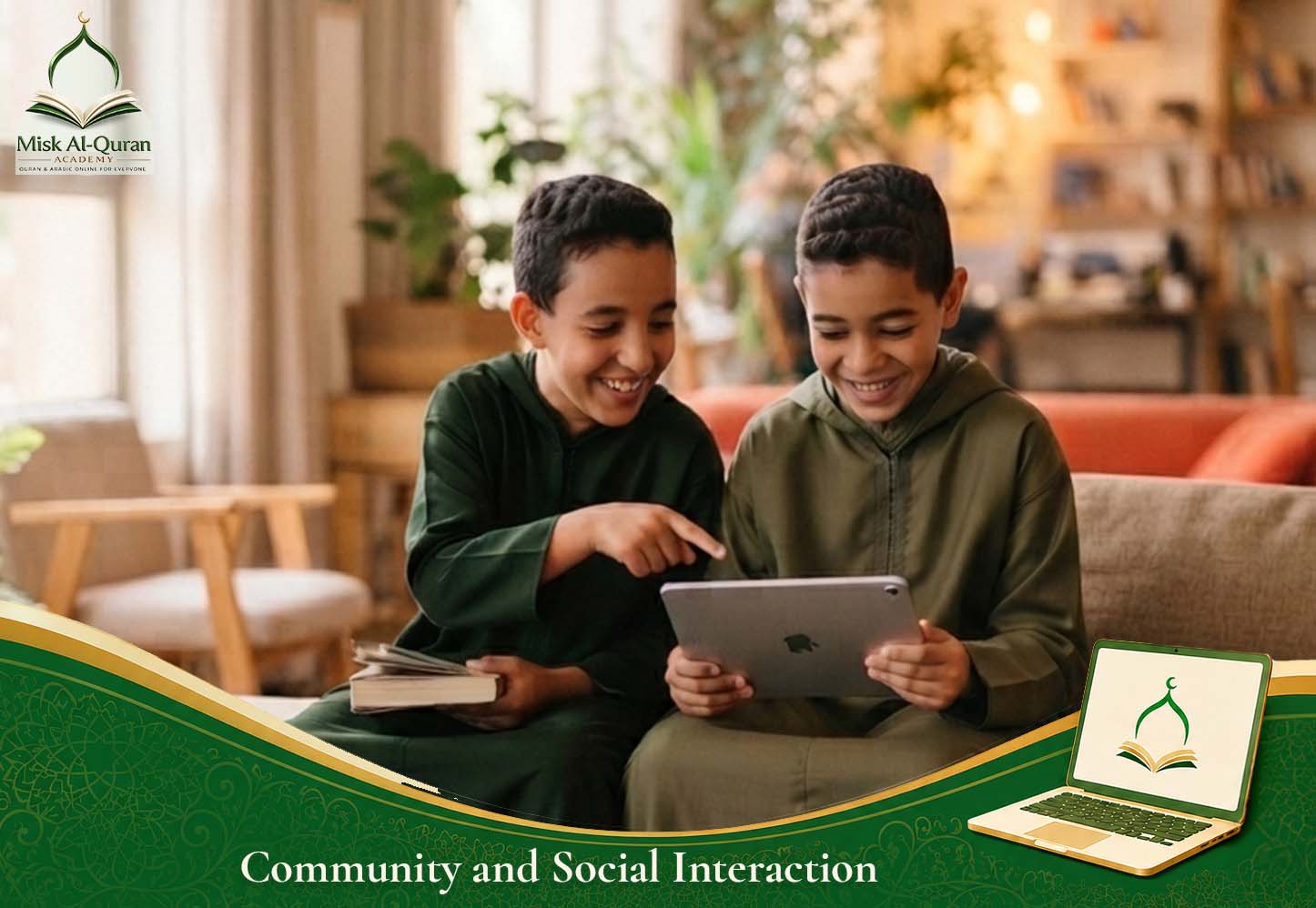
One of the strongest advantages of a local madrasa is community. Children meet other Muslim students, develop friendships, participate in group activities, and experience Quran learning as part of a shared environment. For some learners, this social dimension is highly motivating.
A physical classroom can also create a sense of belonging. Students may see familiar faces every week and develop relationships with teachers and classmates over time.
Online lessons are naturally more individual. Although students may interact with teachers and sometimes participate in group sessions, the experience does not completely reproduce the atmosphere of a local classroom.
Therefore, families should consider the student’s personality. A child who becomes energized by group activities may enjoy a madrasa. A shy student who feels uncomfortable reading in front of others may perform better in a private online setting.
Interestingly, the two approaches can also complement one another. A family might value the community provided by a local program while using private online instruction to strengthen specific Quran skills.
Cost and Overall Value
Cost is an important consideration for many families. Local madrasas may be free, community-supported, or relatively inexpensive. This can make them accessible to families with limited budgets.
Online Quran education usually involves a tuition fee. However, the financial comparison should include the complete cost of participation.
Consider transportation, fuel, commuting time, private tutoring needs, and the possibility of paying for additional lessons when a student does not receive enough individual attention.
For instance, a low-cost group class may appear cheaper at first. However, if the student needs additional private tutoring to correct persistent mistakes, the total expense can increase.
Online lessons may cost more than a community madrasa, yet the additional flexibility and personalized instruction can make the service valuable for certain families.
The best question is therefore not simply, “Which option costs less?” Instead, ask, “Which option provides the learning support my student actually needs?”
Online quran classes vs local madrasa for Children
Children require special consideration because their attention span, confidence, motivation, and learning habits are still developing.
A local madrasa can provide structure. The child leaves home, enters a classroom, sees other students studying, and follows a familiar routine. For children who enjoy social environments, this can be highly effective.
Online learning offers a different set of benefits. Parents can monitor lessons, avoid transportation difficulties, and select a teacher who matches the child’s needs. The quality of the experience often depends on the child’s personality.
An energetic child who struggles to sit alone in front of a screen may need a more interactive approach. Meanwhile, a child who becomes anxious in crowded classrooms may feel much more comfortable with private instruction.
Parents should also consider age. Very young children may require greater supervision during online lessons, while older students can often manage their sessions more independently.
Keeping Children Engaged During Online Lessons
Online learning should not mean asking a child to sit passively in front of a screen. Teachers can maintain engagement through questions, repetition, visual aids, short activities, encouragement, and appropriate lesson pacing. Parents can also help by creating a predictable routine.
A child should know when the lesson starts, where the study materials are, and what practice is expected afterward.
Short breaks may be helpful for younger learners when appropriate. Moreover, celebrating improvement can strengthen motivation without creating unhealthy pressure.
The goal is to build a positive relationship with Quran learning rather than making every lesson feel like a test.
Online quran classes vs local madrasa for Adults
Adults often have different priorities from children. Work, university, marriage, parenting, and other responsibilities can make fixed schedules difficult.
For that reason, online learning can be particularly practical for adults.
A student can attend a lesson before work, during a suitable evening period, or on a weekend. There is also less pressure associated with joining a classroom after a long break from Quran study.
Adults who are beginners may appreciate private instruction because they can ask questions without feeling embarrassed in front of a group.
At the same time, adults who enjoy community learning may prefer a local setting. Some learners are more motivated when they physically attend a class and interact with other students.
Ultimately, the decision should reflect personal learning habits.
Learning Tajweed in Both Settings
Tajweed requires careful listening and correction. Students need to understand rules and, more importantly, apply them while reciting.
Both online and local teachers can teach Tajweed effectively. The key issue is whether the student receives enough opportunities to recite and receive correction.
Private online instruction can be particularly useful because the teacher can listen to the student’s entire recitation. The teacher may stop at a specific word, explain the error, demonstrate the correct pronunciation, and ask the student to repeat it.
A local class can provide the same quality of correction when the group is appropriately sized, and the teacher has sufficient time.
Therefore, students should assess teaching quality rather than assuming that one format automatically produces better Tajweed.
Memorization and Revision Considerations
Quran memorization requires discipline, repetition, revision, and patience. The teaching format can influence these habits, but it does not replace personal effort.
Online Hifz lessons may provide individualized memorization targets. A teacher can adjust the amount of new material according to the student’s ability and dedicate time to revision.
A madrasa may create a strong collective routine where students memorize and revise together. For learners who thrive on external structure, this can be motivating.
However, memorization should never become a race. Moving too quickly can create weak retention, especially when revision is neglected.
A strong program should balance new memorization with older material. Teachers should monitor whether the student can recite previous portions accurately before continually adding new verses.
Islamic Environment and Daily Habits
Quran education is not limited to reading words correctly. For many families, the deeper goal is to develop a lifelong connection with the Quran and Islamic values.
A local madrasa can provide a visible religious environment that reinforces this goal. Students see other learners, interact with teachers, and participate in a shared educational culture.
Online education can also support Islamic learning, although the family plays a larger role in creating the surrounding environment. Parents can encourage Quran reading outside lesson times, establish prayer routines, discuss what the student learns, and make religious learning part of everyday life.
Consequently, the educational environment extends beyond the lesson itself.
A strong online program combined with a supportive home can be highly effective. Likewise, a good madrasa combined with active parental involvement can produce excellent results.
How to Evaluate a Quran Learning Program?
Before choosing any program, create a simple evaluation framework. First, examine the curriculum. Does it cover the student’s actual goals? A beginner needs foundational reading instruction, while an advanced student may need Tajweed, Qira’at, or memorization support.
Next, evaluate the teacher. Look for appropriate qualifications, experience, patience, communication, and pronunciation skills.
Then, examine scheduling. Can the student attend consistently without disrupting school, work, or family responsibilities?
After that, consider progress tracking. A quality program should have a clear way to monitor improvement and identify areas that need additional practice.
Finally, evaluate communication. Parents and adult learners should know how to contact the teacher or administration when questions arise.
This structured approach makes online quran classes vs local madrasa a practical decision rather than a purely emotional one.
Why Misk Online Quran Academy Can Be an Online Option?
For families considering online Quran education, Misk Online Quran Academy can be included among the options worth evaluating.
When reviewing Misk Online Quran Academy, families should focus on the factors that matter most to their situation: teacher quality, lesson structure, scheduling, student support, curriculum, and progress monitoring.
The academy should be judged according to the student’s needs rather than simply the convenience of online learning. A good match should provide clear instruction, appropriate pacing, and a learning environment where the student feels comfortable asking questions.
Parents can also use a trial or introductory lesson, when available, to observe communication between teacher and student. That experience can reveal more than a promotional description alone.
For students who need flexibility, private attention, or the ability to study from home, Misk Online Quran Academy may be worth comparing with the strongest local option available to them.
The most important point is to make the comparison fairly. Do not compare a carefully selected online teacher with an unsuitable madrasa, or a highly respected local teacher with an inexperienced online tutor. Compare equivalent standards of quality.
Online quran classes vs local madrasa: Which Is Better for Your Family?
After considering all the factors, the answer becomes clearer.
Online learning may be the better fit when:
- The student needs individual attention.
- The family has a busy schedule.
- Transportation is inconvenient.
- A suitable local teacher is unavailable.
- The student prefers learning at home.
- Parents want to remain nearby during lessons.
- The learner needs a flexible timetable.
- The family wants access to teachers outside its immediate area.
A local madrasa may be the stronger choice when:
- Community interaction is a major priority.
- The student learns well in groups.
- A trusted and qualified teacher is available nearby.
- The family prefers face-to-face education.
- The madrasa provides an affordable or free program.
- A fixed routine helps the student stay disciplined.
- The student benefits from learning alongside peers.
There is also a third possibility: combining both.
For example, a student could attend a local madrasa for community and group learning while taking occasional private online lessons for Tajweed correction or memorization support. This approach can be useful when each method solves a different problem.
Online quran classes vs local madrasa: A Practical Decision Checklist
Before making the final decision, consider the following questions:
- What is the student’s current Quran level?
- What is the primary goal: reading, Tajweed, memorization, or Islamic education?
- How much individual attention does the student need?
- How many days per week can the student realistically attend?
- Is transportation easy and reliable?
- Does the student enjoy group learning?
- Would the student concentrate better at home?
- Does the family require a female teacher?
- What is the available budget?
- How will progress be monitored?
- Can parents communicate regularly with the teacher?
- Is there an opportunity to try the teaching method before making a long-term commitment?
The answers will usually reveal which model fits the family best.
Rather than choosing based on popularity, think about sustainability. A good Quran program should be something the student can continue comfortably and consistently.
Making the Transition From a Madrasa to Online Learning
Some families hesitate when considering online quran classes vs. a local madrasa because they worry that moving from a familiar classroom to online learning could interrupt their child’s Quran progress. In reality, the transition does not have to happen suddenly. With a clear plan, familiar routines, and communication with the new teacher, students can adapt without losing the habits they have already developed.
Why a Gradual Transition Works Better?
Children often feel more comfortable when changes are introduced step by step. Instead of presenting online learning as a complete replacement for everything the child knows, explain that the learning method is changing to provide a different environment or greater flexibility.
Parents can make the transition easier by:
- Explaining the reason for changing the learning format.
- Keeping the child’s usual Quran revision time.
- Maintaining familiar memorization and recitation routines.
- Introducing the online teacher before regular lessons begin.
- Staying nearby during the first few sessions.
- Allowing the child to become gradually independent.
For example, if the child previously reviewed Quran after Maghrib, maintaining a similar schedule can provide continuity even when the teacher and learning environment change.
Share the Student’s Previous Quran Learning Progress
The new teacher should understand what the student has already learned. This is particularly important when comparing online quran classes vs. a local madrasa, because students may have followed different curricula or memorization schedules.
Parents should provide information about:
- Surahs the student has already memorized.
- Current memorization targets.
- Tajweed rules previously studied.
- Common pronunciation mistakes.
- Reading difficulties.
- The student’s previous revision routine.
- Areas where the child needs additional support.
This information allows the teacher to assess the student’s level before creating a learning plan. As a result, the student is less likely to spend weeks repeating material unnecessarily.
How to Make Online Quran Classes vs Local Madrasa More Effective?
Choosing between online quran classes vs local madrasa is only the first step. The quality of Quran learning also depends on the student’s environment, daily routine, teacher support, and consistency. Whether the student learns from home or attends a physical madrasa, a structured approach can make lessons more productive and easier to maintain.
Create a Dedicated Space for Online Quran Classes vs Local Madrasa
For online learning, a quiet and organized study area can significantly improve concentration. The space does not need to be large, but it should minimize distractions and contain everything the student needs.
Parents can prepare:
- A suitable desk or Quran stand.
- The student’s Quran and notebook.
- Headphones when appropriate.
- A stable internet connection.
- A working microphone and camera.
- A comfortable chair.
- A device positioned at a suitable height.
- Adequate lighting for the lesson.
A consistent study area can also help children recognize that lesson time requires focus. This is especially useful when comparing online quran classes vs local madrasa, because online students need to create a clear separation between learning time and ordinary home activities.
Build a Consistent Routine for Online Quran Classes vs Local Madrasa
A predictable schedule helps students develop regular Quran habits. Parents should establish a specific lesson time and a separate period for revision.
An effective routine can include:
- Attending the scheduled Quran lesson.
- Reviewing the teacher’s corrections immediately afterward.
- Practicing difficult verses during the day.
- Reciting the assigned portion without looking.
- Reviewing previous memorization before starting new material.
- Preparing questions for the next lesson.
Short daily revision is often easier to maintain than occasional long sessions. Even a few focused minutes can reinforce newly learned verses and prevent previously memorized material from becoming weak.
Keep Parents Involved Without Pressure in Online Quran Classes vs Local Madrasa
Parental support can make a major difference, particularly for younger children. However, support should not turn every study session into an examination.
Instead of focusing exclusively on mistakes, parents can ask:
- What did you learn today?
- Which verse was difficult?
- What did your teacher ask you to review?
- Which Tajweed rule did you practice?
- Can you show me what you learned?
This approach allows parents to monitor progress while keeping the learning atmosphere positive. It also encourages children to take responsibility for their own Quran education.
Encourage Questions in Online Quran Classes vs Local Madrasa
Students should feel comfortable asking questions about pronunciation, Tajweed rules, memorization, and reading difficulties.
When a teacher explains why an error occurs, the student can understand the correction instead of simply memorizing the teacher’s instruction. Over time, this can improve independence and help the learner recognize mistakes more effectively.
How to Improve Learning in Online Quran Classes vs Local Madrasa?
A local madrasa can provide an effective Quran learning environment when its teaching structure matches the student’s needs. However, parents should evaluate the actual educational experience rather than assuming that traditional education is automatically superior.
Communicate With Teachers in Online Quran Classes vs Local Madrasa
Regular communication allows parents to understand whether the student is progressing appropriately.
Parents can ask:
- Which Surah is the student currently memorizing?
- How often is previous memorization reviewed?
- Which Tajweed rules require additional practice?
- How much individual recitation time does the student receive?
- What should be practiced at home?
- Is the student’s progress consistent?
Clear communication helps identify weaknesses early and gives parents a better understanding of the child’s learning needs.
Compare Individual Attention in Online Quran Classes vs Local Madrasa
One of the most important differences when evaluating online quran classes vs local madrasa is the amount of direct teacher attention available to each student.
A local class may include several students with different abilities. As a result, the teacher must divide lesson time between multiple learners.
Parents should determine whether their child receives enough opportunities to:
- Recite directly to the teacher.
- Receive immediate pronunciation corrections.
- Ask questions.
- Practice difficult passages.
- Receive personalized feedback.
- Review previously identified mistakes.
A smaller madrasa class may provide more individual interaction, while a larger class may offer stronger group engagement. The important issue is whether the teaching structure supports the student’s learning style.
Consider Location When Comparing Online Quran Classes vs Local Madrasa
Location can influence attendance and consistency. A nearby madrasa may be convenient for one family, while another family may find traveling to and from lessons difficult.
Consider:
- Travel time.
- Transportation.
- Class frequency.
- The student’s school schedule.
- Family responsibilities.
- Weather conditions.
- Daily fatigue.
Likewise, online learning removes daily travel but requires reliable technology and a suitable learning environment at home. Therefore, convenience should be evaluated in terms of the entire family routine.
Online Quran Classes vs Local Madrasa: Which Environment Supports Motivation?
Motivation strongly influences long-term Quran learning. A student may begin enthusiastically but lose interest if lessons become overwhelming, repetitive, or disconnected from achievable goals.
Set Realistic Goals in Online Quran Classes vs Local Madrasa
Whether the student attends a madrasa or studies online, goals should match the learner’s age, ability, and available time.
Useful goals may include:
- Memorizing a small number of verses accurately.
- Improving one Tajweed rule at a time.
- Reviewing a previously memorized Surah.
- Improving reading fluency.
- Correcting recurring pronunciation errors.
- Increasing consistency in daily revision.
Small milestones make progress easier to recognize and can give students a stronger sense of achievement.
Prioritize Consistency Over Speed in Online Quran Classes vs Local Madrasa
Fast memorization is not always a sign of successful Quran learning. A student may memorize several pages quickly but struggle to retain them or recite them accurately.
Parents and teachers should therefore recognize:
- Regular attendance.
- Accurate recitation.
- Consistent revision.
- Improved pronunciation.
- Better concentration.
- Willingness to correct mistakes.
- Long-term retention.
This balanced approach makes the comparison between online quran classes vs local madrasa more realistic because it focuses on educational quality rather than simply measuring how quickly a student completes a lesson.
What Parents Should Check in Online Quran Classes vs Local Madrasa?
Families comparing online quran classes vs local madrasa should assess several educational factors before choosing a program.
Check Teacher Qualifications for Online Quran Classes vs Local Madrasa
The teacher can have a greater impact on learning outcomes than the lesson’s physical location.
Parents should consider whether the teacher has:
- Strong Quran reading skills.
- Knowledge of Tajweed.
- Relevant teaching experience.
- Experience with the student’s age group.
- The ability to identify pronunciation problems.
- A patient teaching style.
- Effective communication skills.
A qualified teacher should also be able to adjust the lesson when a student needs additional explanation or practice.
Compare the Curriculum in Online Quran Classes vs Local Madrasa
A strong Quran program should have a clear learning structure. Parents should understand what the student will study and how progress will be measured.
The curriculum may include:
- Quran reading.
- Tajweed.
- Memorization.
- Revision.
- Islamic studies when appropriate.
- Regular assessments.
- Individual learning objectives.
The curriculum should also match the student’s level. A beginner should not be expected to follow the same pace as an advanced student.
Evaluate Scheduling in Online Quran Classes vs Local Madrasa
Scheduling is another important consideration. Online learning often offers greater flexibility, while local madrasas may operate on fixed class times.
Before choosing, ask:
- When are lessons available?
- Can lesson times be changed?
- What happens when a student misses a lesson?
- Are make-up lessons available?
- How are schedule changes communicated?
- How often are parents updated about progress?
Families should choose a schedule they can realistically maintain rather than selecting a program that looks convenient but is difficult to attend consistently.
Evaluate Technology in Online Quran Classes vs Local Madrasa
Technology is an important part of the online experience. A technically difficult lesson can distract students from Quran learning.
Parents should check whether the platform is:
- Easy for children to use.
- Compatible with available devices.
- Stable during lessons.
- Suitable for live recitation.
- Supported by reliable communication.
- Easy for parents to monitor.
A test lesson can help families identify technical problems before beginning a long-term program.
Evaluating Misk Online Quran Academy in Online Quran Classes vs Local Madrasa
When considering Misk Online Quran Academy, families should apply the same standards they would use when comparing any Quran education provider.
Parents should evaluate:
- Teacher qualifications.
- Teaching methodology.
- Quran and Tajweed curriculum.
- Individual attention.
- Class scheduling.
- Progress monitoring.
- Parent communication.
- Technical support.
- Suitability for the student’s age and level.
The decision should be based on the actual educational structure rather than promotional language alone.
Online Quran Classes vs Local Madrasa: Common Mistakes Parents Should Avoid
Comparing the two options based on assumptions can lead to an unsuitable choice. Parents should examine the student’s actual needs and the quality of the available programs.
Choosing Based Only on Price in Online Quran Classes vs Local Madrasa
Cost is an important practical consideration, but it should not be the only factor.
Compare the overall value by looking at:
- Teacher quality.
- Lesson duration.
- Individual attention.
- Curriculum.
- Progress monitoring.
- Convenience.
- Learning outcomes.
- Family commitment required.
A cheaper option may not provide the educational support the student needs.
Assuming Online Learning Is Less Effective Than a Local Madrasa
Online Quran learning is sometimes viewed as less serious simply because lessons take place through a screen. However, a well-organized online lesson can provide direct recitation, immediate corrections, personalized instruction, and regular progress monitoring.
The quality of the experience depends on the teacher, curriculum, technology, student commitment, and family support.
Assuming Every Local Madrasa Is Better in Online Quran Classes vs Local Madrasa
Traditional learning can be highly effective, but quality varies from one madrasa to another. Some institutions may have experienced teachers and manageable class sizes, while others may have crowded classrooms or limited individual attention.
Therefore, parents should assess the actual madrasa rather than assuming that traditional education is automatically superior.
Ignoring Student Personality in Online Quran Classes vs Local Madrasa
Students have different learning preferences.
Some children perform better with:
- Group interaction.
- Classmates around them.
- Face-to-face activities.
- A fixed classroom routine.
- Others may benefit more from:
- Individual attention.
- A quiet learning environment.
- Flexible scheduling.
- Personalized correction.
- Fewer distractions.
Understanding the student’s personality can make the decision between online quran classes vs. a local madrasa much more accurate.
Focusing Only on Memorization Speed in Online Quran Classes vs Local Madrasa
Completing memorization quickly should not be the main measure of success.
A student may memorize a large amount of Quran but struggle with pronunciation, Tajweed, or retention. Accurate reading, understanding the rules, regular revision, and long-term retention are equally important.
The stronger goal is accurate, consistent, and sustainable Quran learning, regardless of whether the student chooses online classes or a local madrasa.
Online Quran Classes vs Local Madrasa: A Practical Decision Guide
Instead of asking which format is universally better, parents can compare the options according to their family’s priorities.
| Factor | Online Quran Classes | Local Madrasa |
|---|---|---|
| Flexibility | Usually high | Usually fixed |
| Location | Home-based | Requires travel |
| Individual attention | Can be highly personalized | Depends on class size |
| Social interaction | More limited | Usually stronger |
| Teacher choice | Often wider | Usually local |
| Daily routine | Flexible | More structured |
| Technology | Required | Usually minimal |
| Community environment | Limited | Stronger |
| Scheduling | Often adaptable | Usually predetermined |
| Parent involvement | Easier to observe lessons | Depends on the madrasa |
This comparison shows why there is no universal answer. The strongest option depends on the student’s needs and the family’s circumstances.
Frequently Asked Questions
The Frequently Asked Questions section answers common questions parents may have when comparing online Quran classes with a local madrasa, helping them choose the learning environment that best suits their child’s needs.
Can students switch between online and local Quran education?
Yes. A student can change learning formats when circumstances change. The important step is to share previous progress with the new teacher so instruction can continue at an appropriate level.
How long should a Quran lesson last?
The ideal duration depends on the student’s age, level, attention span, and learning objective. Younger children may benefit from shorter focused sessions, while older students can often handle longer lessons.
Should parents attend every online Quran lesson?
Not necessarily. Younger children may need close supervision, especially during the first few sessions. Older students can gradually become independent while parents continue monitoring attendance and progress.
What should a student do if they are not progressing?
First, identify the specific problem. It could involve lesson frequency, insufficient revision, teaching style, pronunciation difficulties, or unrealistic targets. Discuss the issue with the teacher and adjust the learning plan when necessary.
Is a free trial enough to choose a Quran program?
A trial can provide useful information about communication, teaching style, lesson organization, and student comfort. However, families should also review curriculum, teacher qualifications, scheduling, fees, and ongoing support before making a final commitment.
In conclusion, online quran classes vs local madrasa depends on the student’s needs, learning style, schedule, and family priorities. Online classes can provide flexibility, personalized attention, convenient scheduling, and access to qualified teachers from home. A local madrasa, however, can offer face-to-face interaction, group learning, community support, and a structured routine.
Families considering Misk Online Quran Academy should evaluate teacher qualifications, curriculum, lesson duration, scheduling, progress tracking, revision methods, and student support before enrolling. The same factors should be considered when evaluating a local madrasa.
Ultimately, neither option is automatically better for every learner. The right choice is the one that helps the student read the Quran correctly, improve Tajweed, strengthen memorization, and maintain consistent practice. By focusing on educational quality rather than price or assumptions, parents can choose a Quran learning environment that supports steady progress and long-term commitment.