Difference between Hifz and Tafseer is an important topic for Muslims who want to understand the two main approaches to Quranic learning. Although both are connected to studying the Quran, they have different purposes. Hifz focuses on memorizing Quranic verses accurately and retaining them through regular revision, while Tafseer focuses on understanding their meanings, context, themes, and guidance.
For many learners, deciding where to begin can be challenging. Some students want to memorize the Quran while also understanding what they recite. Others may prefer to study the meanings first before starting a structured memorization plan. Therefore, understanding the role of each approach can help learners choose a suitable learning path.
Hifz develops memory, concentration, accurate recitation, and consistency. Tafseer, meanwhile, develops comprehension, reflection, and deeper awareness of Quranic teachings. Although they require different study methods, they can complement one another effectively.
For learners seeking structured online Quran education, Misk Online Quran Academy can support students with organized lessons and guidance suited to their learning goals. Ultimately, combining memorization with understanding can help learners build a stronger and more meaningful relationship with the Quran.
What Is Hifz and How Does It Differ From Tafseer?

Hifz refers to memorizing the Quran and being able to recite its verses accurately without looking at the Mushaf. The process requires regular repetition, careful listening, accurate pronunciation, and consistent revision.
Unlike ordinary memorization, Quran memorization requires particular attention to the exact wording and order of verses. Students also need to recognize similar passages and maintain previously memorized portions.
The Main Purpose of Hifz
The primary purpose of Hifz is to memorize and preserve Quranic verses accurately. Nevertheless, the process can also develop patience, concentration, discipline, and consistency.
A successful student does not simply focus on learning new pages. Regular revision is equally important because memorized material can become weaker when it is not reviewed consistently.
How Does Hifz Work for Quran Memorization?
A structured Hifz routine commonly includes:
- Listening carefully to the assigned verses.
- Reading the verses from the Mushaf.
- Repeating each verse several times.
- Connecting verses in the correct order.
- Reciting without looking.
- Reviewing previous memorization.
- Correcting mistakes with a qualified teacher.
- Testing retention regularly.
The amount of memorization should depend on the student’s ability. A smaller target that can be retained consistently is often more effective than a larger target that leads to frequent forgetting.
Start Your Quran Learning Journey with Misk Online Quran Academy
Begin your Quran learning journey with Misk Online Quran Academy, where students of all ages benefit from structured online Quran classes tailored to their individual level and learning needs.
Whether your goal is to improve Quran recitation, master Tajweed rules, or begin memorizing the Holy Quran, our experienced and qualified teachers provide clear step-by-step guidance through personalized one-to-one lessons. Each session is designed to help learners understand, practice, and improve with confidence and consistency.
With flexible scheduling, interactive teaching methods, and a supportive online environment, Misk Online Quran Academy makes it easier to stay committed and motivated. Students can learn comfortably from home while making steady progress in their Quran studies at their own pace.

What Is Tafseer and How Is It Different From Hifz?
Tafseer is the study and explanation of Quranic meanings. It helps learners understand the message of verses, relevant context, linguistic meanings, scholarly explanations, and practical lessons.
While a translation provides the meaning of Quranic words in another language, Tafseer can provide additional explanation. Depending on the level of study, it may discuss circumstances of revelation, connections between verses, Hadith, Arabic language, and interpretations from recognized scholars.
The Purpose of Tafseer
The main purpose of Tafseer is to help Muslims understand the Quran correctly and benefit from its guidance. A verse may contain meanings that are not fully apparent through a basic translation alone.
Through reliable Tafseer, students can learn how verses relate to their surrounding passages and how scholars have explained important concepts.
What Does Tafseer Study Include?
Tafseer studies may include:
- Quranic vocabulary and meanings.
- Context surrounding revelation.
- Connections between verses.
- Relevant Hadith.
- Prophetic explanations.
- Classical scholarly interpretations.
- Linguistic considerations.
- Ethical and spiritual lessons.
- Practical applications of Quranic guidance.
Because Tafseer is a serious field of Islamic knowledge, students should rely on trustworthy sources and qualified teachers rather than unsupported personal interpretations.Before performing Salah, learners need to know how to make Wudu correctly and understand the basic sequence of purification.
Difference Between Hifz and Tafseer
The clearest difference between Hifz and Tafseer is their primary objective. Hifz develops the ability to memorize and accurately recall Quranic verses, whereas Tafseer develops the ability to understand and reflect on their meanings.
| Aspect | Hifz | Tafseer |
|---|---|---|
| Main focus | Quran memorization | Quranic understanding |
| Primary skill | Memory and accurate recall | Comprehension and reflection |
| Main objective | Retain Quranic verses | Understand Quranic guidance |
| Study method | Repetition and revision | Reading and explanation |
| Assessment | Recitation from memory | Understanding meanings |
| Main challenge | Maintaining memorization | Understanding complex meanings |
Therefore, completing Hifz does not automatically mean that a person has studied Tafseer. Likewise, studying Tafseer does not mean that someone has memorized the Quran.
Difference Between Hifz and Tafseer in Learning Goals
Learning goals provide another clear way to compare the two subjects. A Hifz student normally works toward measurable memorization targets, such as a certain number of verses or pages.
A Tafseer student usually has comprehension-based goals, such as understanding a Surah, learning its main themes, or exploring the lessons contained in particular verses.
Choose Hifz If Your Goal Is Memorization
Hifz may be the better primary focus if you want to:
- Memorize selected Surahs or the entire Quran.
- Recite Quranic passages from memory.
- Establish a structured revision routine.
- Strengthen long-term retention.
- Prepare for regular memorization-based recitation.
Choose Tafseer If Your Goal Is Understanding
Tafseer may be more suitable if you want to:
- Understand Quranic meanings.
- Learn the context of important verses.
- Explore the themes of different Surahs.
- Understand Quranic vocabulary.
- Connect Quranic guidance with everyday life.
- Develop deeper reflection on the Quran.
Your choice does not have to remain permanent. As your knowledge develops, you can gradually include both subjects in your learning plan.
Difference Between Hifz and Tafseer in Study Methods

Hifz relies heavily on repetition and revision. Students repeatedly recite new material until they can recall it accurately. They then continue reviewing older portions to protect their previous memorization.
Tafseer requires a different method. Students read verses, examine explanations, study relevant context, consider vocabulary, and reflect on the lessons.
For that reason, Hifz primarily trains memory, while Tafseer primarily develops comprehension. Nevertheless, both skills can support one another when studied together. Learners with a clear memorization goal may benefit from understanding the advantages of taking an online Quran memorization course and how structured lessons can support regular practice.
Why Revision Matters in Hifz?
Revision is essential because memorization can weaken without regular practice. A useful system should include both recent and older material.
Students can review new passages daily, revise previous lessons several times a week, and periodically test older portions. This approach helps identify weak areas before they become major problems.
Why Context Matters in Tafseer?
Context can make Quranic meanings clearer. Students should consider the relationship between a verse and the surrounding passage instead of treating every verse as an isolated statement.
Reliable Tafseer can also help learners understand relevant historical and linguistic information that may not be obvious from translation alone.
Can You Learn Hifz and Tafseer Together?
Yes. Hifz and Tafseer can be studied together when the schedule is realistic. For example, a student can memorize a small portion and then learn its general meaning. This approach can make memorization more meaningful and provide additional mental connections that support recall.
However, beginners do not necessarily need advanced Tafseer for every verse they memorize. Simple explanations may be enough at the early stages. As students become more knowledgeable, they can gradually explore deeper scholarly discussions.
Is Hifz More Difficult Than Tafseer?
There is no universal answer because the difficulty depends on the learner. Hifz can be challenging because it requires repetition, accuracy, and long-term revision. Similar verses may also be difficult to distinguish.
Tafseer presents different challenges. Advanced study may require Arabic knowledge, familiarity with Islamic sciences, careful reading, and an understanding of scholarly methodology.
Therefore, neither subject should simply be labeled as easier or harder. They develop different skills and require different types of effort.
Difference Between Hifz and Tafseer for Beginners
Beginners should choose their starting point according to their immediate needs. Someone who wants to memorize the Quran may begin with reading skills, pronunciation, basic Tajweed, and then structured Hifz.
Another learner may already recite well but struggle to understand Arabic. In that case, introductory Tafseer and Quranic vocabulary may be a more suitable focus.
Children can also combine short memorization assignments with simple explanations of the verses. This approach can make lessons both educational and engaging without overwhelming them.
Choosing Hifz or Tafseer for Children
Children generally benefit from shorter sessions, repetition, encouragement, and simple explanations. Parents and teachers should avoid setting unrealistic memorization targets.
A child can learn a few verses, practice them repeatedly, and then learn a simple lesson from their meaning. This helps develop both familiarity with the Quran and a positive learning experience.
Choosing Hifz or Tafseer for Adults
Adults often need greater flexibility because of work, family responsibilities, and changing schedules. A realistic Hifz plan can involve a small daily target supported by regular revision.
Similarly, Tafseer can be studied through scheduled lessons or focused reading sessions. The most important factor is creating a routine that can be maintained over time.
The Role of Tajweed in Hifz
Tajweed and Hifz are different areas of Quranic study, but accurate recitation is important during memorization. If a student memorizes incorrect pronunciation, correcting it later may become difficult.
Therefore, learners should develop basic Tajweed skills alongside memorization. A qualified teacher can identify pronunciation errors and help students improve their articulation, elongation, stopping, and other relevant rules.
The Role of Arabic in Tafseer
Arabic knowledge can greatly support Tafseer because the Quran was revealed in Arabic. Vocabulary, grammar, rhetoric, and linguistic usage can all contribute to a deeper understanding of Quranic expression.
However, beginners do not need advanced Arabic knowledge before starting basic Tafseer. They can begin with reliable explanations in their own language and gradually develop Quranic Arabic skills.
How Can Misk Online Quran Academy Support Quran Learning?
Students looking for structured online Quran education can consider Misk Online Quran Academy as an option for developing their Quran learning journey. An organized online program can provide regular lessons, teacher feedback, and a structured schedule.
For learners focusing on Hifz, personalized guidance can help establish suitable memorization and revision targets. Students interested in Tafseer can also benefit from lessons adapted to their level of understanding.
Online learning can be particularly convenient for students and families who prefer studying from home. With a consistent schedule and suitable teacher support, learners can develop their Quranic knowledge without needing to travel to a physical classroom.
A Balanced Hifz and Tafseer Learning Plan
A balanced Quran learning plan can include memorization, revision, recitation, understanding, and reflection.A beginner might organize study time around:
- New memorization: Learn a manageable number of verses.
- Revision: Review recently and previously memorized material.
- Recitation: Practice accurate reading and Tajweed.
- Understanding: Study the general meaning of the verses.
- Tafseer: Explore reliable explanations when appropriate.
- Reflection: Consider practical lessons from the passage.
- Teacher feedback: Recite and discuss difficult areas with a qualified teacher.
The schedule should remain realistic. A student with thirty minutes available each day should not follow the same routine as someone with several hours. Having access to Online Quran Teachers – Learning The Quran Made Easy can give learners regular guidance while they work on reading, memorization, and recitation.
Common Hifz and Tafseer Mistakes to Avoid
Students can improve their progress by avoiding several common mistakes:
- Memorizing too much new material without enough revision.
- Ignoring pronunciation while focusing on memorization.
- Using unreliable online sources for Tafseer.
- Taking verses out of their broader context.
- Comparing personal progress with other students.
- Creating a schedule that is difficult to maintain.
Instead, students should prioritize accuracy, consistency, reliable resources, and gradual progress. Parents may also explore the benefits of taking online Quran classes for kids when deciding whether online learning suits their children’s needs.

Building a Long-Term Hifz and Tafseer Routine
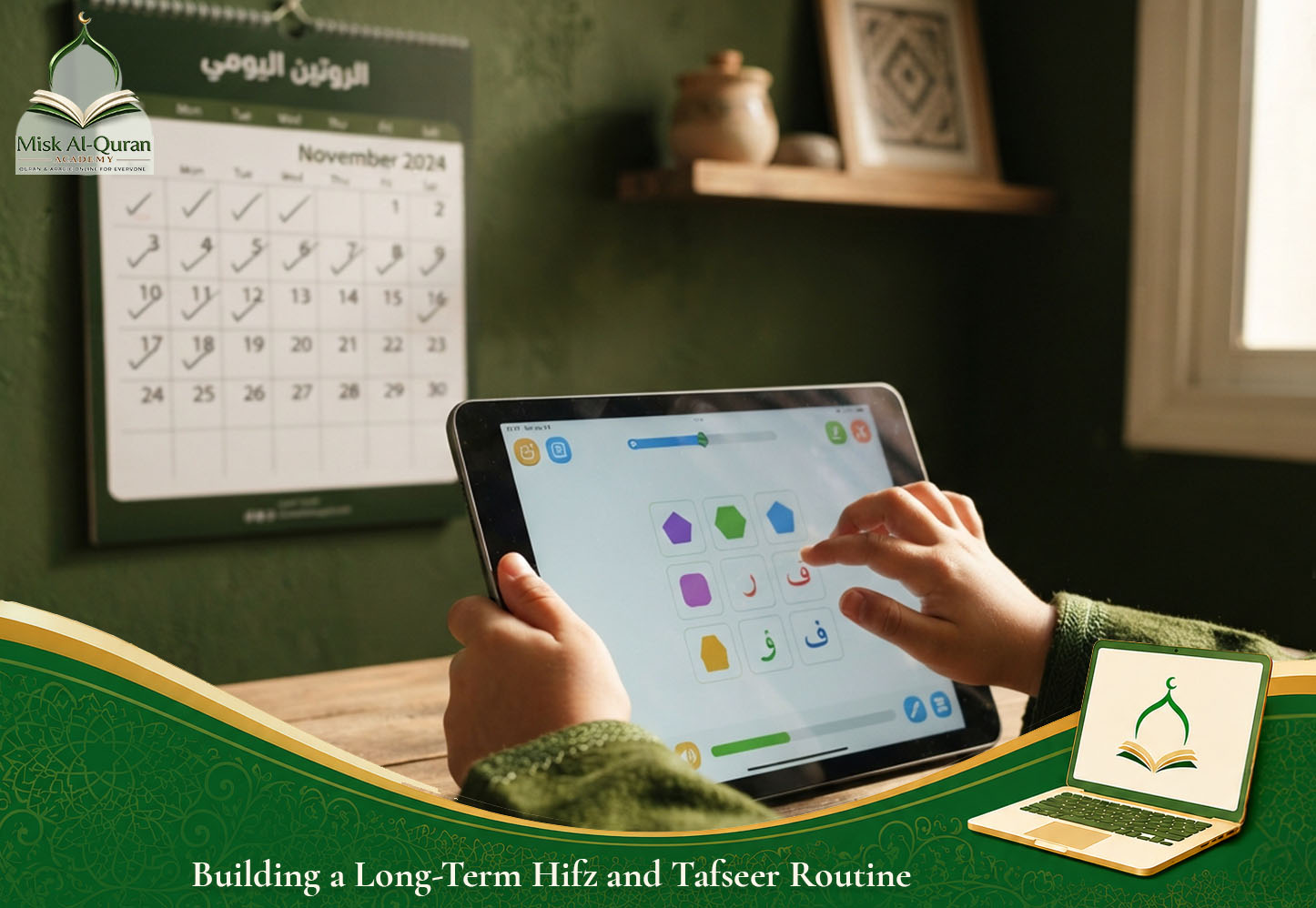
A successful Quran routine should be realistic, flexible, and sustainable. The goal is to develop a habit that can continue for months and years.A practical routine might include:
- 10–15 minutes: New memorization.
- 10–20 minutes: Revision.
- 10 minutes: Recitation and Tajweed.
- 10–15 minutes: Understanding or Tafseer.
- A few minutes: Reflection and review.
These times are only examples and should be adjusted according to the learner’s circumstances.
Track Your Quran Learning Progress
Keep a simple record of memorized passages, revision needs, and Tafseer topics. This can help you identify weak areas and measure progress more accurately.
Keep Your Quran Routine Flexible
Busy periods are normal. If you cannot memorize new material on a particular day, spend a few minutes reviewing previous lessons instead.
Focus on Consistent Quran Learning
Consistency is more valuable than occasional intensive study. Regular practice helps students maintain memorization, improve recitation, and gradually develop deeper Quranic understanding.
Frequently Asked Questions About Hifz and Tafseer
Answers common questions about Quran memorization, Tafseer, learning methods, study time, and how both approaches can complement each other.
Can someone study Tafseer without knowing Arabic?
Yes. Beginners can use reliable translations and explanations in a language they understand. Learning Quranic Arabic later can provide access to additional linguistic details.
Should children memorize the Quran before studying Tafseer?
Not necessarily. Children can memorize short Surahs while learning simple explanations of their meanings. The depth of Tafseer should match their age and understanding.
Does completing Hifz qualify someone to teach Tafseer?
No. Hifz and Tafseer require different areas of knowledge. Teaching Tafseer requires appropriate Islamic scholarship, Arabic knowledge, and familiarity with reliable interpretive sources.
Can adults study Hifz while working full-time?
Yes. Adults can follow flexible memorization plans based on their available time. Consistent revision is particularly important when study time is limited.
What should I do if I keep forgetting memorized verses?
Reduce new memorization if necessary and increase revision. Reciting regularly to a qualified teacher can also help identify specific weaknesses and improve retention.
In conclusion, understanding the difference between Hifz and Tafseer helps students choose a Quran learning path that matches their goals. Hifz focuses on memorizing and retaining Quranic verses, while Tafseer focuses on understanding their meanings, context, lessons, and guidance.
Neither subject needs to replace the other. Memorization strengthens familiarity with the words of the Quran, while Tafseer helps learners understand the message behind those words.
For beginners, a gradual approach is often most practical. Build strong reading and recitation skills, establish a manageable memorization routine, and introduce Tafseer at an appropriate level. As knowledge develops, students can increase both their memorization and their understanding.
Ultimately, Quran learning is not simply about completing pages or lessons. The greater goal is to build a lasting relationship with the Quran through accurate recitation, meaningful understanding, regular practice, and sincere application of its guidance.