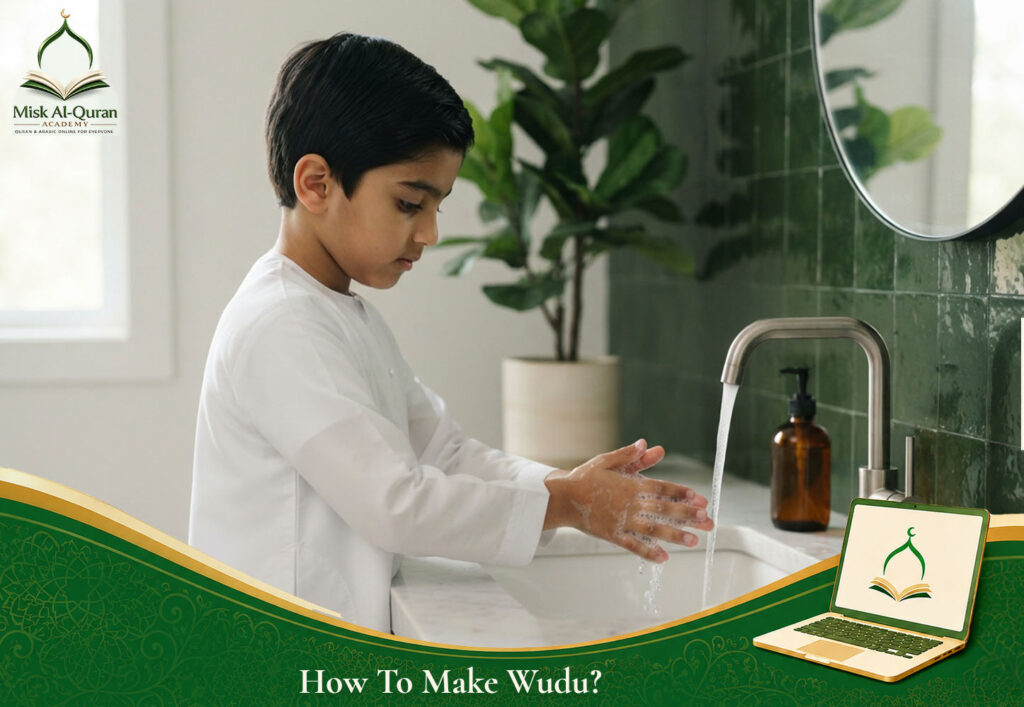
How to Make Wudu Correctly is an important skill for every Muslim who wants to prepare for salah with cleanliness and proper purification. Wudu is a specific form of ritual purification that involves washing and wiping particular parts of the body in an established order.
For someone learning how to pray for the first time, the process can seem unfamiliar. However, once the steps are understood and practiced regularly, wudu becomes a simple part of preparing for prayer. Misk Online Quran Academy can help beginners understand the practical steps of purification while learning how wudu connects with salah and other aspects of Quranic education.
This guide explains the process in a clear sequence, from making the intention to completing the final supplication. It also discusses what breaks wudu, common points that beginners may misunderstand, and the general principles behind wiping over footwear.
What Is Wudu and Why Is It Important?

Wudu is a ritual purification performed before certain acts of worship, particularly salah. It involves using clean water to wash specific areas of the body and wipe others according to the established practice of the Prophet Muhammad, peace and blessings be upon him.
For many Muslims, wudu is more than simply washing the body. It is also a moment to prepare mentally and spiritually for prayer. The physical actions encourage cleanliness, while the intention reminds the worshipper that they are preparing to stand before Allah.
The importance of purification is emphasized in Islamic teachings. The Prophet Muhammad, peace be upon him, taught that prayer is not accepted without purification. Therefore, learning how to Make Wudu correctly is an essential part of learning how to perform salah.
At the same time, beginners should understand that small differences can exist in the details of wudu among Islamic schools of jurisprudence. When studying the subject formally, it is useful to follow a qualified teacher or a recognized scholarly tradition consistently.
Start Your Quran Learning Journey with Misk Online Quran Academy
Begin your Quran learning journey with Misk Online Quran Academy, where students of all ages benefit from structured online Quran classes tailored to their individual level and learning needs.
Whether your goal is to improve Quran recitation, master Tajweed rules, or begin memorizing the Holy Quran, our experienced and qualified teachers provide clear step-by-step guidance through personalized one-to-one lessons. Each session is designed to help learners understand, practice, and improve with confidence and consistency.
With flexible scheduling, interactive teaching methods, and a supportive online environment, Misk Online Quran Academy makes it easier to stay committed and motivated. Students can learn comfortably from home while making steady progress in their Quran studies at their own pace.

How to Make Wudu Correctly: What Should You Prepare First?
Before beginning wudu, make sure you have access to clean water and a suitable place where you can perform the washing comfortably.
You do not need complicated equipment. In ordinary circumstances, the following are enough:
- Clean water suitable for purification.
- A place where the required body parts can be washed.
- The intention to perform purification.
- Enough time to complete the process without unnecessary rushing.
It is also useful to remove anything that prevents water from reaching the required areas. For example, a substance forming a waterproof barrier on the skin should be removed before washing that area.
Once everything is ready, you can begin the process calmly. Misk Online Quran Academy can introduce beginners to these practical details alongside broader lessons about prayer, Quran reading, and Islamic practice.
How to Make Wudu Correctly Easier for Children and New Muslims?
Children and new Muslims usually learn more effectively when they see wudu as a clear sequence instead of trying to memorize a long explanation.
You can divide the process into five simple groups:
- Intention and beginning.
- Hands, mouth, and nose.
- Face and arms.
- Head and ears.
- Feet and completion.
Once the learner understands these groups, encourage them to practice the complete process. A teacher can demonstrate each movement and correct mistakes during the lesson.
Visual learning can also help younger students understand the difference between washing and wiping. Instead of relying only on verbal instructions, show them which areas need water and how to avoid wasting it.
Misk Online Quran Academy can support this structured approach by combining explanation, demonstration, practice, and teacher feedback.
The goal should remain practical. A learner should gradually reach the point where they can perform wudu confidently without constantly checking written instructions.
Families can also strengthen this learning environment through age-appropriate Quran education, including resources such as What Are Easy Methods Of Learning Noorani Qaida For Kids?.
How to Make Wudu Correctly Without Wasting Water?
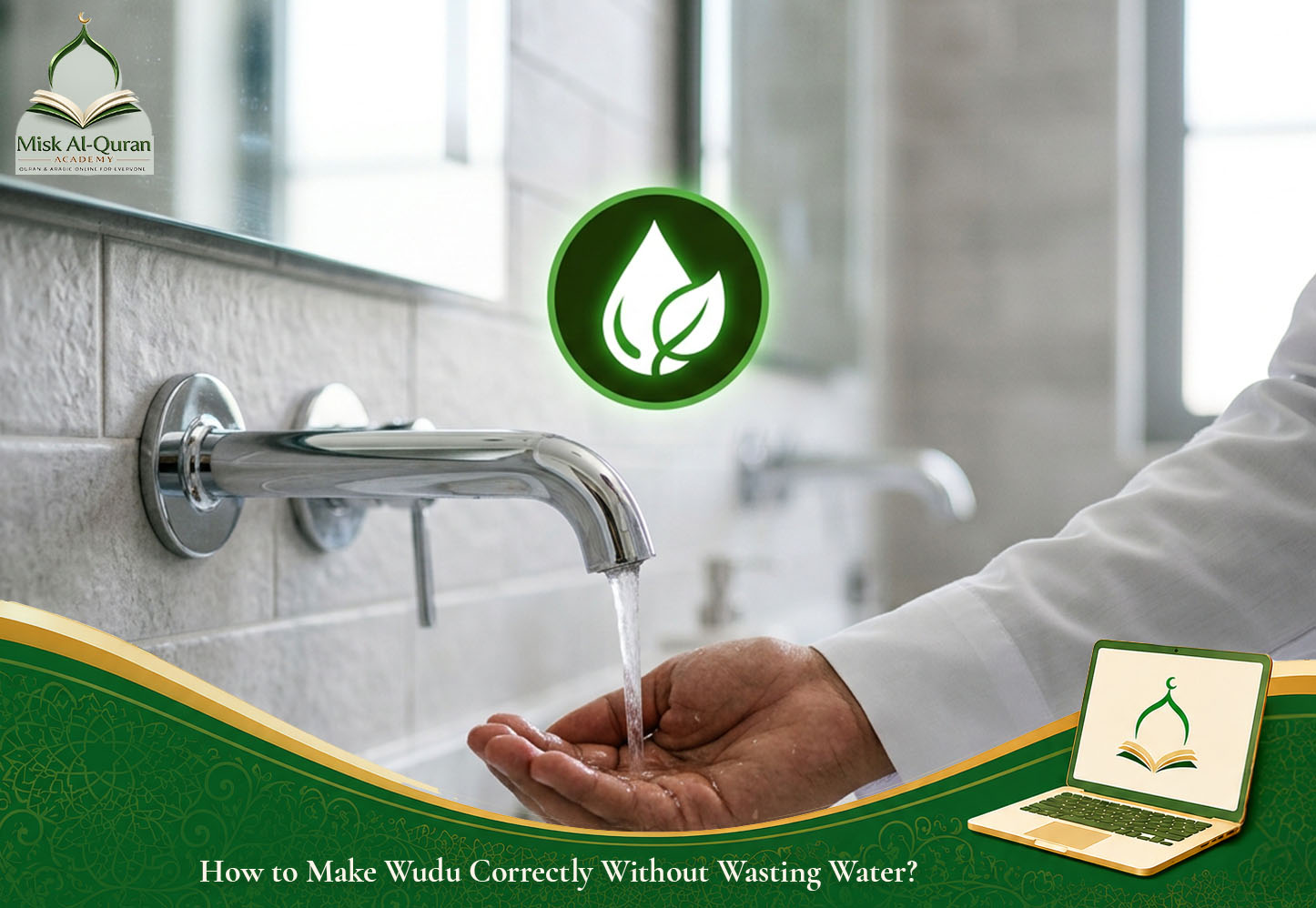
Cleanliness plays an important role in Islamic worship, but you do not need excessive water to complete wudu correctly. Instead, use enough water to cover the required areas and maintain a reasonable flow throughout the process.
A simple routine can help you avoid waste:
- Prepare everything before starting.
- Keep the water flow moderate.
- Wash each area carefully.
- Avoid unnecessary repetition.
- Check areas that water may easily miss.
- Finish the process without rushing.
This approach works particularly well for children because they may use too much water while learning the correct sequence. A teacher can demonstrate how much water they actually need and show them how to complete each action efficiently.
Parents can also support their children’s Islamic education by learning Tips for choosing the Right Online Quran Teacher and selecting an instructor who can explain religious practices clearly and patiently.
What Breaks Wudu?
Wudu remains valid until something occurs that Islamic law recognizes as an invalidating factor. The details can differ between recognized schools of jurisprudence, so students should learn specific rulings from a qualified teacher when necessary.
Common examples include:
- Urination or defecation.
- Passing wind.
- Losing consciousness.
- Deep sleep that removes awareness.
- Ejaculation, which also involves additional purification requirements.
However, ordinary activities such as eating, drinking, talking, walking, or working do not normally require you to repeat wudu.
You should also avoid assuming that every physical sensation invalidates your purification. When you face uncertainty about a particular situation, ask a qualified scholar rather than repeatedly performing wudu without knowing whether you actually need to do so.
How to Make Wudu Correctly Again When It Is Broken?
When something invalidates your wudu, perform purification again before the next prayer that requires it. You do not need to worry about having performed the previous wudu unnecessarily because renewing purification forms a normal part of preparing for worship.
A better approach involves learning the situations that actually invalidate wudu. This knowledge helps you distinguish between a genuine reason to repeat the process and an ordinary doubt.
For example, if you simply wonder whether something happened but have no certainty, do not immediately assume that your wudu ended. Islamic jurisprudence provides principles for dealing with doubt, although their application can vary depending on the circumstances and school of law.
New Muslims and young learners can benefit from structured Islamic instruction because a teacher can explain these situations in context. This makes How to Make Wudu Correctly easier to understand and reduces unnecessary confusion.
Can You Wipe Over Socks During Wudu?
Islamic jurisprudence permits wiping over certain types of footwear under specific conditions. However, the rules involve several details, including when the person put on the footwear, whether they had valid purification at that time, how the footwear covers the required area, and how long the permission remains valid.
For that reason, you should not assume that every type of sock automatically qualifies.
Generally, a person first completes wudu and puts on qualifying footwear while remaining in a state of purification. If the person later needs to renew wudu, they may have permission to wipe over the footwear instead of washing the feet, provided they meet the applicable conditions.
Different scholars discuss these requirements in different ways. Therefore, anyone who wants to rely on this concession should learn the relevant rules from a qualified Islamic teacher rather than applying a general rule to every type of footwear.
How to Make Wudu Correctly While Wearing Socks?
When your footwear meets the conditions for wiping, you can follow a different procedure when you reach the feet.
Instead of removing the qualifying footwear, wipe over its upper surface according to the method recognized by your school of jurisprudence. The permission does not simply allow someone to skip washing the feet whenever they prefer.
Before relying on this concession, learn:
- When you must put on the footwear.
- Which types of socks or footwear qualify.
- Which area you should wipe.
- How long the permission lasts.
- Which situations end the permission.
These details matter because the ruling contains conditions rather than a blanket permission for every kind of sock.
Misk Online Quran Academy can help students understand questions like these within a structured Islamic learning program while encouraging them to seek qualified guidance for detailed jurisprudential matters.Parents may also explore the benefits of taking online Quran classes for kids when deciding whether online learning suits their children’s needs.
Common Mistakes Beginners Make During Wudu
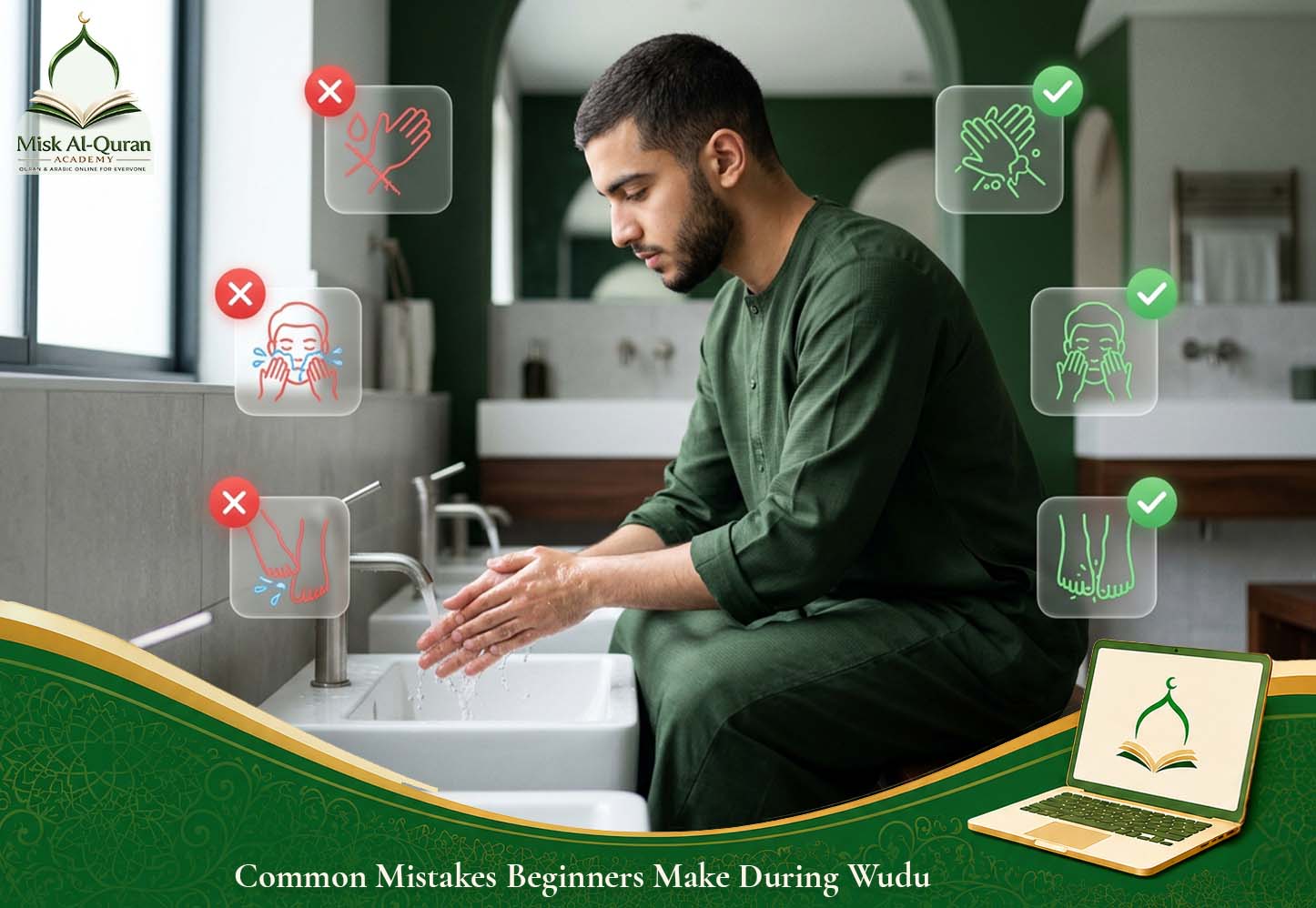
Learning how to make Wudu correctly becomes easier when you recognize common mistakes before they become habits. Beginners often concentrate on remembering the order while overlooking smaller practical details.
Rushing Through the Steps
Moving too quickly can leave some areas dry. Pay particular attention to the elbows, ankles, fingers, toes, and other areas that water may miss.
Using Too Much Water
A larger amount of water does not automatically improve purification. Use enough water to cover the required areas without turning wudu into a wasteful process.
Repeating Every Action Excessively
Follow the established number of repetitions instead of continuing to wash each area without a reason. This keeps the process simple and focused.
Forgetting the Sequence
Practice the steps in their proper order until they become familiar. A consistent routine helps beginners remember what comes next.
Leaving a Barrier on the Skin
Paint, adhesive substances, or another waterproof material can stop water from reaching the skin. Remove any barrier that prevents proper washing where applicable.
Allowing Doubts to Control the Process
Constantly repeating wudu because of minor doubts can make worship unnecessarily difficult. Learn the relevant principles for dealing with uncertainty and ask a qualified teacher when you need clarification.
How to Make Wudu Correctly?
Learn how to make Wudu correctly through simple, clear steps that help you perform this essential act of purification according to Islamic teachings.
Step 1 — Make the Intention
The first step is to have the intention to perform wudu for purification. The intention is an act of the heart rather than a special sentence that must be spoken aloud.
You should know internally why you are making wudu. For example, you may intend to purify yourself so that you can perform salah.
There is no requirement to announce your intention loudly. Instead, understand what you are doing and begin the purification process with that purpose in mind.
This point is particularly helpful for beginners because some new learners assume that every part of worship requires a specific spoken formula. In this case, the essential matter is the intention itself.
Step 2 — Say, Bismillah
After forming the intention, say Bismillah, meaning “In the name of Allah.”
This simple phrase marks the beginning of the act and reminds you that purification is being performed as an act of worship. You can say it quietly.
Some details concerning the ruling and status of saying Bismillah before wudu differ among scholars. Therefore, beginners should avoid becoming confused by discussions of minor jurisprudential differences. The important point is to learn a sound method from a trusted teacher and practice it consistently.
Step 3 — Wash Your Hands
Begin by washing your hands thoroughly. Wash the right hand and then the left hand, making sure water reaches the fingers, palms, backs of the hands, and wrists. Pay attention to areas where water might otherwise be blocked.
A common approach is to wash each hand three times. The number three is used in several washing steps of wudu, although repeating a washing action more than necessary should not become wasteful.
Make sure there is no material preventing water from reaching the skin. If something is stuck between the fingers or around the nails and blocks water, it should be addressed.
For children and beginners, this stage is easy to remember because it comes near the beginning of the process. Misk Online Quran Academy can use a step-by-step teaching method to help students memorize the sequence without making the lesson unnecessarily complicated.
Step 4 — Rinse the Mouth
Next, rinse your mouth with water. Take water and move it around the mouth before expelling it. The purpose is to clean the mouth as part of the purification process.
You should perform this carefully without using more water than necessary. A beginner does not need to make the action difficult or uncomfortable.
The mouth-rinsing step also demonstrates why wudu should be approached with attention rather than performed automatically. Each action has a specific place in the sequence.
Step 5 — Clean the Nose
After rinsing the mouth, clean the nostrils with water. Water is gently drawn into the nose and then expelled. This should be done carefully, especially for children or anyone who finds the sensation uncomfortable.
There is no need to force water deeply into the nose. The goal is to perform the purification properly while avoiding harm or unnecessary discomfort.
The Prophet Muhammad, peace be upon him, taught the practice of cleaning the nose during purification. Therefore, learning how to make Wudu correctly includes understanding both the sequence and the practical way to perform each action safely.
Step 6 — Wash the Face
The next major area is the face. Wash the face so that water reaches the required area, generally from the hairline to the chin and from one side of the face to the other. Be careful around the edges because beginners sometimes wash only the center of the face.
If you have facial hair, make sure you understand how your particular school of jurisprudence treats thick and thin facial hair. Some details concerning the beard differ between scholars, so following qualified instruction is preferable when there is uncertainty.
The face is commonly washed three times in the established method, although excessive repetition should be avoided.
At this point, the sequence becomes easier to remember: hands, mouth, nose, and then face.
Step 7 — Wash the Arms
After washing the face, wash the arms, beginning with the right arm. Water should reach from the fingertips through the hand and up to and including the elbows. Pay attention to the area around the elbow because stopping below it would leave part of the required area unwashed.
Repeat the process with the left arm. Each arm is commonly washed three times. However, the purpose is not to use as much water as possible. The goal is to make sure the entire required area is properly washed.
Jewelry, watches, bracelets, or other objects should not prevent water from reaching the skin when they cover an area that needs to be washed.
Step 8 — Wipe the Head
The next action is different from the previous washing steps. Instead of washing the head repeatedly, wipe the head with wet hands.
Wet your hands and pass them over the head according to the method taught by your school of jurisprudence. This action is generally performed once. It is important to distinguish between washing and wiping because they are not identical actions in wudu.
Hair length does not mean that a person needs to wash the hair repeatedly. Whether someone has short hair, long hair, or little or no hair, they should follow the established method for wiping the head.
Learning this distinction makes How to Make Wudu easier because it prevents beginners from treating every body part in exactly the same way.
Step 9 — Wipe the Ears
The ears are commonly wiped after the head as part of the purification sequence. Use wet fingers to wipe the appropriate parts of the ears according to the method you have been taught. Many teachers explain this as using the index fingers for the inner portions and the thumbs for the outer or rear portions.
There are differences among scholars concerning some details related to wiping the ears, including whether it is treated independently or together with the head. Therefore, beginners should follow a reliable instructional tradition instead of becoming distracted by minor disagreements.
The main goal is to learn a consistent method and understand why each action belongs in the sequence.
Step 10 — Wash the Feet
The final washing stage focuses on the feet. Start with the right foot and wash it carefully from the toes to the ankle. Make sure water reaches the spaces between the toes, around the heel, and across every area that needs washing.
Next, wash the left foot in the same way. Many Muslims wash each foot three times as part of the established practice. However, focus on covering the required areas rather than using excessive water or repeating the action without purpose.
Beginners should take a little extra care during this step because the toes, heels, and areas around the ankles can easily remain dry. Move your fingers between the toes when necessary and check the back of the ankle before moving on.
For children who are still learning Islamic practices, parents can use practical resources such as Best age to start Quran memorization to build a broader foundation in Quran learning and daily worship.
Once you finish both feet, you have completed the main physical actions of wudu.
Step 11 — Complete the Wudu
After finishing the physical steps, you can complete your wudu with the testimony of faith and a supplication associated with purification.
A commonly recited testimony says:
“I bear witness that there is no deity worthy of worship except Allah, and I bear witness that Muhammad is His servant and Messenger.”
A well-known supplication asks Allah to make the worshipper among those who repent and those who purify themselves.
When you finish, you can prepare for salah. At this point, you should understand the complete sequence rather than memorize individual actions without knowing where they belong.
Learning about purification also fits naturally into broader Islamic education. For example, understanding What Is The Third Pillar Of Islam? can help beginners connect individual acts of worship with the wider foundations of Islam.
How to Make Wudu Correctly Part of Your Daily Prayer Routine?

Once you understand the process, wudu can become a natural part of preparing for salah. Rather than treating every occasion as a new lesson, follow the same sequence each time until the movements become familiar.
You can also use these moments to shift your attention away from daily distractions. Take your time, focus on the purification process, and prepare yourself mentally for prayer.
For students who study the Quran and salah together, this routine creates a useful connection between knowledge and practice. Wudu prepares the worshipper for salah, while regular prayer reinforces the importance of maintaining that preparation.
If you remain uncertain about a specific ruling, ask a qualified teacher instead of relying on random online explanations. Misk Online Quran Academy can provide structured Islamic learning that helps students develop their Quran knowledge alongside practical understanding of worship.
Frequently Asked Questions About How to Make Wudu Correctly
The following frequently asked questions about How to Make Wudu Correctly address common concerns and help beginners understand the essential steps and rules of wudu.
1. Can I Make Wudu Before the Prayer Time Begins?
Yes. You can generally perform wudu before the prayer time begins and remain in a state of purification until something invalidates it. However, specific situations may require individual guidance, especially when questions about ongoing conditions arise.
2. Do I Need to Repeat Wudu for Every Prayer?
No. You do not normally need a new wudu for every prayer if your previous purification remains valid. You only need to renew it when an event occurs that invalidates your wudu.
3. Can I Perform Wudu With Very Little Water?
Yes. You do not need a large amount of water to perform wudu. Use enough water to wash the required areas properly while avoiding unnecessary waste.
4. What Should I Do If I Forget One Step of Wudu?
The answer depends on which step you missed, when you remembered it, and the school of jurisprudence you follow. When the situation is unclear, ask a qualified scholar who can consider the details instead of applying a general answer to your specific case.
In conclusion, how to Make Wudu Correctly becomes much easier once you understand the sequence and practice it regularly. The process moves from the initial intention through the washing of the hands, mouth, nose, face, arms, and feet, along with wiping the head and ears according to the method you follow.
The objective goes beyond memorizing a checklist. You should understand how purification prepares you for salah and learn to perform each action carefully without unnecessary repetition or water waste.
Beginners should also recognize that some detailed rulings differ among recognized schools of Islamic jurisprudence. When a particular situation raises a question, qualified guidance can provide the clarity you need.
With regular practice, the sequence becomes familiar and comfortable. Misk Online Quran Academy can help learners build a stronger foundation in Quran reading, Islamic studies, and practical knowledge related to worship.
Ultimately, approach wudu with sincerity, cleanliness, moderation, and attention. A clear understanding of the steps allows you to prepare for salah confidently and make purification a natural part of your daily worship.