Qirat, meaning in Islam, refers to the authentic methods of reciting the Holy Quran that Allah preserved through the Prophet Muhammad (peace be upon him) and transmitted through reliable chains of narration. Every accepted Qirat follows precise rules of pronunciation, articulation, pauses, and elongation while preserving the exact words and message of the Quran. Although the recitation styles may differ slightly in pronunciation or dialect, they never alter the meaning of Allah’s revelation.
At Misk Online Quran Academy, experienced teachers guide students through authentic Quran recitation using structured lessons designed for beginners and advanced learners alike. As a result, students develop confidence while mastering Quran reading according to authentic Islamic tradition.
What Does Qirat Mean in Islam?
Understanding Qirat’s meaning in Islam begins with understanding the Arabic word itself. Linguistically, Qiraah means reading or reciting. However, within Islamic studies, the term has a much deeper meaning. Find reliable online Quran teachers who can provide personalized lessons and help students improve their Quran reading, memorization, and recitation skills.
It refers to the authentic methods of reciting the Quran that Prophet Muhammad (peace be upon him) taught to his companions. These methods were carefully transmitted through uninterrupted chains of trustworthy narrators until they reached Muslims today.
Consequently, every authentic Qirat remains directly connected to the Prophet. Explore an online Quran academy UK to learn more about flexible Quran education options for students and families living in the UK.
Unlike personal reading styles or regional accents, authentic Qirat are based entirely on revelation and verified scholarly transmission. Each recitation follows established rules that Muslim scholars have preserved with exceptional care for centuries. In simple terms, the meaning in Islam includes:
- Authentic methods of Quran recitation.
- Correct pronunciation transmitted from the Prophet.
- Specific rules for articulation, pauses, and elongation.
- Accepted recitation styles that preserve one Quranic revelation.
- A respected branch of Islamic scholarship.
Furthermore, every authentic Qirat conveys the same Quranic message. The differences appear only in pronunciation, vowelization, dialectical expressions, or elongation without affecting Islamic beliefs or the meanings of the verses. Therefore, Muslims can confidently recite any authentic Qirat while knowing they are reading the same Quran revealed by Allah.
Start Your Quran Learning Journey with Misk Online Quran Academy
Begin your Quran learning journey with Misk Online Quran Academy, where students of all ages benefit from structured online Quran classes tailored to their individual level and learning needs.
Whether your goal is to improve Quran recitation, master Tajweed rules, or begin memorizing the Holy Quran, our experienced and qualified teachers provide clear step-by-step guidance through personalized one-to-one lessons. Each session is designed to help learners understand, practice, and improve with confidence and consistency. For learners who want to go further, take a look at our Tajweed classes.
With flexible scheduling, interactive teaching methods, and a supportive online environment, Misk Online Quran Academy makes it easier to stay committed and motivated. Students can learn comfortably from home while making steady progress in their Quran studies at their own pace.

Why Is Understanding Qirat Meaning in Islam Important?
Many Muslims focus on learning Tajweed but spend little time understanding the science behind authentic Quranic recitation.
However, studying Qirat meaning in Islam offers numerous spiritual and educational benefits. Discover the Benefits of Online Quran Learning and see how online lessons can make Quran education more flexible, accessible, and convenient for different learners.
First, it strengthens confidence in the miraculous preservation of the Quran. Instead of assuming that different recitations create contradictions, students discover that every authentic Qirat confirms the perfection of Allah’s revelation. Learn whether is online quran learning safe for kids and what parents should consider when choosing a secure and suitable online learning environment for their children.
Additionally, learning Qirat develops more accurate pronunciation because students become more attentive to every letter, pause, and sound. Consequently, their overall Quran recitation improves significantly. Understand how to get ijazah online and learn about the general steps involved in studying with a qualified teacher and completing an online Quran certification pathway.
Furthermore, studying authentic Qirat allows Muslims to appreciate the richness of classical Arabic. Since every authentic recitation highlights unique linguistic features, learners gradually recognize the beauty and flexibility of the Quranic language. Some of the major benefits include:
- Improving Quran pronunciation.
- Strengthening Tajweed application.
- Building confidence during recitation.
- Understanding how the Quran was preserved.
- Appreciating the diversity of authentic Quranic recitation.
- Developing a stronger spiritual connection with Allah’s Book.
Moreover, students who understand the meaning in Islam often approach Quran memorization with greater awareness. Rather than memorizing verses mechanically, they appreciate every pronunciation detail and every linguistic feature preserved throughout Islamic history.
At Misk Online Quran Academy, teachers introduce these concepts gradually. Students first master Quran reading, then strengthen their Tajweed skills, and finally study authentic Qirat according to their goals and experience.
Qirat Meaning in Islam vs Tajweed: What’s the Difference?
Many beginners mistakenly believe that Tajweed and Qirat refer to the same science because both relate to Quran recitation. In reality, each has a different purpose, although they complement one another perfectly.
Tajweed teaches Muslims how to pronounce every Arabic letter correctly by focusing on articulation points, letter characteristics, nasal sounds, stopping rules, and elongation. Discover the benefits of listening to quran and how regular listening can become a meaningful part of a consistent Quran routine.
By contrast, Qirat, meaning ” recitation ” in Islam, refers to the authentic recitation method a Muslim follows while reading the Quran. Every accepted Qirat applies Tajweed rules, yet each includes unique pronunciation features transmitted directly from the Prophet Muhammad (peace be upon him).
Therefore, Tajweed explains how to recite correctly, while Qirat explains which authentic method of recitation is being followed.
| Tajweed | Qirat |
|---|---|
| Focuses on pronunciation rules | Focuses on authentic recitation methods |
| Required for every Muslim who recites the Quran | Usually studied after mastering Tajweed |
| Applies to every authentic recitation | Each Qirat has unique transmitted characteristics |
| Improves pronunciation accuracy | Preserves authentic prophetic recitation |
For this reason, scholars recommend mastering Tajweed before studying multiple Qirat. This gradual approach helps students build a strong foundation while avoiding confusion.
Likewise, teachers at Misk Online Quran Academy follow this structured learning path by guiding students from basic Quran reading to Tajweed mastery before introducing authentic Qirat.
Why Is Qirat Meaning in Islam an Important Islamic Science?
The science of Qirat, meaning in Islam, occupies a distinguished place in Islamic scholarship because it safeguards one of Allah’s greatest blessings—the Holy Quran.
Unlike many sciences that developed through personal reasoning, Qirat has been preserved through direct oral transmission from one qualified teacher to another until the chain reaches the Prophet Muhammad (peace be upon him). As a result, Muslims today recite the Quran exactly as it was taught more than fourteen centuries ago.
Moreover, scholars established strict conditions before accepting any recitation as authentic. They carefully verified every chain of narration, examined the reliability of each narrator, confirmed compatibility with the Uthmanic Mushaf, and ensured agreement with the rules of classical Arabic.
For this reason, studying Qirat meaning in Islam goes beyond improving recitation. It introduces students to the remarkable efforts Muslim scholars invested in preserving every word of Allah’s revelation without alteration. Explore what is qiraat in the quran to understand the concept of Quranic readings and learn more about this important area of Quranic studies.
Furthermore, understanding this science strengthens faith in the authenticity of the Quran. Instead of viewing different recitation styles as contradictions, Muslims recognize them as evidence of Allah’s wisdom and the extraordinary preservation of His Book.
What Are the Types of Qirat Meanings in Islam?
To fully understand the meaning in Islam, it is essential to learn about the authentic types of Qirat and the wisdom behind their preservation.
Many Muslims assume that there is only one way to recite the Quran. However, Allah preserved several authentic methods of recitation, each transmitted through reliable chains of narration from the Prophet Muhammad (peace be upon him).
Although these Qirat differ in pronunciation, vowelization, pauses, and some linguistic forms, they all preserve the same Quran and convey the same divine guidance. Their differences enrich the recitation without changing the meaning of the revelation.
Furthermore, Muslim scholars spent centuries verifying every accepted recitation. Only those that fulfilled strict scholarly conditions were recognized as authentic. Consequently, Muslims can study these Qirat with complete confidence.
Today, scholars recognize ten canonical Qirat, while the first seven became the most widely known through the work of Imam Ibn Mujahid. Later, three additional authentic Qirat were confirmed after scholars verified their chains of narration. Learning these authentic recitations offers several important benefits:
- Improves Quran recitation.
- Strengthens Tajweed skills.
- Highlights the richness of classical Arabic.
- Deepens appreciation for Quran preservation.
- Introduces students to one of Islam’s greatest scholarly traditions.
Therefore, studying the different types of Qirat meaning in Islam is an important step for anyone seeking a deeper understanding of the Quran. Prepare for Ramadan with how to prepare for Ramadan with quran by creating a practical routine for reading, listening, reflection, and memorization.
The Seven Authentic Qirat Meanings in Islam Every Muslim Should Know
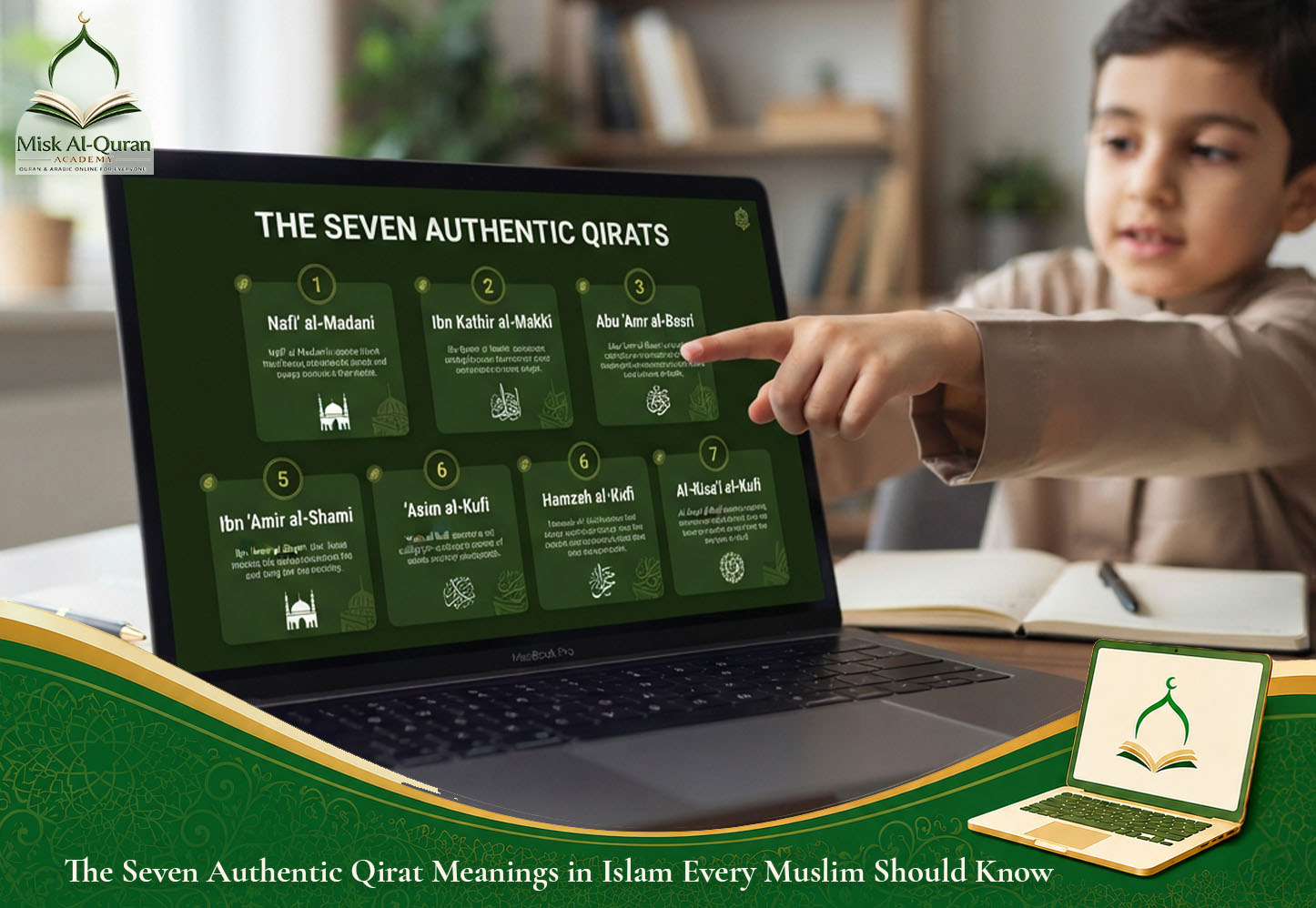
Although Islamic scholars recognize ten authentic Qirat today, seven recitation methods remain the most widely studied throughout the Muslim world. Each Qirat is named after the renowned Imam who preserved and taught that particular recitation. Compare online quran classes vs local madrasa to understand the differences between online Quran education and traditional local learning environments.
Moreover, every one of these recitations traces back through an authentic chain of narration to the Prophet Muhammad (peace be upon him). Consequently, Muslims may recite any of them with complete confidence. Understand the difference between hifz and tafseer to distinguish between memorizing the Quran and studying its meanings and interpretation.
1. Qirat of Nafi’ Al-Madani
Nafi’ Al-Madani was one of the leading Quran reciters of Madinah. His students later spread his recitation throughout North and West Africa, particularly through the narrations of Warsh and Qalun. This Qirat is known for:
- Smooth pronunciation.
- Balanced rhythm.
- Clear articulation.
- Strong historical significance.
Even today, Muslims in Morocco, Algeria, Tunisia, Libya, and many West African countries continue to recite according to this tradition. Learn how to choose an online quran teacher for your child by considering teaching experience, communication, lesson structure, and your child’s individual learning needs.
2. Qirat of Ibn Kathir Al-Makki
Ibn Kathir became one of the most respected Quran scholars in Makkah. His recitation is recognized for:
- Accurate pronunciation.
- Strong adherence to early Makkan traditions.
- Beautiful rhythmic flow.
- Precise Tajweed application.
Furthermore, the narrators, Al-Buzzi and Qunbul, carefully preserved this authentic recitation for future generations. Discover how long does it take to memorize the quran and the main factors that can influence the time required to complete Quran memorization.
3. Qirat of Abu Amr Al-Basri
Abu Amr gained widespread recognition in Basra because of his exceptional mastery of Quran recitation. Students appreciate this Qirat because it offers:
- Gentle pronunciation.
- Smooth transitions.
- Excellent recitation rhythm.
- Consistent application of recitation rules.
As a result, many advanced Quran students continue studying this Qirat in specialized Islamic institutions.
4. Qirat of Ibn Amir Ash-Shami
Ibn Amir taught Quran recitation throughout Ash-Sham and became one of the most respected scholars of his era. Its distinguishing features include:
- Distinct pronunciation patterns.
- Beautiful recitation flow.
- Strong scholarly heritage.
- Authentic prophetic transmission.
Moreover, this Qirat continues to be taught in advanced Quran programs around the world.
5. Qirat of Asim Al-Kufi
Among all authentic recitations, Hafs ‘an Asim remains the most commonly practiced throughout the Muslim world.
Today, millions of Muslims read the Quran according to this narration because it is widely taught in Quran schools and used in printed Mushafs. Its popularity comes from several important advantages:
- Easy pronunciation for beginners.
- Wide availability of qualified teachers.
- Extensive learning resources.
- Strong scholarly acceptance.
Therefore, many students exploring Qirat meaning in Islam begin with Hafs ‘an Asim before studying other authentic Qirat.
6. Qirat of Hamzah Al-Kufi
Hamzah’s recitation is famous for its remarkable precision in pronunciation and elongation. Students studying this Qirat develop stronger attention to detail by practicing:
- Accurate articulation.
- Controlled elongation.
- Advanced pronunciation techniques.
- Careful Tajweed application.
Consequently, experienced students often choose this recitation after mastering Hafs.
7. Qirat of Al-Kisa’i
Al-Kisa’i ranks among the greatest Quran scholars of Kufa. His recitation combines:
- Elegant pronunciation.
- Rich linguistic features.
- Strong historical authenticity.
- Outstanding educational value.
Overall, these seven authentic recitation methods beautifully demonstrate how Allah preserved His Book through multiple authentic forms of recitation while maintaining one unchanged revelation.
Why Do Different Qirat Exist in Islam?
After learning about the authentic recitation methods, many people naturally ask why multiple Qirat exist in the first place. The answer reflects Allah’s mercy and wisdom.
During the lifetime of the Prophet Muhammad (peace be upon him), Arab tribes spoke with slight variations in pronunciation and dialect. Therefore, Allah allowed the Quran to be recited through authentic forms that accommodated these linguistic differences while preserving the exact revelation.
Furthermore, as Islam spread across Arabia and beyond, the companions taught the Quran exactly as they had learned it from the Prophet. Their students then continued transmitting every authentic recitation with extraordinary precision. Consequently, every accepted Qirat reached later generations through uninterrupted and trustworthy chains of narration. Although authentic Qirat differ in certain details, these variations are limited to:
- Pronunciation.
- Vowelization.
- Letter elongation.
- Pausing positions.
- Certain grammatical expressions.
However, they never contradict one another or alter Islamic beliefs, Quranic teachings, or legal rulings.
Instead, these differences highlight:
- The flexibility of classical Arabic.
- The miraculous preservation of the Quran.
- The precision of Islamic scholarship.
- Allah’s mercy toward different Arab dialects.
- The beauty and richness of Quranic recitation.
For this reason, understanding the meaning in Islam replaces confusion with confidence and helps Muslims appreciate one of the greatest miracles of Quran preservation.
How is the Qirat Meaning in Islam Preserved?
One of the most remarkable aspects of Qirat meaning in Islam is the extraordinary way Muslims have preserved every authentic recitation. Unlike many historical texts that changed over time, the Quran has remained protected through both memorization and written manuscripts. As a result, every accepted Qirat has reached Muslims today exactly as it was taught by Prophet Muhammad (peace be upon him).
From the very beginning, the Prophet recited the Quran to his companions, who memorized every verse with great care. Afterwards, they taught the next generation using the same pronunciation, pauses, and articulation they had learned. Consequently, every authentic Qirat continued through an uninterrupted chain of qualified teachers.
Moreover, Muslim scholars developed strict standards before accepting any recitation as authentic. An accepted Qirat must fulfill all of the following conditions:
- It must have an authentic chain of narration leading back to the Prophet Muhammad (peace be upon him).
- It must agree with the Uthmanic Mushaf.
- It must comply with the rules of classical Arabic.
- It must be accepted by recognized Quran scholars.
Therefore, scholars rejected every recitation that failed to meet these conditions. This careful verification protected the Quran from alteration while preserving every authentic method of recitation.
Furthermore, this preservation demonstrates the unique status of the Quran among all religious scriptures. Instead of relying solely on written documents, Muslims combined memorization, oral transmission, and written preservation. Consequently, millions of Muslims continue reciting the Quran today exactly as previous generations did.
Who preserved the Qirat Meaning in Islam?
Although Prophet Muhammad (peace be upon him) taught the authentic recitations, generations of dedicated scholars worked tirelessly to preserve and document this knowledge. Their efforts allow Muslims today to study Qirat, meaning in Islam, with complete confidence.
Rather than introducing new recitation methods, these scholars carefully recorded the authentic recitations transmitted through reliable teachers across the Islamic world.
Among the most influential scholars are:
Imam Abu Bakr Ibn Mujahid
Imam Ibn Mujahid organized the seven famous canonical Qirat into a systematic field of study. Consequently, students could easily distinguish authentic recitations from weak or unsupported narrations.
His work continues to influence Quran studies today because it established a clear framework for learning authentic Qirat.
Imam Al-Shatibi
Imam Al-Shatibi authored the famous poem Ash-Shatibiyyah, which summarizes the rules of the seven canonical Qirat in an easy-to-memorize format.
Even today, thousands of Quran students memorize this poem before studying advanced Qirat. Therefore, his contribution remains one of the most valuable resources in Quranic education.
Imam Ibn Al-Jazari
Later, Imam Ibn Al-Jazari expanded the study of Qirat by confirming three additional authentic recitations. As a result, Muslims now recognize ten canonical Qirat.
Moreover, his books remain among the most trusted references because they explain both Tajweed and Qirat with exceptional detail.
Thanks to the dedication of these scholars, authentic Quran recitation has been preserved for every generation.
Which Qirat Meaning in Islam Is Most Common Today?
Although every authentic Qirat remains valid, one narration has become far more widespread than the others.
Today, the narration of Hafs ‘an Asim is the most commonly used throughout the Muslim world. In fact, the majority of printed Mushafs, Quran schools, Islamic universities, and online Quran programs teach this narration.
Several reasons explain its widespread popularity:
- Most educational institutions teach Hafs first.
- Printed Mushafs generally follow Hafs.
- Qualified teachers are widely available.
- Beginners usually find it easier to learn.
Nevertheless, other authentic narrations continue to flourish in different regions.
| Country or Region | Common Qirat |
|---|---|
| Egypt | Hafs ‘an Asim |
| Saudi Arabia | Hafs ‘an Asim |
| Turkey | Hafs ‘an Asim |
| Pakistan | Hafs ‘an Asim |
| Morocco | Warsh ‘an Nafi’ |
| Algeria | Warsh ‘an Nafi’ |
| Mauritania | Warsh ‘an Nafi’ and others |
| Parts of Sudan | Al-Duri ‘an Abu Amr |
Therefore, regional differences simply reflect educational traditions rather than differences in belief. Every authentic Qirat preserves the same Quran and the same divine guidance.
Can Beginners Learn Qirat Meaning in Islam?
Many learners assume that only advanced scholars can study Qirat. However, this misconception is far from the truth.
In reality, anyone can begin learning the meaning in Islam with proper guidance. Nevertheless, students should first establish a solid foundation before studying multiple recitation methods. Most Quran teachers recommend the following learning path:
- Learn Quran Reading: Begin by recognizing Arabic letters and reading Quranic words fluently.
- Master Tajweed: Next, learn how to pronounce every Arabic letter correctly while applying the rules of Tajweed.
- Study One Authentic Narration: Most beginners start with Hafs ‘an Asim, as it is the most widely taught narration around the world.
- Practice Consistently: Consistency is essential for success. Students should:
1. Read the Quran every day.
2. Review previous lessons regularly.
3. Listen to qualified Qaris.
4. Practice under teacher supervision.
5. Correct mistakes immediately. - Explore Additional Qirat: After mastering one narration, students can gradually learn other authentic Qirat under qualified instructors.
At Misk Online Quran Academy, teachers personalize every lesson according to the student’s experience. Consequently, beginners learn comfortably while advanced students continue developing their recitation skills without feeling overwhelmed.
Common Misconceptions About Qirat Meaning in Islam
As interest in Quran studies continues to grow, several misconceptions about the meaning of Islam frequently appear online. Fortunately, understanding the facts helps remove confusion.
- Different Qirat Mean Different Qurans: This statement is incorrect. Every authentic Qirat belongs to the same Quran revealed by Allah. Although pronunciation may differ slightly, the revelation itself never changes.
- Only Scholars Can Study Qirat Meaning in Islam: Many people believe that Qirat is reserved for specialists. However, any Muslim can begin learning the fundamentals under qualified teachers. Afterwards, students can gradually progress toward advanced studies.
- Learning Qirat Has No Practical Benefit: On the contrary, studying Qirat improves pronunciation, strengthens Tajweed, deepens Quran understanding, and increases appreciation for Islamic scholarship. Moreover, many students become more confident during recitation after studying authentic Qirat.
- Every Beautiful Recitation Is a Qirat: Although many reciters have beautiful voices, not every style qualifies as an authentic Qirat. Instead, scholars recognize only those recitations that fulfill the accepted conditions of authenticity. Therefore, Muslims should always study Qirat under qualified teachers rather than relying on personal interpretation.
Benefits of Learning Qirat Meaning in Islam
Studying Qirat’s meaning in Islam offers much more than learning different ways to recite the Quran. It strengthens faith, improves recitation, enhances Tajweed skills, and increases appreciation for the miraculous preservation of Allah’s Book. Moreover, learning authentic Qirat connects students with one of the richest scholarly traditions in Islamic history.
Whether your goal is to improve your daily recitation, memorize the Quran, or pursue advanced Islamic studies, understanding the meaning in Islam provides lifelong spiritual and educational benefits.
How Qirat Meaning in Islam Strengthens Your Connection with the Quran
One of the greatest benefits of learning the meaning in Islam is developing a stronger relationship with the Quran. Instead of reading verses mechanically, students become more attentive to pronunciation, articulation, pauses, and the beauty of every recitation, encouraging deeper Quranic and self-reflection.
As a result, Quran recitation becomes more meaningful, reflective, and spiritually rewarding. Furthermore, many learners notice that they contemplate the meanings of the verses more deeply as their recitation improves.
How Qirat Meaning in Islam Improves Quran Recitation
Another significant advantage is the noticeable improvement in Quran pronunciation. As students study authentic Qirat, they gradually learn how to:
- Pronounce every Arabic letter accurately.
- Apply Tajweed rules correctly.
- Control elongation and pauses.
- Develop a smoother and more confident recitation.
Consequently, they recite the Quran with greater precision while avoiding many common pronunciation mistakes.
How Qirat Meaning in Islam Supports Tajweed Mastery
Although Tajweed and Qirat are separate sciences, they complement each other perfectly.
Studying Qirat meaning in Islam reinforces Tajweed rules because students learn how authentic recitation methods apply those rules in practical situations.
Therefore, learners become more attentive to pronunciation details while strengthening their overall recitation skills.
How Qirat Meaning in Islam Demonstrates Quran Preservation
Many Muslims know that Allah has preserved the Quran. However, studying the Qirat’s meaning in Islam explains exactly how this miraculous preservation has continued across generations.
Students discover the importance of:
- Authentic chains of narration.
- Oral transmission.
- Written preservation.
- Scholarly verification.
- Continuous teaching from qualified instructors.
As a result, their confidence in the authenticity of the Quran grows even stronger.
How Qirat Meaning in Islam Enhances Classical Arabic Skills
Another valuable benefit is gaining a deeper appreciation for classical Arabic.
Every authentic Qirat showcases the richness and flexibility of the Arabic language. Although each recitation preserves the same meaning, slight linguistic variations help learners appreciate the eloquence of the Quran.
Consequently, many students also improve their understanding of Arabic while studying authentic Qirat.
How Qirat Meaning in Islam Builds Confidence During Recitation
Finally, regular study under qualified teachers helps students recite confidently in different settings.
Whether reading at home, in the mosque, or during community gatherings, learners feel reassured because they know they are following authentic methods of Quran recitation. These experiences also highlight the many benefits of reciting the Quran consistently throughout life.
How to Learn Qirat Meaning in Islam Successfully?
After understanding the meaning in Islam, many students wonder how they should begin their learning journey.
Fortunately, following a structured plan makes the process much easier. Families seeking quality instruction often choose the Best online Quran classes for kids as well as programs for adults, allowing learners of every age to build their knowledge step by step.
Build a Strong Foundation Before Learning Qirat Meaning in Islam
Before studying different Qirat, every learner should master the basics of Quran recitation.
This foundation includes:
- Reading Arabic fluently.
- Recognizing Quranic vocabulary.
- Applying Tajweed correctly.
- Reading the Quran confidently.
Without these essential skills, advanced Qirat studies become much more challenging.
Start with One Authentic Qirat Meaning in Islam Narration
Students should first master one authentic narration before exploring others.
Since Hafs ‘an Asim remains the most widely taught narration across the Muslim world, it provides the ideal starting point for beginners.
Moreover, mastering one narration first helps prevent confusion later.
Learn Qirat Meaning in Islam from Qualified Teachers
Authentic Qirat depends on direct oral transmission.
Therefore, students should always study under experienced Quran teachers who can:
- Listen carefully to their recitation.
- Correct pronunciation mistakes.
- Explain differences between authentic Qirat.
- Monitor learning progress.
- Build confidence through continuous guidance.
Consequently, learners improve much faster than those studying entirely on their own.
Practice Qirat Meaning in Islam Every Day
Consistency is more important than studying for long hours occasionally.
Instead, students should aim to:
- Recite the Quran daily.
- Review previous lessons.
- Listen to skilled Qaris.
- Record their recitation.
- Apply teacher corrections immediately.
As a result, pronunciation and fluency improve steadily over time.
Continue Expanding Your Knowledge of Qirat Meaning in Islam
After mastering one narration, students can gradually begin studying additional authentic Qirat.
However, they should avoid rushing through the learning process. Instead, they should focus on understanding each narration thoroughly before moving to the next.
This gradual approach leads to stronger long-term progress while reducing confusion.
Learn Qirat Meaning in Islam at Misk Online Quran Academy
Choosing the right teacher plays a vital role in every Quran learning journey. Therefore, students should select an academy that combines qualified instructors, structured lessons, and personalized guidance.
Misk Online Quran Academy offers a comprehensive learning experience for children, teenagers, and adults around the world. Flexible online classes make it easy for students to learn according to their schedules and personal goals. Students at Misk Online Quran Academy benefit from:
- Certified Quran and Qirat teachers.
- One-to-one live online classes.
- Flexible scheduling.
- Personalized study plans.
- Interactive learning sessions.
- Continuous progress evaluations.
- Tajweed and Qirat courses for every level.
- Lessons designed for beginners and advanced learners.
Whether you want to improve your daily recitation, memorize the Quran, or master authentic Qirat, Misk Online Quran Academy provides the guidance needed to achieve your goals.
Frequently Asked Questions About Qirat Meaning in Islam
Below are answers to some of the most common questions about the meaning in Islam. These FAQs provide additional insights that help learners better understand authentic Quran recitation.
Can I Learn Qirat Meaning in Islam Online?
Yes. Many students successfully learn authentic Qirat through live online classes. However, it is essential to study with qualified teachers who provide direct feedback and correct pronunciation throughout the learning process.
Which Qirat Should I Learn First?
Most teachers recommend beginning with Hafs ‘an Asim because it is the most widely taught narration across the Muslim world. After mastering it, students can gradually explore other authentic Qirat.
Does Learning Qirat Meaning in Islam Help with Quran Memorization?
Absolutely. Studying authentic Qirat improves pronunciation, strengthens concentration, and encourages more accurate revision. Consequently, many students memorize the Quran with greater confidence and fewer mistakes.
How Long Does It Take to Master One Qirat?
The answer depends on your previous Quran experience, consistency, and study schedule. Students who already read the Quran fluently and apply Tajweed correctly often progress more quickly. Nevertheless, regular practice and qualified instruction remain the most important factors for long-term success.
In conclusion, understanding Qirat meaning in Islam allows Muslims to appreciate one of the greatest miracles of Quran preservation. Authentic Qirat do not represent different versions of the Quran. Instead, they preserve the authentic methods of recitation taught by the Prophet Muhammad (peace be upon him) and faithfully transmitted through reliable generations of scholars.
Moreover, learning Qirat meaning in Islam improves pronunciation, strengthens Tajweed, deepens appreciation for classical Arabic, and builds a closer relationship with the Book of Allah. At the same time, it introduces students to centuries of Islamic scholarship dedicated to preserving every word of the Quran with extraordinary precision.
If you want to strengthen your Quran recitation and study authentic Qirat under experienced instructors, Misk Online Quran Academy provides an excellent learning environment. Through structured online classes, personalized guidance, and continuous support, students of every age can confidently master authentic Quran recitation while gaining a deeper understanding of Qirat meaning in Islam.