What is qiraat in the quran is a common question for Muslims who discover that the Quran has been transmitted through several authentic recitation traditions. At first, hearing different reciters pronounce certain words, vowels, or sounds in different ways may seem confusing. However, these differences follow established Quranic traditions and do not represent different versions of the Quran. Instead, they reflect authenticated methods of recitation that generations of qualified scholars and teachers carefully transmitted and taught.
Learning about Qiraat gives students a clearer understanding of the richness of Quranic recitation. It also helps them recognize the difference between an authentic Qiraah, a Tajweed rule, and an ordinary pronunciation mistake. Therefore, anyone interested in advanced Quran study should first build a strong foundation in Quran reading and Tajweed before exploring the details of different Qiraat. This gradual approach makes the subject easier to understand and helps learners recite with greater confidence and accuracy.
Moreover, studying Qiraat offers more than technical knowledge. It can help Muslims appreciate the careful transmission of Quranic recitation and understand why qualified reciters may follow different authentic methods while remaining within the established Quranic tradition. With consistent practice, patient learning, and reliable guidance, students can develop a deeper appreciation for the Quran and approach advanced recitation with greater confidence.
What Is Qiraat in the Quran and Why Does It Matter?
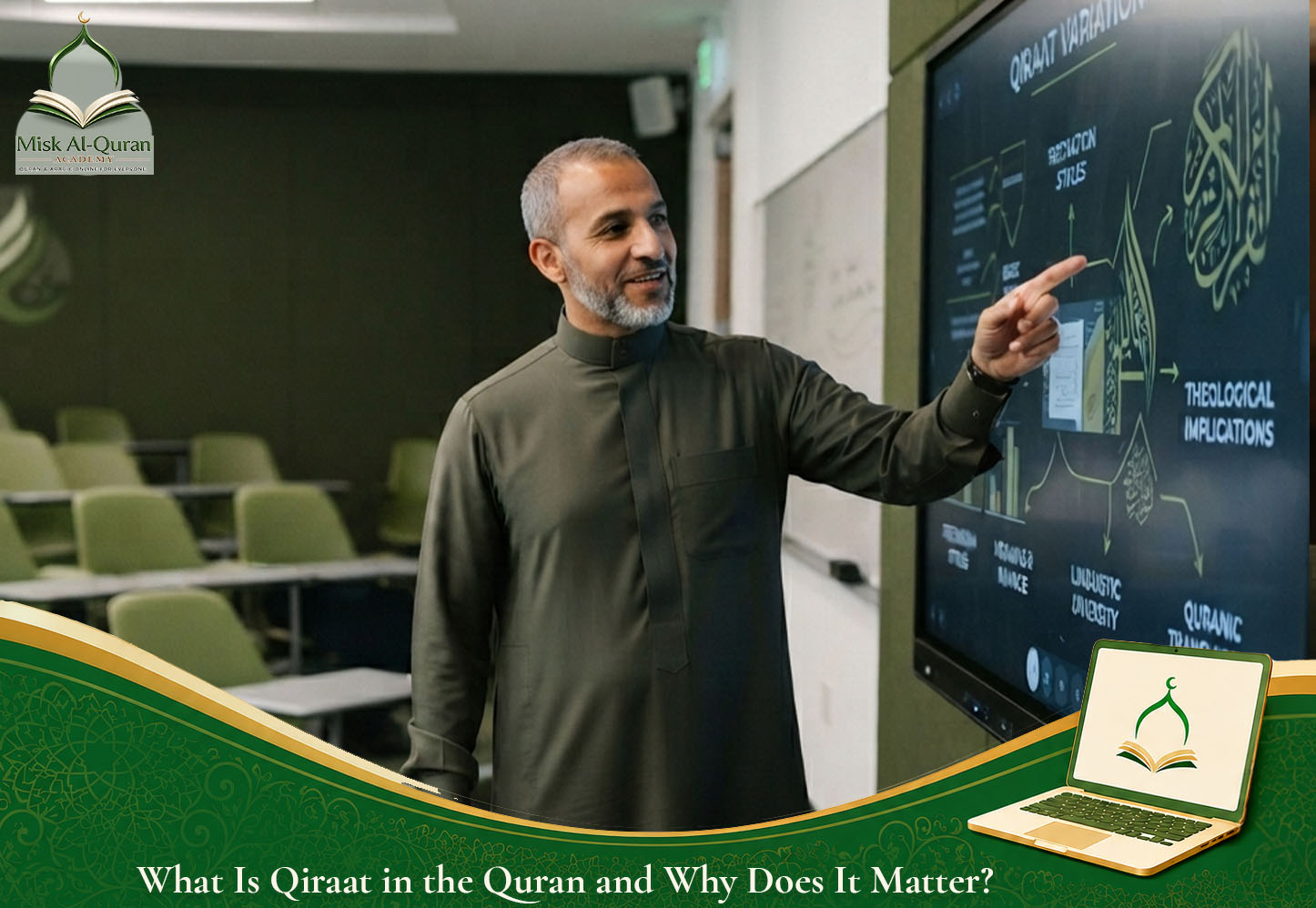
When asking what Qiraat is in the quran, the simplest answer is that Qiraat refers to authenticated methods of Quranic recitation that were transmitted through established chains of narration.
The Arabic word Qiraat is the plural of Qira’ah, meaning recitation or reading. In Quranic studies, however, the term has a more specific meaning. It refers to recognized ways of pronouncing and reciting the Quran that were transmitted from authoritative reciters through reliable chains.
These recitations can include differences in pronunciation, vowels, elongation, articulation, grammatical forms, and other established features. Nevertheless, they remain within the framework of the transmitted Quranic tradition.
This distinction is important because casual pronunciation differences between individual readers are not automatically considered Qiraat. A person cannot simply change the pronunciation of a word and call the result a new Qiraah. Authentic Qiraat depend on transmission, scholarly verification, and established rules.
Therefore, studying Qiraat is not about creating a personal style of recitation. Instead, it is about learning a particular inherited method accurately.
Start Your Quran Learning Journey with Misk Online Quran Academy
Begin your Quran learning journey with Misk Online Quran Academy, where students of all ages benefit from structured online Quran classes tailored to their individual level and learning needs.
Whether your goal is to improve Quran recitation, master Tajweed rules, or begin memorizing the Holy Quran, our experienced and qualified teachers provide clear step-by-step guidance through personalized one-to-one lessons. Each session is designed to help learners understand, practice, and improve with confidence and consistency.
With flexible scheduling, interactive teaching methods, and a supportive online environment, Misk Online Quran Academy makes it easier to stay committed and motivated. Students can learn comfortably from home while making steady progress in their Quran studies at their own pace.

What Is Qiraat in the Quran Compared With Tajweed?
A common source of confusion is the relationship between Qiraat and Tajweed. Although the two subjects are closely connected, they are not identical.
Tajweed teaches the principles needed to pronounce Quranic letters and words correctly. It covers areas such as articulation points, characteristics of letters, elongation, nasalization, assimilation, stopping, and continuation.
Qiraat, on the other hand, concerns authenticated recitation traditions. Each Qiraah has its own transmitted features and rules. Those features may affect how certain words, letters, vowels, or sounds are recited.
A useful way to understand the relationship is to think of Tajweed as the foundation of accurate Quranic pronunciation, while Qiraat represents a more advanced field involving particular transmitted recitation systems.
For example, a student may first learn how to pronounce Arabic letters correctly and apply basic Tajweed rules. After gaining sufficient confidence, the student can study a particular Qiraah and learn the specific variations associated with it.
Consequently, someone interested in advanced Qiraat should not rush past foundational Tajweed. A weak foundation can make the differences between recitations much harder to recognize.
How Many Qiraat Are There in the Quran?
One of the most common questions about what qiraat is in the quran concerns the number of recognized recitations.
In the commonly taught scholarly classification, there are ten canonical Qiraat. Each is associated with a prominent Imam of recitation and was transmitted through recognized narrators.
The ten Imams are:
- Nafi’ al-Madani
- Ibn Kathir al-Makki
- Abu ‘Amr al-Basri
- Ibn ‘Amir al-Shami
- ‘Asim al-Kufi
- Hamzah al-Kufi
- Al-Kisa’i
- Abu Ja’far al-Madani
- Ya’qub al-Hadrami
- Khalaf al-‘Ashir
Each Imam’s recitation was transmitted through narrators known as Rawi. For instance, the famous Hafs recitation is Hafs ‘an ‘Asim, meaning that Hafs transmitted the recitation of Imam ‘Asim.
Similarly, Warsh ‘an Nafi’ represents the transmission of Imam Nafi’s recitation through Warsh.
This structure demonstrates why Qiraat should not be confused with accents or individual preferences. The traditions are connected to specific scholars and transmission chains.
What Is Qiraat in the Quran and How Were They Transmitted?
To understand what qiraat is in the quran, it is essential to understand the importance of oral transmission. The Quran was transmitted through recitation as well as written preservation. Muslims learned verses by hearing them from qualified teachers and then reciting them back. This method continued through generations.
The concept of Sanad is therefore central to traditional Quranic education. A sanad is a chain of transmission connecting a student to a teacher and, through successive teachers, to earlier authorities.
In Qiraat studies, the chain is especially important because small pronunciation details matter. A written page may show the words, but it cannot always communicate every feature of an oral recitation.
For that reason, advanced Qiraat education traditionally depends on direct listening and correction. The teacher listens to the student’s recitation, identifies mistakes, demonstrates the correct form, and allows the student to repeat it.
Modern technology can make this process easier to access. However, recordings and digital resources should support instruction rather than replace qualified correction.
The Ten Qiraat Explained in Simple Terms
For beginners, the names of the ten Qiraat can initially seem difficult. Fortunately, there is no need to memorize all their technical details at once.
Each Qiraah is associated with an Imam whose recitation became known through transmission. Two narrators are commonly associated with each Imam in the standard presentation.
Among the best-known examples are:
- Nafi’ — associated with transmissions such as Warsh and Qalun.
- Ibn Kathir — associated with Al-Bazzi and Qunbul.
- Abu ‘Amr — associated with Al-Duri and Al-Susi.
- Ibn ‘Amir — associated with Hisham and Ibn Dhakwan.
- ‘Asim — associated with Hafs and Shu’bah.
- Hamzah — associated with Khalaf and Khallad.
- Al-Kisa’i — associated with Abu Al-Harith and Al-Duri.
- Abu Ja’far — associated with Ibn Wardan and Ibn Jammaz.
- Ya’qub — associated with Ruways and Rawh.
- Khalaf — associated with Ishaq and Idris.
The purpose of learning these names is not simply to memorize a list. Instead, they help students understand how the recitation traditions are organized.
What Is Qiraat in the Quran and How Is Hafs Different From Warsh?
Many students encounter Hafs and Warsh before they study the wider field of Qiraat. Hafs ‘an ‘Asim is particularly familiar to Muslims in many parts of the world. It is the recitation used in many printed Mushafs and is commonly taught in Quran classes internationally.
Warsh ‘an Nafi’, meanwhile, has a strong historical and contemporary presence in North and West Africa. Students from communities where Warsh is commonly recited may naturally encounter it at home, in local mosques, or through their teachers.
The differences between Hafs and Warsh are not simply differences in accent. Depending on the verse and rule involved, they can include variations in elongation, treatment of certain Hamzahs, pronunciation, vowel patterns, and other established features.
Therefore, a student who already knows Hafs should not assume that learning Warsh means merely copying a different accent. It requires learning the rules and transmitted characteristics of the new Qiraah.
Why Do the Qiraat Have Different Recitations?
A natural question is why authenticated Qiraat can contain differences at all. The Islamic scholarly tradition explains that the Quran was transmitted with recognized modes of recitation. These were preserved through reliable transmission rather than invented later by individual readers.
The differences are generally limited and systematic. They do not mean that Muslims possess different Qurans. Instead, the variations occur within an authenticated recitation tradition.
For students, this distinction is crucial. Hearing a word pronounced differently in an authentic Qiraah should not immediately lead to the conclusion that someone is making a mistake.
At the same time, not every variation someone hears online is automatically authentic. Internet videos may contain personal pronunciation errors, dialectal influences, or unsupported claims. Therefore, students should verify advanced recitation differences with qualified teachers.
What Is Qiraat in the Quran and Are All Qiraat Authentic?
The question of what Qiraat is in the quran is sometimes followed by another question: are all recitations equally authentic?
The ten canonical Qiraat are recognized within the Islamic scholarly tradition as authenticated recitation traditions. They were preserved through established transmission and studied by generations of Quran scholars.
However, the existence of ten canonical Qiraat does not mean that every unusual pronunciation found on social media represents one of them.
This is why terminology and scholarly transmission matter. A Qiraah has an established identity, recognized transmission, and documented rules.
Students should therefore be cautious when encountering claims such as “this is another Quranic reading” without a reliable scholarly explanation.
Learning from a qualified teacher provides an important safeguard. The teacher can distinguish authentic transmitted variations from ordinary mistakes.
What Is Qiraat in the Quran and Why Is Sanad Important?
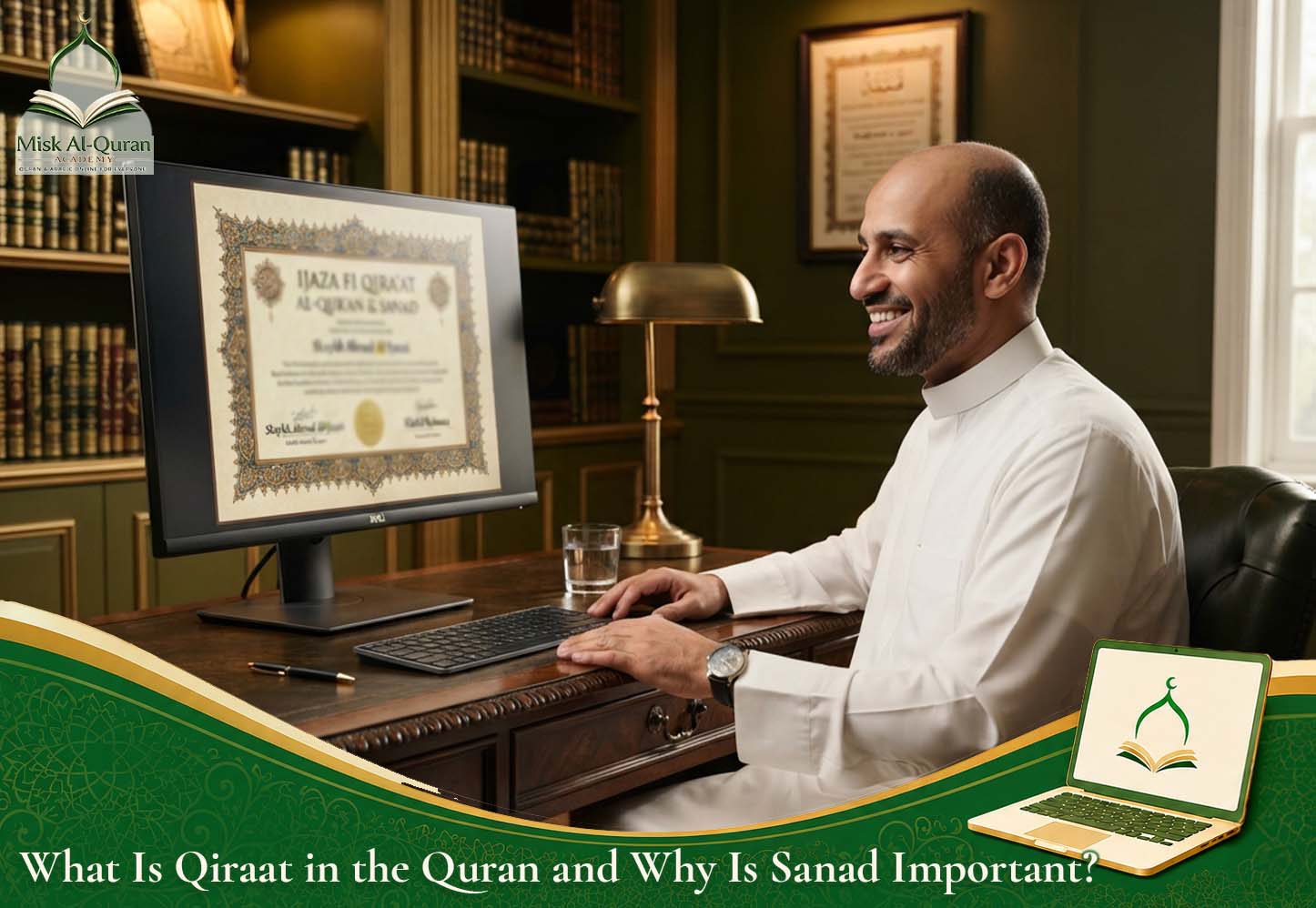
Sanad is one of the most important concepts for anyone who wants to pursue advanced Qiraat study.
A student may listen to hundreds of recordings and become very good at imitating a particular reciter. Nevertheless, imitation is not the same as formal transmission.
A qualified teacher provides direct correction and confirms whether the student is actually applying the rules of the selected Qiraah correctly.
For advanced students seeking Ijazah, this becomes even more significant. An Ijazah represents a teacher’s certification that the student has demonstrated an acceptable level of mastery according to the requirements of the program and tradition.
Consequently, anyone considering serious Qiraat study should ask about the teacher’s qualifications, the Qiraat being taught, the transmission method, and the structure of assessment.
How Does Qiraat Differ From a Quran Reciter’s Personal Style?
Every skilled reciter has a recognizable voice and performance style. Some reciters read slowly, while others use a faster pace. Some have a naturally deep voice, whereas others have a lighter tone. These personal characteristics should not be confused with Qiraat.
A Qiraah concerns transmitted rules and pronunciation features. A personal recitation style concerns elements such as vocal tone, rhythm, emotional expression, and pacing, provided they remain within acceptable recitation principles.
This distinction helps explain why two reciters can both read Hafs while sounding noticeably different. They may use the same Qiraah but have different voices and performance styles.
What Is Qiraat in the Quran and Which Qiraah Should a Beginner Learn?
For beginners asking what Qiraat is in the quran, choosing a starting point can seem complicated. In reality, the best approach is usually straightforward.
First, learn to read Arabic accurately. Then develop basic Tajweed. Afterward, gain consistency in your primary recitation before considering another Qiraah.
For many international students, Hafs ‘an ‘Asim is a practical starting point because it is widely available and many teachers are trained to teach it.
However, this does not mean that Hafs is the only valid choice or that every student must eventually study another Qiraah.
A student living in a community where Warsh is dominant may have a practical reason to learn Warsh. Likewise, someone following a family or scholarly tradition may have a different starting point.
The important point is consistency. A student should choose a qualified learning pathway rather than repeatedly switching between different recitations without understanding their rules.
Learning Qiraat After Mastering Tajweed
Tajweed should normally come before advanced Qiraat study. A student needs to recognize Arabic letters, understand articulation points, apply basic pronunciation rules, and read Quranic words with reasonable fluency. After that foundation is established, Qiraat-specific study becomes easier.
The student can begin learning the fundamental rules, often called Usul, of the selected Qiraah. These principles explain recurring features throughout the Quran.
Then the learner can move to particular words and verses where the Qiraah has specific transmitted differences. This progression is more effective than trying to memorize hundreds of isolated differences.
A good teacher can also identify which areas require additional practice. For example, one student may struggle with Hamzah-related rules, while another may need more work on Madd or pronunciation.
What Is Qiraat in the Quran and How Should You Practice It?
Effective practice requires patience. Instead of trying to learn large sections immediately, students should begin with manageable portions. Short Surahs can be useful because their words are often familiar, allowing learners to focus more attention on pronunciation.
A practical practice session can include several stages:
- Review the relevant Qiraah rule.
- Listen carefully to an authenticated model.
- Read the selected verses slowly.
- Record your own recitation when possible.
- Compare your performance with your teacher’s correction.
- Repeat difficult words several times.
- Review the same passage in later sessions.
Moreover, students should avoid mixing rules accidentally. Someone who knows Hafs and begins studying Warsh may unconsciously return to familiar Hafs patterns.
That is normal during the learning process. However, regular correction helps prevent these habits from becoming permanent.
Common Differences Students May Encounter in Qiraat
The differences between Qiraat can appear in several areas.
Differences in Madd
Certain forms of elongation may be recited differently depending on the Qiraah. A student must therefore learn the specific length required by the selected tradition rather than assuming that every Madd is identical.
Differences in Hamzah
Hamzah can be one of the more challenging subjects for students studying advanced recitation. Some Qiraat preserve particular Hamzah pronunciations, while others have established treatments in specific contexts.
Differences in Vowels
Some words may contain transmitted differences in vowel pronunciation. These variations are learned through the rules and examples of the relevant Qiraah.
Differences in Certain Word Forms
Some canonical readings include differences involving particular forms of words. Such differences are not random. They belong to the established transmission of the Qiraah.
Differences in Pausing and Continuation
Stopping and beginning can also involve specific considerations. Therefore, advanced learners need to study Waqf and Ibtida’ alongside their Qiraah rather than treating them as unrelated subjects.
What Is Qiraat in the Quran and Can You Learn It Online?
Modern online education has made advanced Quran learning available to students who do not have a qualified teacher nearby.
However, the quality of an online Qiraat course depends heavily on the instructor and teaching method.
A strong program should provide live interaction rather than relying exclusively on prerecorded lessons. The student needs opportunities to recite while the teacher listens and corrects mistakes.
This is one area where Misk Online Quran Academy can provide a structured environment for students who want to develop their Quranic recitation online.
A suitable online program should also consider the student’s current level. A beginner may need reading and Tajweed instruction first, while an advanced student may be ready to study a specific Qiraah.
Therefore, students should avoid choosing a course simply because it promises fast results. Accuracy, consistency, and qualified instruction are more valuable than speed.
How Misk Online Quran Academy Can Support Qiraat Learning
For students interested in structured online Quran education, Misk Online Quran Academy can offer a learning environment where lessons are organized around the student’s needs and current ability.
The first step should be evaluating the learner’s recitation level. This helps determine whether the student needs to strengthen Quran reading, Tajweed, or pronunciation before moving toward advanced Qiraat.
Once the foundation is strong, lessons can become more focused.
A personalized approach is particularly useful because students do not make the same mistakes. One learner may read fluently but struggle with particular pronunciation rules. Another may understand Tajweed terminology but need more practical recitation.
With consistent teacher feedback, the student can work on specific weaknesses instead of spending time reviewing material that has already been mastered. For online learning to succeed, however, students also need regular practice between lessons.
What Is Qiraat in the Quran and What Should You Look for in a Teacher?
Choosing the right teacher plays an essential role in advanced Quran study. A qualified instructor should understand Quranic sciences deeply and have practical experience with the Qiraah you want to study. Before you begin, ask about the teacher’s qualifications, teaching experience, and approach to Quranic recitation.
In addition, look for a teacher who:
- Listens carefully to your recitation.
- Corrects mistakes immediately.
- Explains why a pronunciation is correct.
- Distinguishes Qiraah rules from general Tajweed.
- Adjusts lessons to match your level.
- Encourages consistent practice.
- Avoids overwhelming beginners with unnecessary technical details.
A skilled teacher does more than demonstrate beautiful recitation. The teacher helps you understand the rules, apply them correctly, and maintain them during continuous Quran reading.
A Practical Roadmap for Studying Qiraat

If you want to study advanced recitation, follow a gradual learning path. A clear roadmap makes the subject easier to understand and prevents you from trying to master everything at once.
Stage One: Learn Quran Reading
First, make sure you can recognize Arabic letters, connect them correctly, and read Quranic words with confidence. Strong reading skills will give you a reliable foundation for every later stage.
Stage Two: Build Tajweed Foundations
Next, study articulation points, letter characteristics, Madd, Ghunnah, the rules of Noon and Meem, Waqf, and other essential Tajweed topics. These skills will help you recognize the differences between general Tajweed rules and Qiraah-specific rules.
Stage Three: Strengthen Your Primary Recitation
Choose one recognized Qiraah and develop consistency with it. For many learners, Hafs ‘an ‘Asim provides a practical starting point because many Quran teachers and resources use this recitation.
Stage Four: Study Qiraah-Specific Rules
Once you have built a reliable foundation, study the Usul and major principles of your chosen Qiraah. Learn these principles carefully before you move into detailed verse-by-verse practice.
Stage Five: Practice Selected Passages
Begin with short Surahs and familiar verses. Instead of focusing on reading speed, concentrate on applying every rule correctly. This approach allows you to identify difficult areas and correct them early.
Stage Six: Receive Regular Correction
Recite frequently to a qualified instructor. Regular feedback helps you identify small mistakes before they become permanent habits. Your teacher can also explain the reason behind each correction.
Stage Seven: Progress Through Larger Portions
After you gain confidence with shorter passages, gradually increase the amount of Quran you recite. Maintain accuracy as you move toward longer Surahs and larger portions.
Stage Eight: Consider Ijazah Study
If you want formal certification, discuss an Ijazah pathway with a qualified teacher. Your instructor can explain the requirements and determine whether your current level prepares you for this advanced stage.
This gradual approach keeps the learning process organized and prevents unnecessary confusion.
What Is Qiraat in the Quran and Why Should You Avoid Learning Too Quickly?
Speed may seem attractive, especially when online courses promise rapid progress. However, Qiraat requires patience and careful practice. Students who choose an online Quran academy UK can follow structured lessons while maintaining a steady learning pace that allows them to focus on accuracy rather than speed.
You might memorize a rule within minutes, but you may need weeks of practice before you can apply it naturally during continuous recitation. For this reason, give yourself enough time to develop accuracy and avoid judging your progress only by the number of lessons you complete.
Furthermore, switching between Qiraat too early can confuse your pronunciation habits. If you have not yet strengthened your primary recitation, another system may interfere with the rules you already know. Therefore, focus on one recitation until you can apply its essential rules with confidence.
Instead, measure your progress through accuracy, confidence, and consistency. These three factors provide a much clearer picture of your development than speed alone.
A student who learns slowly but applies every rule correctly often makes stronger progress than someone who completes many lessons while repeating the same pronunciation mistakes.
For learners who want structured guidance, Misk Online Quran Academy can provide an organized learning environment that matches lessons with the student’s individual level instead of forcing every learner into the same schedule.
Common Mistakes When Studying Qiraat
Several mistakes can make advanced Quran recitation more difficult than necessary. Understanding these problems can help you avoid them from the beginning and make your study sessions more productive.
Starting Qiraat Before Learning Tajweed
Without strong pronunciation skills, you may struggle to distinguish an authentic Qiraah variation from an ordinary reading mistake. Therefore, establish your Tajweed foundation before moving into advanced Qiraat study. A strong foundation will also help you understand the Benefits of Online Quran Learning when you use digital lessons to reinforce what you learn with your teacher.
Relying Only on Audio
Listening to expert reciters provides valuable support, but imitation alone cannot guarantee accuracy. A qualified teacher needs to hear your recitation and identify the specific problems in your pronunciation. Regular listening can improve your familiarity with correct sounds, but direct correction remains essential.
Mixing Two Qiraat
If you study more than one recitation, organize your practice carefully. Mixing rules from two systems during the same passage can create confusion and weaken your consistency. Keep separate practice sessions when necessary, and allow your teacher to decide when you are ready to introduce another Qiraah.
Memorizing Without Understanding
Memorizing isolated examples can make revision difficult. Instead, connect every example to the principle behind it. Once you understand the rule, you can recognize similar examples more easily and apply the same principle to new passages.
Changing Teachers Frequently
Different teaching methods can interrupt your progress. Consistency helps you develop stable pronunciation habits, especially when you study a detailed subject such as Qiraat. If you are considering online lessons for younger learners, it is also natural to ask: Is online quran learning safe for kids, particularly when children need a focused and supervised learning environment?
Prioritizing Speed Over Accuracy
Do not make finishing a book or course your primary goal. Focus on accurate and confident Quran recitation. Strong results require time, repetition, and correction. A patient learning process usually produces more reliable results than rushing through advanced material.
How Long Does It Take to Learn a Qiraah?
No single timeline works for every student. Your study period depends on several factors, including your Arabic reading ability, Tajweed foundation, previous Quran experience, available practice time, and the Qiraah you choose.
A student with strong Hafs recitation may understand the basic principles of another Qiraah relatively quickly. However, that student still needs consistent practice before applying those principles accurately throughout the Quran.
Similarly, students who want Ijazah should expect a longer commitment than learners who simply want to understand the basics of another Qiraah. Students who plan to pursue formal certification may also ask how to get ijazah online, especially when they want to study with a qualified teacher without attending a physical classroom.
Therefore, establish measurable goals instead of relying on a fixed number of months. For example, your teacher can help you set goals such as mastering specific Usul, completing selected Surahs accurately, or applying Qiraah rules consistently during regular recitation.
What Is Qiraat in the Quran and Is It Necessary for Every Muslim?
Advanced Qiraat study is not a requirement for every Muslim. Every Muslim should strive to recite the Quran correctly according to their ability. Learning basic Quran reading and Tajweed provides the necessary foundation for accurate recitation.
Advanced Qiraat represents a specialized field. It can greatly benefit students who have a strong interest in Quranic sciences, teaching, scholarly study, or the preservation of traditional recitation.
Therefore, someone who already recites Hafs correctly does not need to study all ten Qiraat simply to maintain a valid Quran recitation.
The key point is balance. Quran education should remain accessible to beginners while also giving advanced learners a clear path toward specialization.
The Spiritual Value of Studying Qiraat
Qiraat involves detailed technical rules, but the subject goes beyond academic study. For many students, learning about Quranic transmission creates a deeper appreciation for the care that Muslim scholars and teachers have given to Quran preservation.
As you study Qiraat, you may also become more attentive to pronunciation and more aware of the value of learning directly from qualified teachers. Regular exposure to authentic recitation can also highlight the benefits of listening to quran, especially when students use careful listening to improve pronunciation, rhythm, and familiarity with Quranic sounds.
Moreover, studying authentic recitations can broaden your understanding of the Quranic tradition. Instead of feeling confused when you hear a legitimate variation, you can recognize it as part of a carefully transmitted tradition.
However, technical knowledge should always serve the central purpose of Quran recitation: worship, reflection, understanding, and strengthening your connection with Allah.
Building a Consistent Qiraat Practice Routine
Consistency matters more than occasional long study sessions. Set aside a specific period each day for Quran recitation. Even a short daily routine can produce meaningful progress when you maintain it consistently.
A practical routine could include:
- Five minutes reviewing the rule from your previous lesson.
- Ten minutes listening carefully to a reliable recitation.
- Fifteen minutes practicing the assigned passage.
- Ten minutes reviewing your teacher’s corrections.
- A short final reading without interruption.
Adjust the schedule according to your level and available time. Furthermore, keep notes about recurring mistakes. Write down difficult words, pronunciation issues, or rules that require additional practice. These notes can become a simple revision tool. Over time, these small habits can make advanced Quran recitation easier and more natural.
How Misk Online Quran Academy Can Help Students Stay Consistent
A clear lesson schedule can make regular Quran study much easier. Students also benefit from receiving consistent feedback from the same qualified instructor.
Misk Online Quran Academy can support learners who prefer online Quran education while still wanting direct interaction with a teacher.
Online lessons offer flexibility for adults, parents, students, and learners who cannot attend a local Quran class at a fixed time. Students can study from home while maintaining direct communication with their instructor.
Nevertheless, technology should support the learning process rather than replace personal effort. Your progress ultimately depends on your commitment, your teacher’s competence, and the accuracy of your practice. For the best results, combine live lessons with independent practice and regular revision.
What Is Qiraat in the Quran and How Can You Start Today?

If you are still asking what qiraat in the Quran is, remember the central idea: Qiraat refers to authenticated traditions of Quranic recitation that scholars transmitted through established chains. You do not need to master every technical detail before beginning your Quran journey.
Start with accurate Quran reading. Then strengthen your Tajweed. After that, build consistency in one authentic recitation. Once you have established a strong foundation, speak with a qualified teacher about whether advanced Qiraat study suits your goals.
For learners who want online guidance, Misk Online Quran Academy can support this journey through structured Quran education and personalized instruction.
Most importantly, approach Qiraat with patience. The discipline requires careful listening, repetition, correction, and regular practice. Progress may take time, but every accurate improvement brings you closer to confident Quranic recitation.
Frequently Asked Questions About Qiraat
The Frequently Asked Questions About Qiraat section provides clear answers to common questions about Qiraat, helping beginners and advanced learners better understand authentic recitation traditions, learning requirements, and the best approach to studying them.
1. Can children study Qiraat?
Children can study advanced Qiraat when their reading ability and age make them ready for the subject. Most children should first learn Arabic letters, Quran reading, and basic Tajweed. After they build these skills, a qualified teacher can introduce more advanced material.
2. Do different Qiraat change the meaning of the Quran?
Authentic Qiraat can contain linguistic and pronunciation differences. However, these differences belong to the established Quranic recitation tradition and do not represent different versions of the Quran.
3. Can I practice two Qiraat at the same time?
Advanced students can study multiple Qiraat, but beginners should normally strengthen one recitation first. A qualified teacher can assess your progress and decide when you can safely add another Qiraah.
4. Do I need to memorize the entire Quran before studying Qiraat?
You do not necessarily need to memorize the entire Quran. However, strong reading skills and a reliable Tajweed foundation will make advanced Qiraat study much easier.
5. Is online Qiraat learning as useful as in-person learning?
Online learning can work effectively when students receive live teacher correction, structured lessons, and regular practice. The teacher’s qualifications and teaching quality matter more than the physical location of the classroom.
In conclusion, understanding what qiraat in the Quran is helps Muslims explore an important area of Quranic studies and appreciate the authentic recitation traditions that scholars have transmitted across generations. Beginners do not need to study all Qiraat at once. Instead, they can start by mastering Quran reading and essential Tajweed rules before gradually exploring advanced Qiraat with a qualified teacher.
Consistent learning, regular practice, and correction play an important role in developing accurate and confident recitation. Through Misk Online Quran Academy, students can access a structured learning environment and receive guidance that supports their Quran reading skills and helps them progress according to their individual levels and needs.
Therefore, start with steady steps and focus on accuracy rather than speed. With patience, regular practice, and qualified guidance, studying Qiraat can deepen your appreciation of the Quranic recitation tradition and strengthen your connection with the Book of Allah.