What Are Easy Methods Of Learning Noorani Qaida For Kids? Parents often ask this question when they want their children to build a strong foundation for reading the Quran correctly. Noorani Qaida introduces young learners to Arabic letters, sounds, vowel marks, pronunciation patterns, and basic Tajweed concepts in a gradual way. However, children do not always respond well to long explanations or repetitive lessons.
For that reason, an effective learning approach should be simple, engaging, age-appropriate, and consistent. Instead of expecting a child to memorize every rule immediately, parents and teachers can use short activities, visual examples, listening exercises, repetition, and positive encouragement. This makes each lesson easier to understand while helping children develop confidence.
A structured program can also make a major difference. For example, Misk Online Quran Academy can provide children with guided Quran learning in a format that gives them regular practice and personalized support. The goal is not simply to finish the Qaida quickly. Rather, children should understand what they are reading and develop the pronunciation habits they will need for Quran recitation.
What Is the Best Way for Kids to Learn Noorani Qaida?
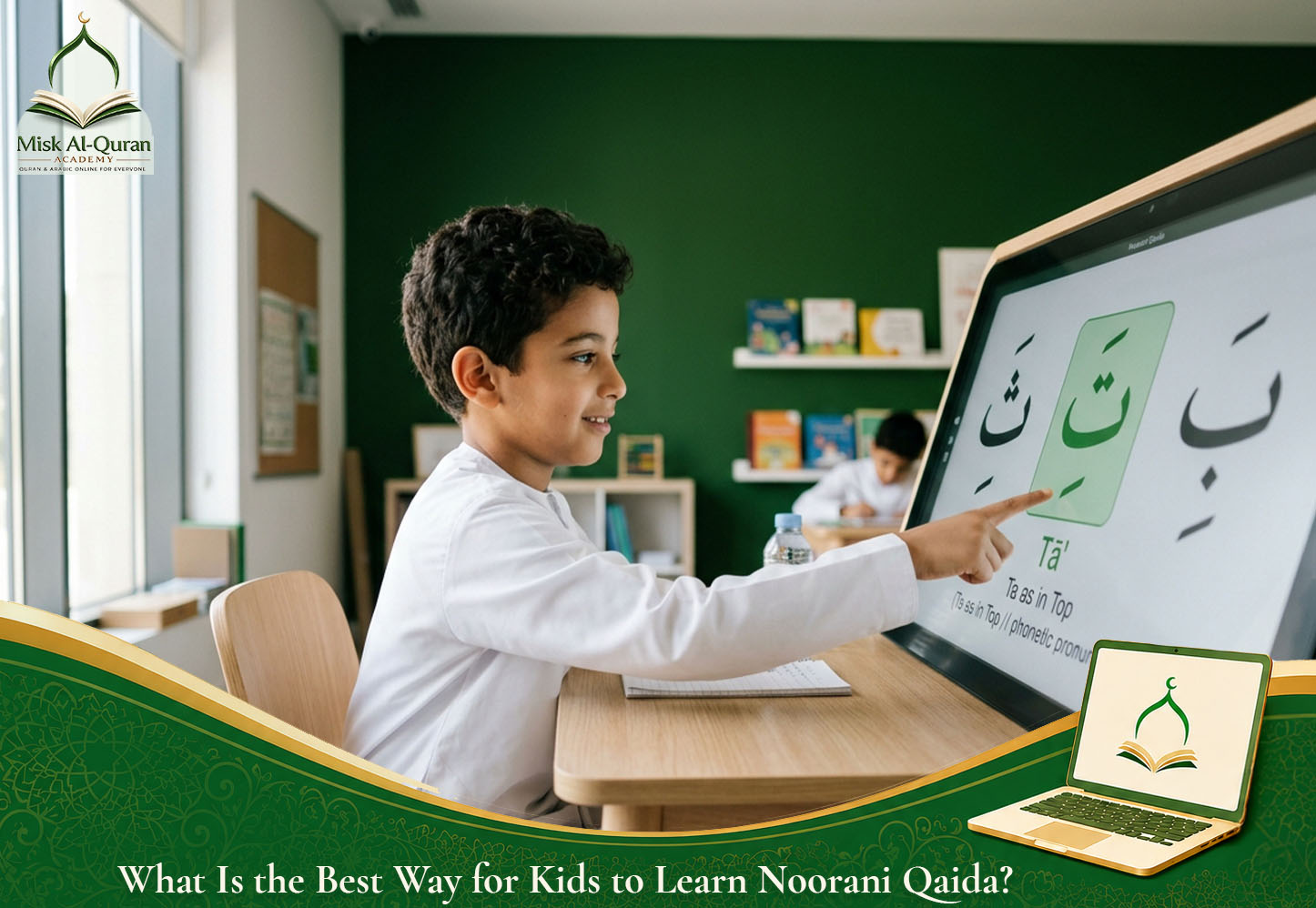
The easiest method is usually the one that matches a child’s learning ability rather than forcing every learner through exactly the same routine. Young children need repetition, but repetition should not feel like punishment. Therefore, lessons can combine reading, listening, speaking, visual recognition, and simple games.
A practical approach includes:
- Introducing a small number of letters at a time.
- Practicing each sound before adding new material.
- Using colorful cards or visual examples.
- Listening to correct pronunciation regularly.
- Reviewing previously learned lessons.
- Introducing Tajweed gradually.
- Keeping sessions short and focused.
- Celebrating genuine progress.
- Giving the child opportunities to read independently.
This approach answers What Are Easy Methods Of Learning Noorani Qaida For Kids? from a practical perspective because it focuses on how children actually learn. Moreover, parents can adjust the pace when a child needs more time with a particular sound or lesson.
Start Your Quran Learning Journey with Misk Online Quran Academy
Begin your Quran learning journey with Misk Online Quran Academy, where students of all ages benefit from structured online Quran classes tailored to their individual level and learning needs.
Whether your goal is to improve Quran recitation, master Tajweed rules, or begin memorizing the Holy Quran, our experienced and qualified teachers provide clear step-by-step guidance through personalized one-to-one lessons. Each session is designed to help learners understand, practice, and improve with confidence and consistency.
With flexible scheduling, interactive teaching methods, and a supportive online environment, Misk Online Quran Academy makes it easier to stay committed and motivated. Students can learn comfortably from home while making steady progress in their Quran studies at their own pace.

Start With Arabic Letters Before Difficult Rules
The first stage should be comfortable and familiar. Children need to recognize Arabic letters visually and connect each letter with its correct sound. At this point, there is no need to overload the learner with complicated terminology.
For example, a teacher can introduce a few letters and ask the child to identify them in different positions. Once recognition becomes easier, the child can practice producing the corresponding sounds.
Visual learning can be especially useful. Flashcards, letter charts, and simple matching exercises can turn a basic lesson into an active activity.
Parents can try activities such as:
- Showing one letter and asking the child to name it.
- Mixing familiar letters and asking the child to find a specific one.
- Matching letters with their sounds.
- Reviewing older letters before introducing new ones.
- Asking the child to recognize letters without looking at the answer.
Most importantly, avoid rushing through the alphabet. A child who recognizes fewer letters accurately is in a stronger position than one who has memorized many letters but cannot distinguish their sounds.
What Are Easy Methods Of Learning Noorani Qaida For Kids Through Sound Practice?
Learning the appearance of a letter is only one part of the process. Children also need to hear and reproduce its sound correctly. Consequently, pronunciation practice should begin from the earliest lessons.
A teacher can pronounce a letter clearly and then ask the child to repeat it. If the pronunciation is inaccurate, the teacher should correct it calmly and allow the child to try again.
Listening can also be incorporated into the daily routine. Children may hear a correct pronunciation several times before attempting to reproduce it. This creates a useful connection between hearing and speaking.
During pronunciation practice:
- Introduce the sound clearly.
- Let the child listen without interruption.
- Ask the child to repeat it.
- Correct only the part that needs improvement.
- Repeat the sound in a different example.
- Review it during a later lesson.
This gradual process is much more effective than constantly telling a child that a pronunciation is wrong. Encouragement keeps the learner relaxed, which makes it easier to notice and correct mistakes.
Use Short and Interactive Lessons
Children can lose concentration when a lesson continues for too long. Therefore, one of the most useful answers to What Are Easy Methods Of Learning Noorani Qaida For Kids? is to divide learning into manageable sessions.
A short lesson can include several different activities instead of spending the entire time on one exercise. For instance, a session might begin with letter revision, continue with pronunciation, and finish with a simple reading activity.
An effective lesson could follow this pattern:
- Warm-up: Review familiar letters for a few minutes.
- New material: Introduce one small concept.
- Practice: Let the child repeat and read.
- Activity: Use matching, identification, or another simple game.
- Review: Return briefly to the lesson before ending.
This structure creates variety without making the session chaotic. Furthermore, children are more likely to remain interested when they know that a difficult exercise will be followed by something enjoyable.
The key is consistency. A short lesson practiced regularly can produce better results than a long lesson followed by several days without practice.
Make Learning More Engaging With Visual Activities
Children often respond strongly to visual information. As a result, colorful and interactive materials can make Noorani Qaida lessons easier to follow.
Instead of presenting pages of letters without context, online Quran teachers can use visual prompts that encourage children to participate. For example, a child can identify a letter, choose the matching sound, or find the same letter among several options.
Simple activities include:
- Letter-matching cards.
- Find-the-letter challenges.
- Sound-and-letter matching.
- Simple reading races without pressure.
- Digital quizzes.
- Recognition exercises.
- Progress charts.
These activities should support learning rather than distract from it. The purpose is to reinforce recognition and pronunciation while keeping the child’s attention.
Parents should also avoid turning every activity into a competition. Some children become discouraged when they feel they are constantly being compared with others. A better approach is to compare today’s performance with the child’s previous progress.
What Are Easy Methods Of Learning Noorani Qaida For Kids With Digital Tools?
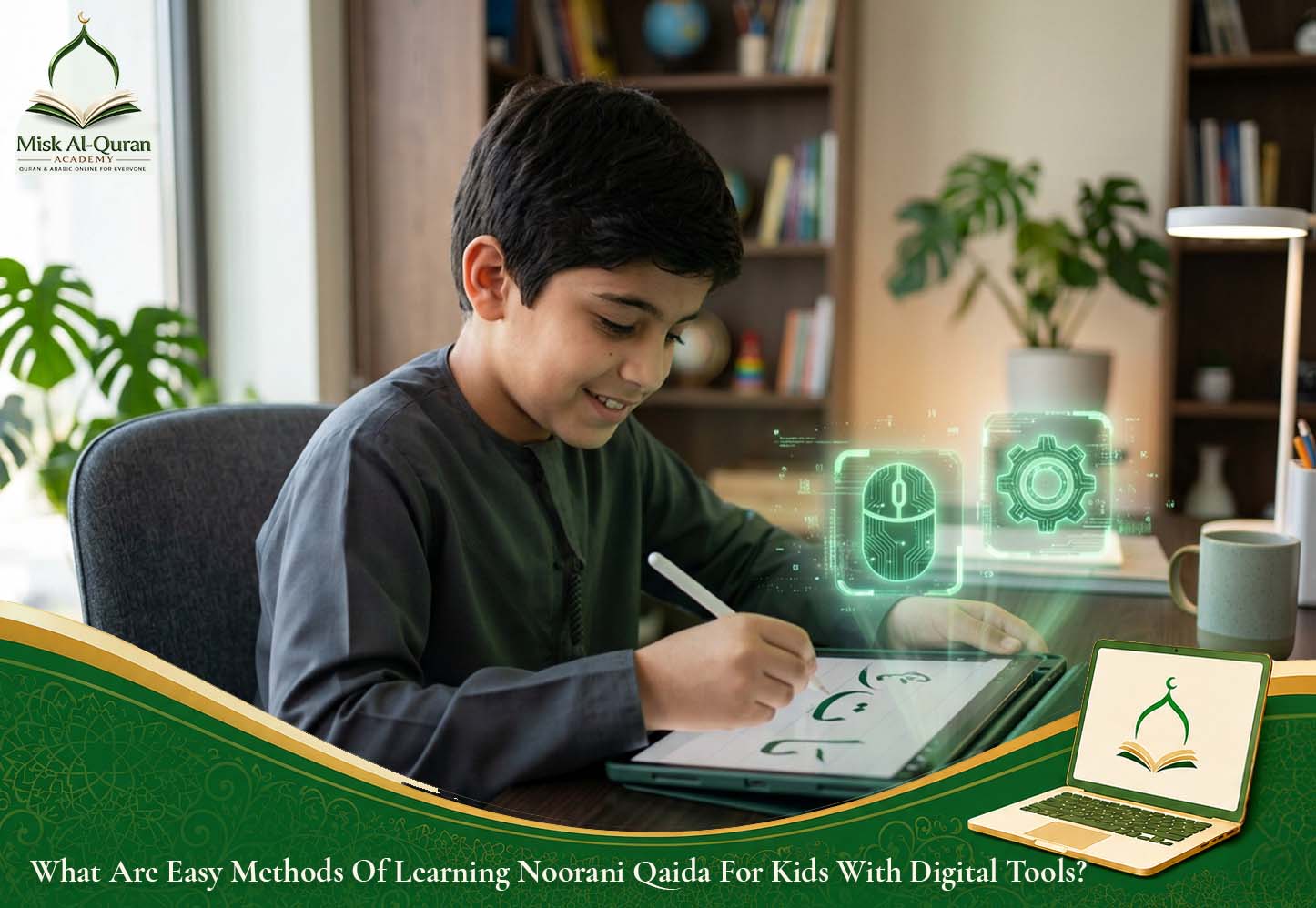
Technology can support Quran learning when it is used carefully. Today, children can access audio recordings, digital Qaida lessons, interactive exercises, and online tutoring from home.
However, simply giving a child a phone or tablet does not create an effective learning plan. Digital resources work best when an adult or qualified teacher guides their use.
For example, Misk Online Quran Academy can be part of a structured online learning routine where the child receives instruction instead of relying entirely on independent screen time.
Useful digital activities may include:
- Listening to accurate letter pronunciation.
- Replaying difficult sounds.
- Watching a teacher demonstrate pronunciation.
- Completing simple recognition exercises.
- Practicing with online lessons.
- Reviewing previous material between classes.
Parents should still monitor the quality of the material. The most attractive animation is not necessarily the most accurate educational resource. Correct pronunciation and appropriate instruction should remain the priority.
Introduce Tajweed Gradually
Noorani Qaida is closely connected to the foundations needed for accurate Quran reading. Nevertheless, children do not need to learn every Tajweed rule at once.
A better method is to introduce rules according to the child’s level. Once the child understands basic letters, vowel marks, and simple combinations, the teacher can gradually introduce relevant pronunciation rules.
For example, lessons can eventually include concepts related to:
- Madd.
- Ghunna.
- Ikhfa.
- Idgham.
- Qalqalah.
- Proper stopping and starting.
The teacher should demonstrate the rule before expecting the child to apply it. In addition, examples should remain short enough for the learner to understand.
Rather than saying, “Memorize this definition,” the teacher can demonstrate the sound and then ask the child to identify it. This makes Tajweed practical instead of purely theoretical.
What Are Easy Methods Of Learning Noorani Qaida For Kids Through Repetition?
Repetition is essential, but meaningless repetition can quickly become boring. Therefore, the goal should be purposeful review.
A child may learn a group of letters today and then revisit them tomorrow. Later, those same letters can appear inside a different exercise. This repeated exposure strengthens recognition without requiring the child to memorize a page mechanically.
A useful review cycle can include:
- Same day: Repeat the new concept.
- Next lesson: Review before adding new material.
- Later in the week: Test recognition in a different format.
- Following week: Include the concept in reading practice.
If a child continues to struggle with a particular sound, the teacher should slow down rather than simply repeating the entire lesson. Identify the specific difficulty and work on that part.
With Misk Online Quran Academy, a consistent learning schedule can help children receive regular instruction and avoid long gaps between lessons.
Create a Simple Daily Noorani Qaida Routine
A reliable schedule gives children a sense of familiarity. They begin to understand when learning takes place and what is expected from them.
However, the routine should remain realistic. Parents do not need to create an exhausting timetable. Instead, a short daily practice period can be enough to establish consistency.
A simple routine could look like this:
| Activity | Suggested Focus |
|---|---|
| Review | Previously learned letters |
| New lesson | One manageable concept |
| Pronunciation | Repeat difficult sounds |
| Reading | Practice short combinations |
| Listening | Hear accurate pronunciation |
| Final review | Recall the day’s lesson |
The exact duration should depend on the child’s age and attention span. Some children can focus longer than others. Therefore, parents should observe the child rather than follow an inflexible schedule.
Consistency matters more than forcing a particular number of minutes. Over time, regular practice can make reading feel increasingly natural.
Use Positive Reinforcement Instead Of Pressure
Children often learn better when they feel safe enough to make mistakes. Therefore, encouragement should be a central part of Noorani Qaida teaching.
A child who struggles with a sound should not feel that making mistakes is a failure. Instead, mistakes should be treated as normal steps in learning.
Parents can encourage progress by saying things such as:
- “Your pronunciation is clearer today.”
- “You remembered that letter without help.”
- “Let’s try that sound one more time.”
- “You improved compared with yesterday.”
Small rewards can also be useful when they are appropriate. A sticker chart, achievement certificate, or special activity may motivate some children.
Nevertheless, praise should focus on effort and improvement rather than creating pressure to finish quickly. The objective is to build a positive relationship with Quran learning.
What Are Easy Methods Of Learning Noorani Qaida For Kids With One-to-One Teaching?
Individual instruction can be especially useful when a child has difficulty with pronunciation, concentration, or reading speed. In a one-to-one lesson, the teacher can observe the child’s performance closely and adapt the lesson accordingly.
For instance, one learner may need extra pronunciation practice while another may need more visual recognition exercises. Treating both children exactly the same could slow down one of them.
One-to-one teaching allows the instructor to:
- Adjust the lesson speed.
- Identify pronunciation difficulties.
- Give immediate corrections.
- Repeat difficult concepts.
- Choose activities according to the child’s level.
- Track individual progress.
- Provide direct encouragement.
This personalized approach is one reason families may consider Misk Online Quran Academy when looking for structured online Quran education.
The teacher can also communicate with parents about areas that require additional practice. As a result, home practice becomes more focused instead of becoming another long lesson.
Involve Parents Without Turning Them Into Teachers
Parents have an important supporting role, but they do not necessarily need to teach every rule themselves. Their main responsibility can be creating an environment where learning is consistent and comfortable.
For example, parents can listen to the child for a few minutes, remind them about practice time, celebrate improvements, and communicate with the teacher when difficulties appear.
At home, parents can:
- Keep the Qaida easily accessible.
- Establish a regular practice time.
- Reduce distractions during lessons.
- Listen when the child practices.
- Avoid criticizing mistakes harshly.
- Ask the teacher how they can reinforce lessons.
- Celebrate steady progress.
When children associate Quran learning with encouragement rather than pressure, they may become more willing to practice independently.
Avoid Common Mistakes During Noorani Qaida Learning
Understanding what not to do is also important. Even a good learning resource can become ineffective if the teaching method creates unnecessary pressure. Parents should focus on steady progress and choose an appropriate learning pace. Understanding the best age to start Quran memorization can also help families develop realistic expectations about children’s Quran learning journey.
One common mistake is moving forward before the child has understood the previous lesson. Another is focusing heavily on memorization while ignoring pronunciation.
Parents should also avoid:
- Comparing one child with another.
- Correcting every mistake at the same moment.
- Making lessons excessively long.
- Introducing too many rules together.
- Skipping regular revision.
- Depending entirely on digital videos.
- Treating Quran learning like a school exam.
- Expecting immediate fluency.
Instead, progress should be gradual. If a child needs additional practice, spending more time on a foundation is not wasted time. Strong basic skills can make later Quran reading much easier.
How Can Misk Online Quran Academy Support Children’s Learning?
When families choose online Quran education, the quality of instruction and the structure of the program matter. Misk Online Quran Academy can be considered by parents who want their children to learn in an organized online environment.
A useful online learning experience should provide more than a video or digital textbook. Children benefit from interaction, feedback, correction, and a clear learning path. Parents can also explore Tips For Choosing The Right Online Quran Teacher when comparing different teaching approaches.
Parents evaluating an online program should look for:
- Qualified and patient teachers.
- Lessons appropriate for children.
- Clear pronunciation instruction.
- Regular revision.
- Individual feedback.
- Flexible scheduling.
- Communication with parents.
- A comfortable online classroom.
- A clear method for monitoring progress.
The right program should also recognize that every child learns differently. Therefore, the teaching process should be flexible enough to accommodate different levels of confidence, concentration, and reading ability.
What Are Easy Methods Of Learning Noorani Qaida For Kids At Home?
Home practice can reinforce what children learn during formal lessons. However, the home environment should be calm and predictable rather than overly demanding. Parents who are planning their child’s wider Quran education can also learn how to choose an online Quran teacher for your child to ensure that home practice complements professional instruction.
Parents can create a small Quran-learning corner where the child keeps the Qaida and other learning materials. This physical setup can help establish a clear association between the space and study time.
A practical home routine might include:
- Review yesterday’s material.
- Practice the current lesson.
- Repeat difficult sounds.
- Read a few examples.
- End with a positive comment.
There is no need to extend the session simply because the child has not mastered everything. If attention begins to decline, ending positively and returning later may be more productive.
Furthermore, parents can use the same pronunciation approach recommended by the child’s teacher. Consistency between online instruction and home practice prevents confusion.
Build Confidence Before Increasing Difficulty
Confidence plays a major role in children’s learning. A child who believes that mistakes are acceptable is more likely to participate and attempt difficult sounds.
Therefore, lessons should progress from familiar concepts toward more challenging ones. Each new step should have a connection to something the child already understands.
For example, after recognizing individual letters, the child can move toward combinations. Once those combinations become familiar, the learner can practice vowel marks and increasingly complex patterns.
This gradual progression helps answer What Are Easy Methods Of Learning Noorani Qaida For Kids? without relying on shortcuts. Easy learning does not mean removing practice. Instead, it means organizing practice so that each step feels achievable.
When children experience small successes regularly, they often become more willing to continue.
Track Progress Without Creating Pressure
Progress tracking can help parents and teachers understand whether the learning method is working. Nevertheless, tracking should be used to guide instruction, not to make children anxious.
A simple progress record can show:
- Letters mastered.
- Sounds requiring additional practice.
- Lessons completed.
- Tajweed concepts introduced.
- Reading improvements.
- Areas needing revision.
Teachers can use this information to decide what should happen next. Parents can also use it to understand how they can support practice at home. For families planning long-term Quran study, understanding how long it takes to memorize the Quran can also provide a broader perspective on the importance of patience and consistency.
At Misk Online Quran Academy, a structured learning process can help make children’s progress easier to monitor while maintaining individual attention.
The most useful measure is not how quickly a child finishes the book. Instead, consider whether the child can recognize letters, pronounce them accurately, apply learned rules, and read with increasing confidence.
Keep the Learning Experience Enjoyable
Ultimately, children should feel that Quran learning is a meaningful part of their lives rather than a daily punishment. Therefore, enjoyment should not be viewed as something separate from serious learning.
A teacher can vary activities, use encouraging language, and connect new concepts to practical Quran reading. Parents can also create a peaceful atmosphere before lessons.
Simple changes can make a noticeable difference:
- Allow short breaks when necessary.
- Alternate difficult and easy activities.
- Celebrate improvement.
- Use age-appropriate examples.
- Let children ask questions.
- Give them opportunities to demonstrate what they learned.
When the learning environment is positive, children may develop greater patience with difficult material. Consequently, they can continue practicing even when progress is slower than expected.
How To Choose The Right Noorani Qaida Learning Approach?
There is no single method that works identically for every child. Age, previous exposure to Arabic, pronunciation ability, attention span, and personality can all influence the learning process.
Before choosing a method or online program, parents should consider:
- Does the teacher understand how to work with children?
- Is pronunciation corrected during lessons?
- Are lessons interactive enough?
- Does the program include regular revision?
- Can the pace be adjusted?
- Is there communication with parents?
- Does the child feel comfortable during lessons?
- Is the learning path clear?
For families considering Misk Online Quran Academy, these questions can help determine whether the available learning structure matches the child’s needs.
The best choice is ultimately the one that combines accurate instruction with patience, consistency, and a learning environment in which the child can progress confidently.
Easy Ways to Teach Noorani Qaida to Kids
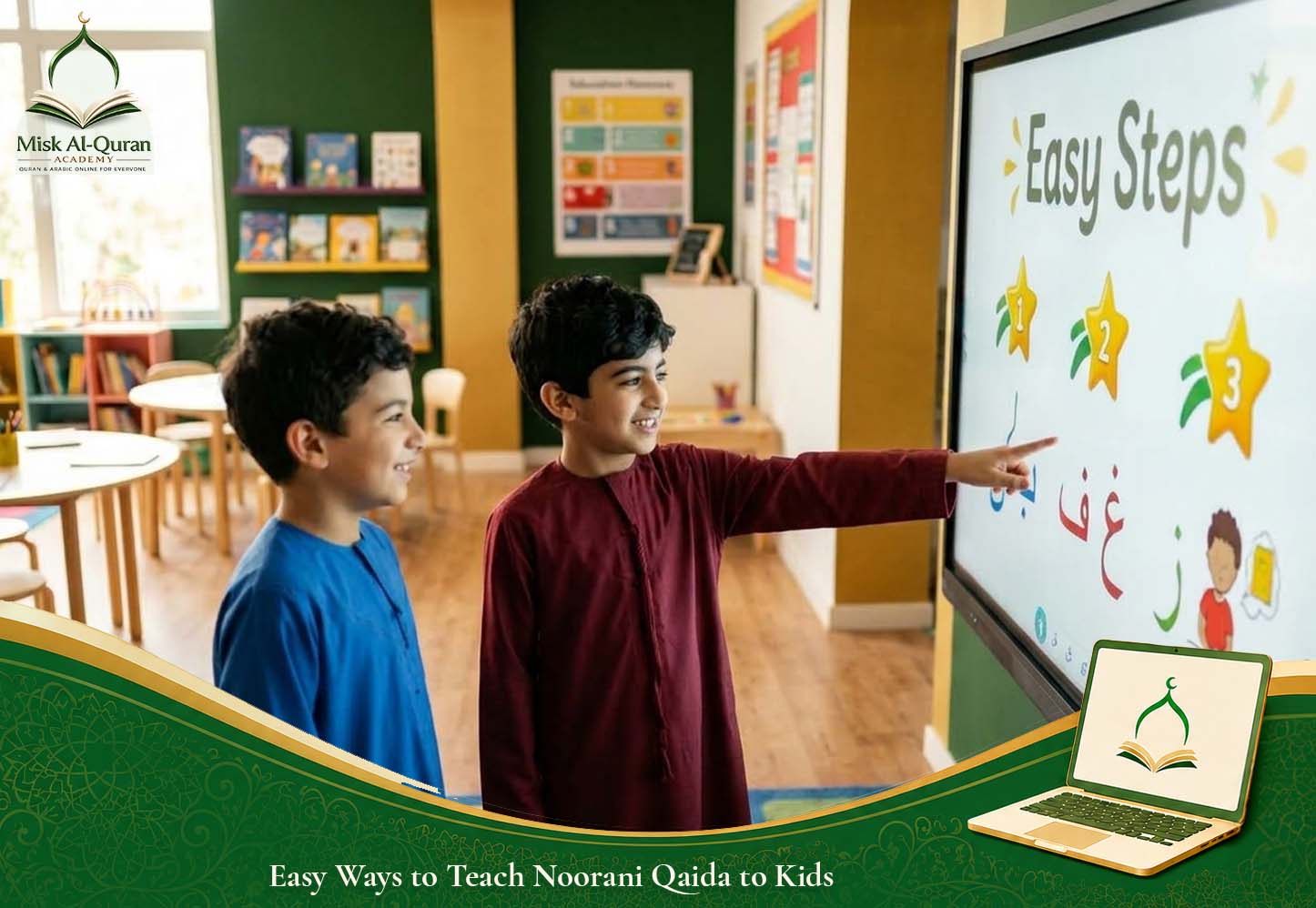
Parents looking for a simple answer to What Are Easy Methods of Learning Noorani Qaida for Kids? should focus on a few principles rather than searching for a shortcut.
The most useful approach is to:
- Start with accurate Arabic letter recognition.
- Practice sounds before moving too quickly.
- Keep lessons short and regular.
- Use visual and interactive activities.
- Include listening practice.
- Introduce Tajweed step by step.
- Review older lessons frequently.
- Give children positive feedback.
- Adjust the pace to the child’s ability.
- Involve parents without creating unnecessary pressure.
- Use online instruction when personalized guidance is needed.
Most importantly, remember that children develop at different speeds. A learner who needs additional repetition is not necessarily falling behind. With patient teaching and consistent practice, the foundations developed through Noorani Qaida can support more confident Quran reading later.
Misk Online Quran Academy can be an option for families seeking organized online support, particularly when they want children to receive guidance while practicing from home.
Can a child learn Noorani Qaida if Arabic is not spoken at home?
Yes. Children can learn the foundational sounds and reading patterns even when Arabic is not the family’s everyday language. What matters most is access to accurate pronunciation, regular practice, and clear instruction.
Should a child memorize the entire Qaida before reading the Quran?
Not necessarily. The purpose is to develop the skills needed for accurate reading. A child can gradually apply learned concepts to Quranic words as their teacher determines that they are ready.
What should parents do if their child refuses to practice?
First, identify the reason for the resistance. The lesson may be too long, too difficult, repetitive, or scheduled at an unsuitable time. Shortening the session, changing the activity, or giving the child a brief break can make practice more manageable.
Is it better for siblings to learn Noorani Qaida together?
It depends on their levels and personalities. Siblings with similar abilities may benefit from shared activities, while children at very different levels may progress more effectively through separate instruction.
In conclusion, Learning Noorani Qaida becomes easier when children receive clear instruction, frequent practice, and enough encouragement to make mistakes without fear. The goal is not simply to complete pages. Instead, children should gradually recognize Arabic letters, pronounce sounds accurately, understand basic reading patterns, and become prepared for Quran recitation.
The answer to What Are Easy Methods of Learning Noorani Qaida for Kids? therefore begins with simplicity. Introduce one concept at a time, use engaging activities, review regularly, and increase difficulty only when the child is ready.
Technology can provide useful support, while one-to-one teaching can offer personalized correction. At the same time, parents can make a major difference by maintaining a calm routine and celebrating genuine improvement.
For families considering Misk Online Quran Academy, the most important step is to choose a learning environment that combines qualified instruction, child-friendly teaching, regular feedback, and a consistent path toward better Quran reading.
With patience and the right method, Noorani Qaida does not have to feel difficult. Instead, it can become the first enjoyable step toward helping children read the Quran with greater confidence, accuracy, and understanding.