How to choose an online quran teacher for your child is an important question for parents who want their children to learn the Quran correctly, confidently, and with a positive attitude toward their faith. Choosing an online teacher is not simply about finding someone who can recite well. A good teacher should understand how children learn, explain Arabic sounds clearly, correct mistakes patiently, and create lessons that keep young students engaged.
Online Quran learning gives families access to qualified teachers without requiring regular travel to a learning center. However, the wide range of teachers and programs can make the decision difficult. Parents may wonder whether a teacher has suitable qualifications, whether the lessons will match the child’s age, or whether the online environment will really keep the child focused.
Therefore, the best approach is to evaluate the teacher from several angles before making a long-term commitment. Parents should consider Quranic knowledge, teaching experience, communication skills, lesson structure, technology, personality, and the child’s individual needs. This guide explains the most important factors to consider and shows how Misk Online Quran Academy can fit into a structured learning journey.
How to Choose an Online Quran Teacher Based on Qualifications?
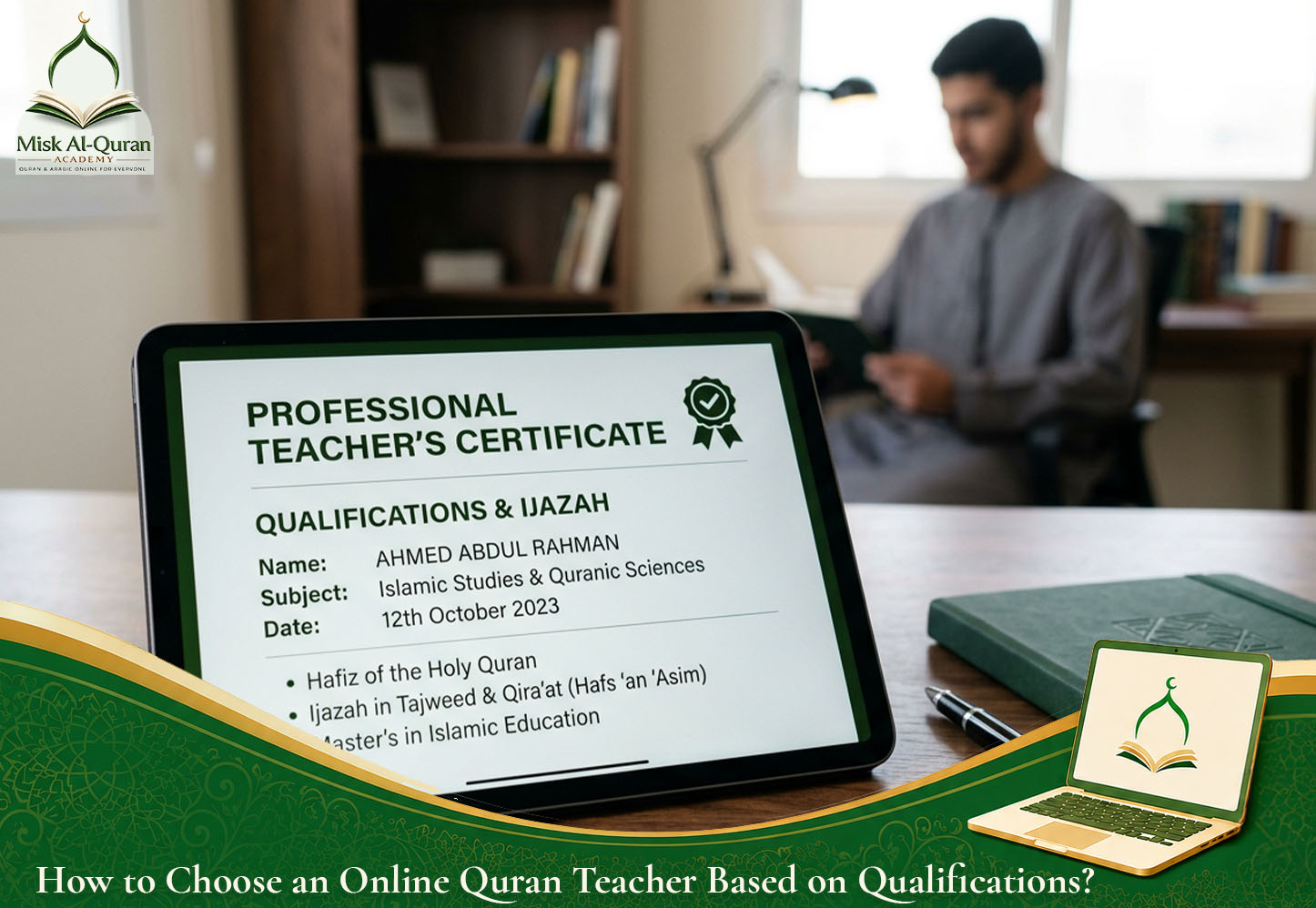
The first step in learning how to choose an online quran teacher for your child is checking the teacher’s knowledge and qualifications. A teacher may have excellent Quran recitation skills, but teaching children requires additional abilities. The teacher needs to explain concepts simply, identify mistakes accurately, and adjust the lesson according to the student’s level.
Parents should therefore ask about the teacher’s Quran education, Tajweed knowledge, teaching background, and experience with children. If the child is a beginner, experience with Arabic letters and foundational reading is especially valuable.
A suitable teacher should also demonstrate correct pronunciation during the first interaction. Children often copy what they hear, so inaccurate pronunciation can become difficult to correct later.
Before choosing a teacher, consider these points:
- Quran and Tajweed knowledge
- Experience teaching children online
- Ability to explain difficult concepts simply
- Clear and accurate pronunciation
- Patience with beginners
- Familiarity with age-appropriate learning methods
- Ability to provide constructive correction
Qualifications matter, but they should not be considered separately from teaching ability. A teacher can possess strong academic knowledge while still struggling to communicate effectively with young learners. For that reason, parents should evaluate both expertise and classroom behavior.
Start Your Quran Learning Journey with Misk Online Quran Academy
Begin your Quran learning journey with Misk Online Quran Academy, where students of all ages benefit from structured online Quran classes tailored to their individual level and learning needs.
Whether your goal is to improve Quran recitation, master Tajweed rules, or begin memorizing the Holy Quran, our experienced and qualified teachers provide clear step-by-step guidance through personalized one-to-one lessons. Each session is designed to help learners understand, practice, and improve with confidence and consistency.
With flexible scheduling, interactive teaching methods, and a supportive online environment, Misk Online Quran Academy makes it easier to stay committed and motivated. Students can learn comfortably from home while making steady progress in their Quran studies at their own pace.

Why Does Learning How to Choose an Online Quran Teacher for Your Child Require a Trial Lesson?
A trial lesson can reveal information that a profile or certificate cannot. When parents investigate how to choose an online quran teacher for their child, they should pay close attention to what happens during an introductory class.
Notice how the teacher greets the child. Does the teacher create a comfortable atmosphere? Does the child have opportunities to speak and recite? When a mistake occurs, does the teacher correct it calmly? These details can indicate whether the teacher understands children’s learning needs.
The teacher should also avoid turning the lesson into a one-sided lecture. Young students generally benefit from interaction, repetition, questions, and short activities. A good online lesson should give the child enough time to participate rather than simply listening for the entire session.
During a trial, parents can observe:
- Whether the teacher speaks at an appropriate pace
- How mistakes are corrected
- Whether explanations are easy to understand
- How often the child participates
- Whether the teacher checks comprehension
- How the teacher responds to hesitation
- Whether the lesson feels organized
Furthermore, the child’s reaction after the lesson is valuable. A child does not need to love every lesson, but persistent fear, frustration, or unwillingness to participate may indicate a poor teacher-student match.
How to Choose an Online Quran Teacher for Your Child by Understanding Teaching Style?
Teaching style can significantly influence a child’s progress. While some students respond well to energetic instruction, others learn better in a quiet and structured environment. Consequently, parents should look beyond general claims such as “experienced teacher” and determine whether the teaching style fits their child’s personality.
For example, a highly active child may need frequent interaction and short learning activities. Meanwhile, a shy child may need additional encouragement before reciting independently. A teacher who understands these differences can adapt without losing the structure of the lesson.
The right teacher should balance correction with encouragement. Children need to know when they make mistakes, yet constant interruption can make them afraid to recite. Instead, the teacher can allow the child to complete a short phrase, identify the error, and then practice the difficult part.
A positive teaching style usually includes:
- Gentle correction
- Clear instructions
- Frequent encouragement
- Reasonable repetition
- Age-appropriate examples
- Opportunities for independent recitation
- Consistent expectations
This balance helps children associate Quran learning with progress rather than constant criticism. At the same time, parents should consider is online quran learning safe for kids when selecting an online program, ensuring that the learning environment provides appropriate supervision, secure communication, and a comfortable experience for young students.
What Makes a Good Online Quran Teacher for Kids?
When considering how to choose an online quran teacher for your child, parents should evaluate whether the teacher understands the difference between teaching a child and teaching an adult.
Children often have shorter attention spans and may need variety during a lesson. They may also ask unexpected questions or lose concentration for a few minutes. A teacher who becomes impatient can quickly create a negative learning experience.
A child-friendly teacher knows how to redirect attention without making the student feel embarrassed. Instead of saying that a child is not paying attention, the teacher might introduce a quick repetition exercise or ask the student to identify a particular letter.
Another important quality is consistency. Children benefit from predictable lesson patterns. For example, a class might begin with a brief review, continue with new material, practice pronunciation, and finish with a short revision task.
A structured routine makes progress easier to measure while still allowing the teacher to adapt the lesson when necessary.
How to Choose an Online Quran Teacher for Your Child According to Age?
Age should influence the way Quran lessons are delivered. A five-year-old and a twelve-year-old should not necessarily receive identical lessons, even if they are studying the same material.
Younger children may need more visual support, repetition, and shorter activities. Their first goals might include recognizing Arabic letters, learning basic sounds, and becoming comfortable with Quranic reading.
Older children may be ready for longer recitation practice, Tajweed rules, memorization plans, and more independent revision. Therefore, parents should ask whether the teacher has experience working with the child’s age group.
Consider asking:
- Does the teacher teach children in my child’s age range?
- Can the lesson be adjusted to the child’s attention span?
- Will the teacher adapt the pace if the child progresses quickly?
- What happens if the child needs additional practice?
- How is homework or revision handled?
An age-appropriate approach prevents the child from becoming overwhelmed. At the same time, it avoids making lessons unnecessarily easy for students who are ready for greater challenges.
How to Choose an Online Quran Teacher for Your Child Based on Tajweed Skills?
Correct Tajweed is one of the most important considerations when selecting a teacher. Parents should choose online Quran teachers who can identify pronunciation and recitation errors accurately rather than simply listening to memorized passages. For families beginning structured Quran education, the teacher should also explain mistakes clearly and provide practical exercises.
For beginners, Arabic pronunciation can be challenging because several sounds do not have direct equivalents in English. Letters such as ع, ح, خ, ص, ض, ط, ظ, and ق may require focused practice. A patient teacher can make this stage easier by introducing each sound gradually and giving the child enough time to practice.
A capable teacher should isolate difficult sounds and demonstrate how they are produced. The child should then repeat them before using them within words or verses. This approach can help young learners build accurate pronunciation without feeling overwhelmed.
Tajweed instruction can gradually include areas such as:
- Correct articulation points
- Letter characteristics
- Madd rules
- Noon and Meem rules
- Qalqalah
- Rules of stopping and starting
- Proper rhythm and fluency
The teacher should introduce these concepts according to the child’s level rather than overwhelming a beginner with terminology. When children learn step by step, they can develop stronger recitation habits and greater confidence.
How Technology Affects Your Choice of an Online Quran Teacher?

Technology can either support or disrupt online Quran education. Therefore, parents should consider the technical side when selecting a teacher, especially when comparing the Benefits of Online Quran Learning with traditional study methods.
A stable internet connection is essential because frequent audio interruptions can make pronunciation correction difficult. The teacher should also use a clear microphone and camera when appropriate. The child needs to hear every sound accurately, especially during Tajweed practice.
The learning platform should be simple enough for both the parent and child. Complicated interfaces can waste lesson time and distract younger students. Additionally, parents should consider whether the platform offers easy access to lesson materials and communication with the teacher.
For families looking for an online Quran academy UK option, technical reliability is particularly important because international online lessons depend on stable communication between the student and teacher.
Parents should also create a suitable learning environment at home. A quiet desk, comfortable chair, reliable headphones, and limited distractions can make online lessons considerably more effective.
Before starting regular classes, check:
- Internet stability
- Microphone quality
- Audio clarity
- Screen visibility
- Ease of joining lessons
- Availability of learning materials
- Backup arrangements for technical problems
A strong teacher cannot completely overcome poor technology. Similarly, excellent technology cannot replace effective teaching. Both elements need to work together to create a productive learning experience.
How to Choose an Online Quran Teacher for Your Child by Checking Lesson Structure?
A well-organized lesson gives children a clear sense of progress. Parents should ask how the teacher plans each session and how previous material is reviewed.
For example, a balanced class may include a short revision section, new Quranic material, pronunciation practice, and a final review. This structure gives the student repeated exposure without making the lesson feel repetitive. It also helps parents understand what their child is expected to practice between classes.
Revision deserves special attention. Children may appear to memorize a passage quickly, but without regular review, they can forget it soon afterward. A teacher should therefore have a system for monitoring previous memorization.
Parents can ask whether the teacher maintains records of:
- New lessons
- Previous memorization
- Pronunciation mistakes
- Tajweed points
- Homework
- Areas that require additional revision
This information helps parents understand whether their child is progressing steadily. Furthermore, it allows the teacher to adjust future lessons according to the student’s strengths and weaknesses.
At Misk Online Quran Academy, parents can consider a learning approach that takes the student’s level and goals into account instead of treating every child in exactly the same way.
How to Choose an Online Quran Teacher for Your Child Without Creating Pressure?
One of the most overlooked parts of how to choose an online quran teacher for your child is understanding the difference between motivation and pressure. A teacher should encourage children to improve while allowing them enough time to develop naturally.
Parents naturally want their children to make progress. However, demanding rapid memorization or comparing one child with another can create unnecessary stress. Quran learning should encourage consistency and respect the child’s individual pace.
A good teacher can support ambition while maintaining realistic expectations. If a child struggles with a particular passage, the solution should usually involve additional explanation or practice rather than punishment.
Positive motivation can include:
- Recognizing genuine improvement
- Setting achievable weekly goals
- Celebrating completed milestones
- Allowing the child to ask questions
- Using encouraging language
- Maintaining a predictable routine
The objective is not merely to complete pages quickly. Instead, children should develop accurate recitation, retention, confidence, and a lasting connection with the Quran.
For parents exploring Quran for kids, this balance is especially important because early learning experiences can influence how children feel about Quran study in the future.
Signs You May Have Chosen the Wrong Online Quran Teacher
Knowing how to choose an online quran teacher for your child also means recognizing warning signs. Not every problem appears during the first lesson, so parents should monitor the experience during the first few weeks.
A teacher may not be the right fit if the child repeatedly finishes lessons confused about what was learned. Another concern is a teacher who rarely listens to the child’s recitation and spends most of the session talking.
Parents should also pay attention if mistakes are ignored. Small pronunciation problems can become habits when they are not addressed early. Likewise, repeated technical issues or poor communication may interfere with the child’s routine.
Potential warning signs include:
- Frequent unexplained cancellations
- Little preparation between lessons
- Repeatedly ignoring pronunciation errors
- Excessive criticism
- No clear learning plan
- Lack of communication with parents
- Lessons that regularly exceed the child’s ability to concentrate
- No measurable progress over time
One difficult lesson does not automatically mean the teacher is unsuitable. However, a consistent pattern deserves attention. Parents can discuss their concerns with the teacher first and then decide whether a different approach would better support the child.
How Parents Can Support an Online Quran Teacher at Home?
Even after finding the right teacher, parents remain an important part of the learning process. They do not need to become Quran instructors themselves. Instead, they can create conditions that make regular learning easier.
A fixed schedule is particularly useful. Children often perform better when they know exactly when their Quran lesson will take place. Keeping the learning space ready can also reduce delays.
Parents can support the process by:
- Preparing the device before class
- Providing a quiet place
- Encouraging the child to attend on time
- Listening occasionally to recitation
- Helping with assigned revision
- Asking about progress without creating pressure
- Communicating concerns with the teacher
Furthermore, parents should avoid correcting every mistake immediately after the teacher has finished. Too much additional correction can confuse the child. It is usually better to discuss recurring concerns with the teacher and agree on a consistent approach.
How to Choose an Online Quran Teacher for Your Child With a Personalized Plan?
Children do not all have the same Quranic goals. Some families prioritize reading fluency, while others focus on memorization, Tajweed, or a combination of these areas.
Therefore, parents should define the primary objective before selecting a teacher. A child who cannot yet read Arabic needs a different starting point from a student who already memorizes several Juz.
Ask the teacher to explain how the program can address your child’s current level. A useful plan should identify the starting point, learning objectives, revision method, and ways to measure improvement.
For instance, an individualized plan may focus first on:
- Arabic letter recognition
- Basic vowel sounds
- Combining letters into words
- Reading short Quranic passages
- Correcting recurring pronunciation errors
- Introducing relevant Tajweed rules
- Building consistent revision habits
As the child improves, the plan can gradually become more advanced.
Why Misk Online Quran Academy Can Be Part of Your Child’s Learning Journey?
Parents comparing options for how to choose an online quran teacher for their child may consider Misk Online Quran Academy when they want an online learning environment designed around structured Quran education.
The academy can be evaluated according to the same standards parents should apply to any provider: teacher qualifications, communication, lesson structure, student support, curriculum, flexibility, and the child’s response to the learning experience.
Rather than choosing based only on advertising, parents should use the introductory process to determine whether the teacher matches their child’s level and personality.
A suitable Quran learning program should help the child understand what to practice between sessions. It should also provide a clear sense of direction so that parents are not left wondering whether meaningful progress is taking place.
The most important question remains simple: does the learning experience help the child read the Quran more accurately while developing confidence and consistency?
How to Choose an Online Quran Teacher for Your Child Before Long-Term Enrollment?
Parents should avoid feeling pressured to make a long-term decision immediately. The first few lessons can provide valuable information about the teacher’s communication style and the child’s comfort level.
During this period, compare the experience with the goals you established at the beginning. If your child needs Tajweed support, for example, determine whether the teacher actually spends enough time correcting pronunciation. If memorization is the priority, check whether revision is included rather than focusing exclusively on new verses.
It is also useful to ask your child simple questions after class:
- What did you enjoy today?
- What was difficult?
- Did you understand the teacher?
- Did you feel comfortable asking questions?
- What would you like to practice next?
Children may provide observations that adults do not notice. Their answers can help parents identify whether the teacher-student relationship is developing naturally.
Creating a Long-Term Quran Learning Routine for Children
Selecting a teacher is only the beginning. Long-term results depend heavily on consistency. A child who studies occasionally may struggle to retain what was previously learned, even with an excellent instructor.
For that reason, families should establish a realistic routine rather than an ambitious schedule that becomes difficult to maintain.
A practical routine might include:
- Scheduled live lessons
- Short daily revision
- Regular recitation practice
- Weekly progress checks
- Periodic review of older memorization
- Occasional adjustments based on school commitments
The routine should fit the family’s actual lifestyle. If the schedule becomes unrealistic, parents should discuss adjustments with the teacher rather than allowing missed lessons to accumulate.
Consistency is more valuable than intensity when building a sustainable Quran learning habit.
Questions Parents Should Ask Before Choosing a Quran Teacher
A thoughtful list of questions can make the selection process easier. Instead of asking only about price or availability, parents should explore the teacher’s approach to children and progress.
Useful questions include:
- What age groups do you teach?
- How do you assess a new student’s level?
- How do you correct pronunciation mistakes?
- How do you keep younger students engaged?
- How often do you review previous material?
- How do you communicate progress to parents?
- What happens if the child is struggling?
- Can the learning plan change as the child improves?
- How are missed lessons handled?
- What goals can reasonably be achieved at my child’s level?
The answers can reveal whether the teacher has a clear methodology or simply follows the same lesson format with every student.
Building a Positive Relationship Between Your Child and the Quran
The final goal should go beyond completing a curriculum. Children are more likely to continue Quran learning when they associate it with encouragement, achievement, and meaningful routine.
A teacher has an important role in creating that relationship. However, the home environment matters as well. Parents can make Quran reading part of family life without turning every interaction into a test.
For example, parents can encourage children to listen to recitation, recognize familiar verses, or participate in simple family Quran routines. These small experiences can reinforce what the child learns during formal lessons.
Most importantly, children should understand that mistakes are part of learning. A child who feels safe enough to make mistakes can continue practicing. Over time, that confidence can become an important foundation for stronger recitation and memorization.
A Simple Checklist for Choosing the Right Online Quran Teacher
Before making your final decision, review the following checklist. It brings the most important points together in one place.
- The teacher has suitable Quran and Tajweed knowledge.
- The teacher has experience working with children.
- The lesson pace matches the child’s age and level.
- Pronunciation mistakes are corrected clearly.
- The teacher uses encouragement rather than excessive pressure.
- Lessons have a clear structure.
- Previous material is reviewed regularly.
- The online platform works reliably.
- Parents receive useful progress information.
- The child feels comfortable participating.
- The learning plan reflects the child’s specific goals.
- The schedule is realistic for the family.
If most of these points are satisfied, the teacher is more likely to provide a productive learning environment. Nevertheless, parents should continue monitoring progress after enrollment because children’s needs can change as their skills develop.
Tips for Choosing the Right Online Quran Teacher for Your Child
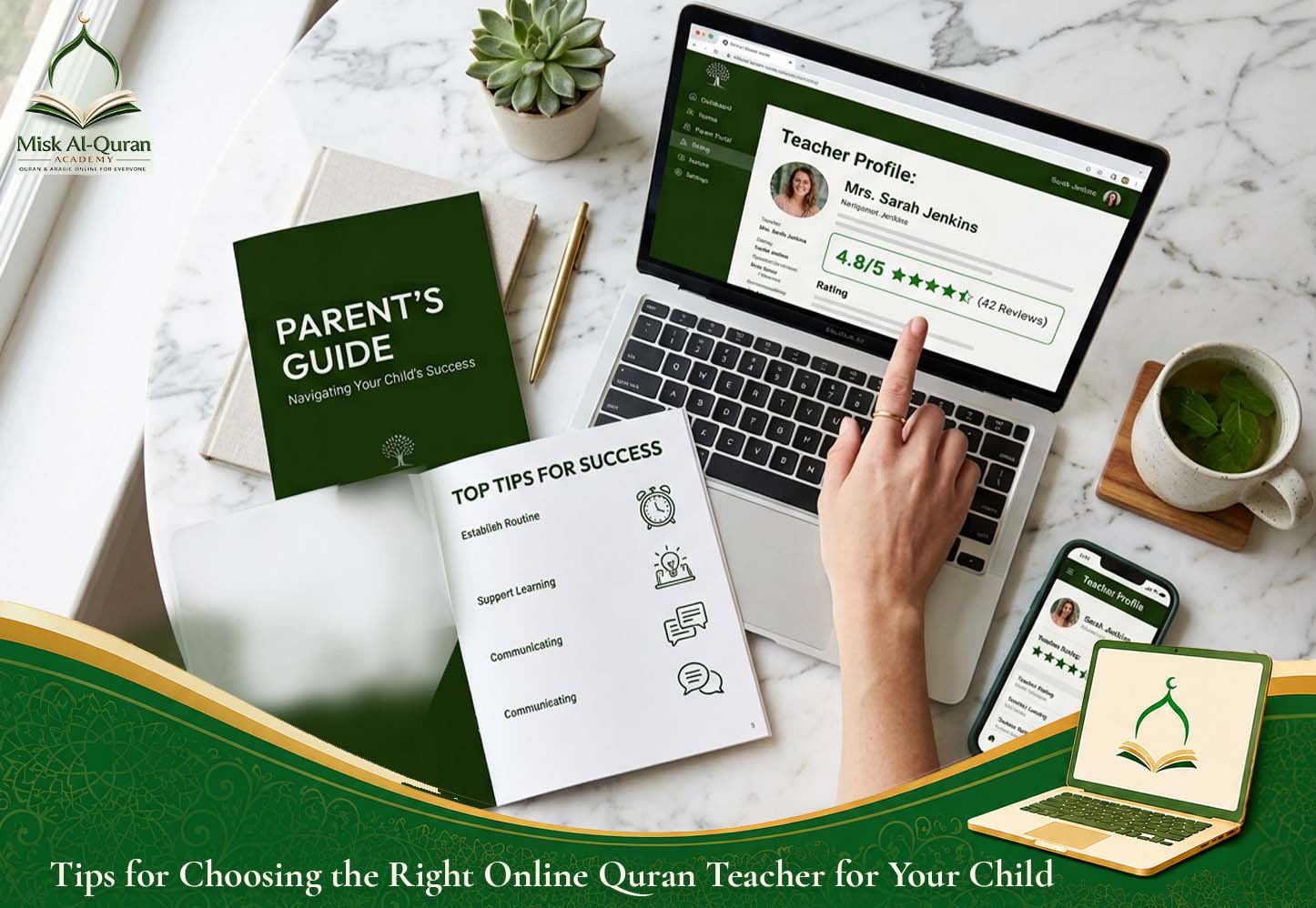
Understanding how to choose an online quran teacher for your child requires more than comparing teachers by qualifications or lesson prices. The right choice combines Quranic knowledge, teaching experience, patience, communication, age-appropriate instruction, reliable technology, and a structured learning plan.
Most importantly, parents should consider the child’s experience. A teacher who can recite accurately but cannot connect with young students may not produce the results a family expects. On the other hand, a patient teacher who understands children’s needs can make difficult skills feel manageable.
A trial lesson provides an excellent opportunity to observe this relationship before making a long-term commitment. Parents can evaluate the teacher’s pronunciation, correction style, lesson organization, and ability to keep the child involved.
For families considering Misk Online Quran Academy, the same principle applies: evaluate the program according to your child’s goals, level, personality, and learning needs. A strong program should provide direction while leaving room for individual progress.
Ultimately, the best Quran teacher is not simply the person with the most impressive profile. It is the teacher who helps your child learn accurately, participate confidently, and develop a consistent relationship with the Quran.
Frequently Asked Questions about how to choose an online quran teacher for your child
can help parents understand the key factors to consider before selecting the right Quran teacher for their child.
Can an online Quran teacher help a child who has never learned Arabic?
Yes. A suitable teacher can begin with Arabic letters, sounds, and basic reading skills before moving into Quranic passages. The starting point should depend on the child’s existing knowledge rather than assuming prior Arabic experience.
What should parents do if a child refuses to attend Quran lessons?
First, identify the reason instead of immediately increasing pressure. The child may be tired, uncomfortable with the teaching style, confused by the material, or struggling with the schedule. Discussing the issue with the teacher can help determine whether a change in pace or approach is needed.
Should parents sit beside their child during every online Quran lesson?
Not necessarily. The appropriate level of supervision depends on the child’s age and independence. Younger students may need more assistance, while older children can gradually manage their own lessons with periodic parental follow-up.
How can parents tell whether Quran lessons are producing meaningful progress?
Look for gradual improvements rather than expecting dramatic changes after every class. Better pronunciation, stronger recall, greater reading confidence, fewer repeated mistakes, and improved independence can all indicate useful progress over time.
In conclusion, choosing the right teacher can make online Quran learning more organized, comfortable, and effective. By evaluating qualifications, teaching style, Tajweed ability, lesson structure, technology, and your child’s personal response, you can make a decision based on real learning needs rather than convenience alone.
If you are still researching how to choose an online quran teacher for your child, take time to compare the available learning options and ask specific questions before committing. A thoughtful decision at the beginning can help your child build stronger habits for years to come.
For parents considering Misk Online Quran Academy, the next step is to explore how the learning approach can match your child’s current level and Quranic goals. The right starting point is one that feels manageable, structured, and encouraging while giving your child room to improve with confidence.