
An online Islamic school for kids gives Muslim families a practical way to provide their children with structured Islamic education from home. Instead of relying on occasional lessons or self-study, children can learn through organized classes that make Quran learning, Islamic studies, Arabic, and religious guidance part of a consistent routine.
For parents, the decision involves more than finding an online class. A suitable program should match the child’s age, current level, attention span, and learning goals. At the same time, the teaching approach should keep lessons understandable and engaging rather than turn every session into a passive screen experience.
Online learning can also help families manage education around school, family responsibilities, and different schedules. However, flexibility alone does not determine whether a program is suitable. The quality of instruction, communication with the teacher, lesson structure, and practice opportunities all deserve attention.
This guide explains what parents should look for when considering an online Islamic education program for children. It also explores how Quran and Islamic studies can be taught online and what families should consider before choosing a program such as Misk Online Quran Academy.
Is Online Islamic Education a Good Fit for Children?
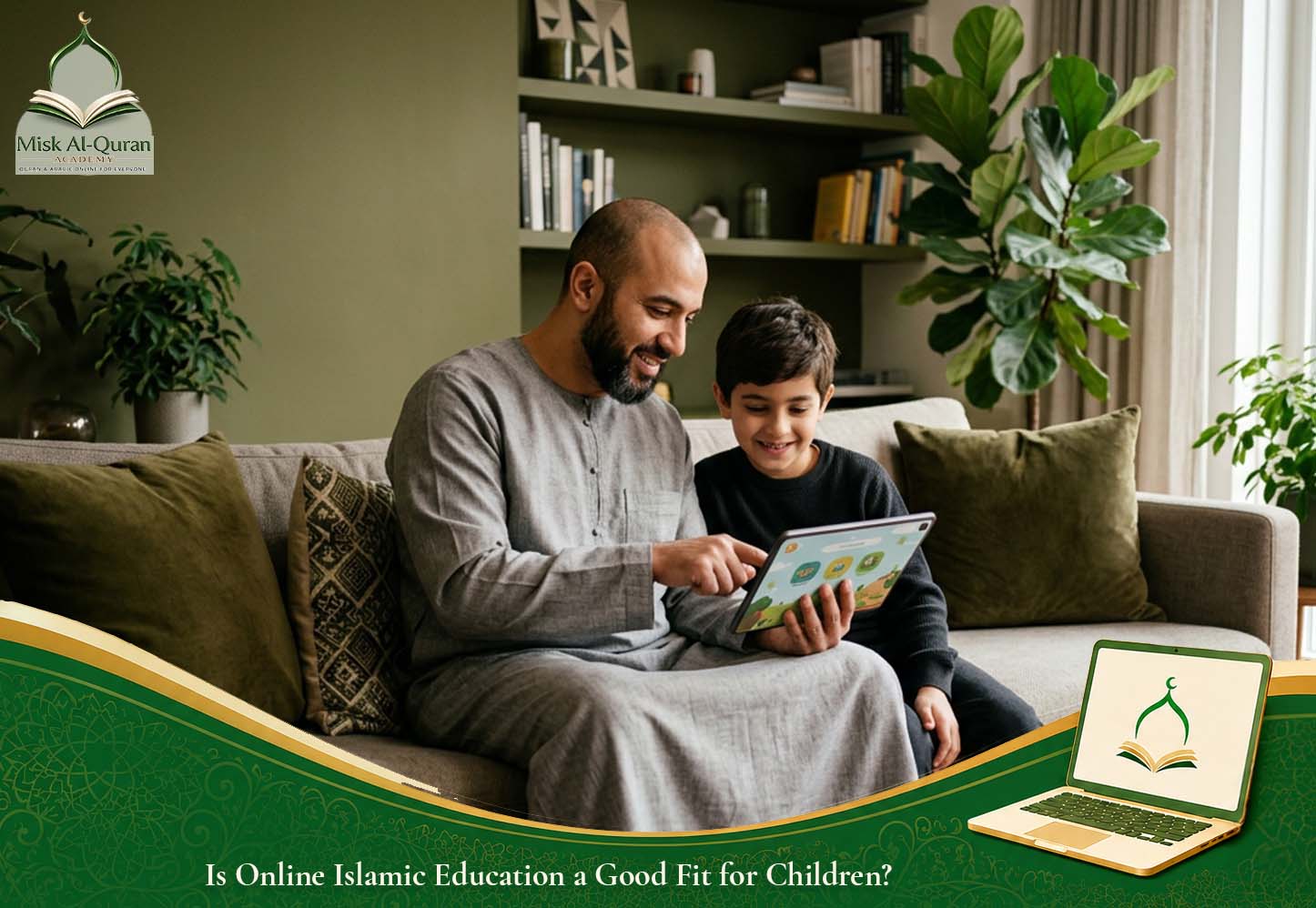
An online Islamic school for kids is an educational program that delivers Islamic learning through the internet rather than requiring children to attend a physical classroom. Depending on the program, lessons may include Quran reading, Tajweed, memorization, Islamic studies, Arabic, and other areas connected with a child’s religious education.
The format can vary considerably. Some programs rely mainly on live teacher-led classes, while others combine live instruction with learning materials, assignments, revision, or recorded resources. Therefore, parents should examine how the learning process actually works instead of judging a program simply by its online format.
A well-organized program can give children a clear learning path. For example, a beginner may first work on Arabic letters and Quran reading before progressing to pronunciation rules and Tajweed. Meanwhile, a child who already reads the Quran may need more focused recitation practice or memorization support.
The most useful question is not whether online learning is simply convenient. Instead, parents should ask whether the program provides the structure and teacher interaction their child needs to make steady progress.
Start Your Quran Learning Journey with Misk Online Quran Academy
Begin your Quran learning journey with Misk Online Quran Academy, where students of all ages benefit from structured online Quran classes tailored to their individual level and learning needs.
Whether your goal is to improve Quran recitation, master Tajweed rules, or begin memorizing the Holy Quran, our experienced and qualified teachers provide clear step-by-step guidance through personalized one-to-one lessons. Each session is designed to help learners understand, practice, and improve with confidence and consistency.
With flexible scheduling, interactive teaching methods, and a supportive online environment, Misk Online Quran Academy makes it easier to stay committed and motivated. Students can learn comfortably from home while making steady progress in their Quran studies at their own pace.

Why Do Parents Choose Online Islamic Education for Children?
Families choose online Islamic education for different reasons. In some cases, there may be no suitable local Islamic learning center nearby. Other parents may prefer a program that fits around their child’s regular school schedule.
For families with demanding routines, online lessons can reduce travel time and make it easier to establish consistent study hours. Children can learn from a familiar environment while parents remain aware of the learning routine.
There are also educational reasons to consider this approach. A child may benefit from receiving direct correction during Quran recitation instead of practicing alone and repeating the same mistakes. Similarly, a teacher can adjust explanations when a student finds a particular concept difficult. Several factors can make online Islamic education attractive:
- Lessons can take place from home.
- Families may have greater scheduling flexibility.
- Children can receive direct teacher guidance.
- Learning can be adapted to different levels.
- Parents can follow the child’s educational routine more easily.
- Quran and Islamic studies can become part of a regular weekly schedule.
Still, these advantages depend on how the program is organized. A convenient schedule cannot compensate for unclear lessons or limited interaction with the teacher.
What Can Children Learn in an Online Islamic School?
The curriculum depends on the individual program, yet children can study several areas of Islamic education through online lessons. Quran education is often a central part, particularly for families looking for structured help with reading, recitation, Tajweed, or memorization.
Islamic studies can complement Quran instruction by helping children understand essential concepts related to faith, worship, manners, and Muslim character. Arabic may also be included because understanding the language can support a child’s connection with the Quran.
A child’s curriculum should match their developmental stage. Younger learners generally need simpler explanations, shorter activities, repetition, and greater interaction. Older children may be ready for more detailed discussions, structured revision, and independent practice. A children’s Islamic program may include:
- Quran reading and recitation
- Basic Tajweed principles
- Quran memorization
- Islamic beliefs and practices
- Stories and lessons from Islamic tradition
- Islamic manners and character
- Arabic letters and vocabulary
- Guided revision and practice
Rather than expecting every child to study everything at once, parents should look for a learning path that introduces subjects according to the child’s ability.
Quran Learning in an Online Islamic School for Kids
Quran learning requires more than giving a child reading material and asking them to practice independently. Young learners often need someone to listen carefully, identify mistakes, and explain how to correct them. For beginners, learning the Arabic letters and their correct sounds can provide an important foundation. Parents looking for simple ways to introduce this stage can also explore What Are Easy Methods Of Learning Noorani Qaida For Kids?.
That is why teacher interaction is particularly important when choosing an online Islamic school for kids. During a live Quran lesson, a teacher can listen to pronunciation, identify difficulties, and provide immediate guidance. Over time, this can help the child build more accurate reading habits.
Beginners may start with foundational skills such as recognizing Arabic letters, connecting letters, reading simple words, and developing correct pronunciation. Once those skills become more secure, the learner can gradually move toward Quran reading and Tajweed.
Children who already have basic Quran skills may need a different approach. Their lessons might focus more heavily on improving recitation, correcting recurring pronunciation problems, revising previous material, or memorizing new passages. For children who are ready to develop their memorization skills, parents may also find the advantages of taking an Online Quran Memorization Course useful when considering the next stage of learning.
Consequently, parents should avoid programs that treat every learner exactly the same. A child’s current ability should influence the pace, lesson content, and amount of practice.
How can Islamic Studies Support a Child’s Learning?
Quran reading is only one part of a child’s Islamic education. Islamic studies can help children understand the meaning behind religious practices and develop knowledge that connects with everyday life.
For younger children, lessons may introduce basic concepts through simple explanations, stories, questions, and examples. As children become older, they can explore Islamic concepts in greater depth and discuss how those principles relate to their behavior and responsibilities.
A balanced program should avoid presenting religious education as memorization alone. Children need opportunities to understand what they are learning and connect it with situations they recognize.
For example, a lesson about Islamic manners can move beyond definitions by discussing how a child speaks to parents, treats classmates, responds to disagreement, or behaves when using technology. Similarly, lessons about worship can explain both the practical steps and the meaning behind them. When children begin learning about purification and prayer preparation, a clear practical guide such as How to Make Wudu – A Step-by-Step Guide can provide useful support alongside teacher-led instruction.
This approach makes Islamic education more relevant to the child’s daily experience. It also gives parents a clearer way to see whether their child’s lessons are building understanding rather than simply increasing the amount of information they memorize.
How do Online Islamic School for Kids Classes Usually Work?
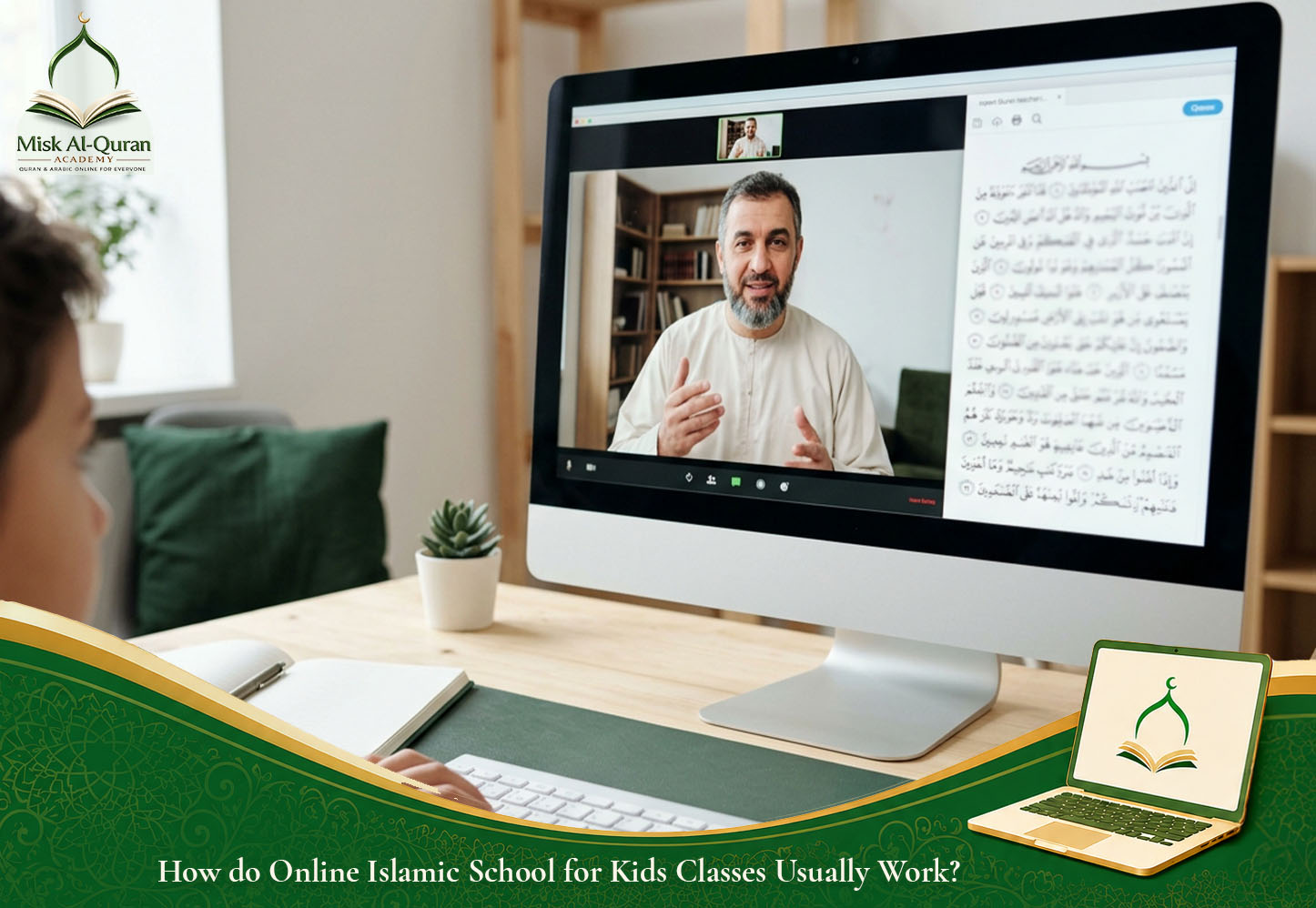
The structure of an online lesson can vary, but a live session generally begins with a short review before moving into new material. This allows the teacher to identify what the child remembers and where additional practice is needed.
Next, the teacher introduces the main lesson. Depending on the subject, this could involve Quran reading, memorization, Tajweed, Arabic, or Islamic studies. Children may then practice while receiving corrections or answering questions.
Toward the end, the teacher can review the main points and clarify what the child should practice before the next session. A simple lesson structure might include:
- Reviewing previous material.
- Introducing the new topic.
- Practicing with teacher guidance.
- Correcting mistakes.
- Reviewing the lesson.
- Setting appropriate practice for the next session.
This structure gives the child a predictable routine. At the same time, a good teacher can adjust the lesson when the student needs more explanation or additional practice.
The goal is not to make every class identical. Instead, consistency should provide stability while the teaching remains responsive to the child’s actual progress. Families can also learn more about the role of qualified instructors through Online Quran Teachers – Learning the Quran Made Easy.
Choosing the Right Online Islamic School for Kids
Choosing an online Islamic school for kids should begin with the child rather than the school’s promotional claims. Parents need to understand what their child currently knows and what they want the child to achieve.
A beginner who cannot yet read Arabic will require a different starting point from a child who already reads the Quran fluently. Likewise, a child who struggles to concentrate may benefit from shorter activities and greater interaction.
Before enrolling, parents can evaluate several areas:
- Teacher interaction: Is the child learning directly with a teacher?
- Curriculum: Does the program cover the subjects the family needs?
- Level placement: Can lessons be adjusted to the child’s ability?
- Lesson structure: Does each class have a clear purpose?
- Practice: Does the child have opportunities to apply what was taught?
- Communication: Can parents understand their child’s progress?
- Consistency: Is there a realistic schedule the child can maintain?
These questions provide a more useful basis for comparison than simply looking at the number of courses offered.
What Should Parents Look for in Online Islamic School for Kids Programs?
A long course list does not necessarily mean that a program will be effective for a particular child. What matters is whether the educational experience fits the learner.
First, consider the teaching method. Children generally respond better when they are involved in the lesson rather than listening passively for the entire session. Questions, recitation practice, repetition, and guided activities can make the learning process more interactive.
Next, consider how the program handles different ability levels. A child should not be pushed through material simply because it appears in a fixed sequence. At the same time, lessons should provide enough structure to prevent the learner from moving forward without mastering the basics.
Parents should also consider the learning environment. A quiet space, stable internet connection, suitable device, and regular study time can make online classes easier for children. Families interested in developing a child’s Quran learning routine can also explore Benefits Of Taking Online Quran Classes For Kids.
Finally, observe the child’s response. If the learner consistently feels confused, disengaged, or overwhelmed, the problem may be the pace or teaching approach rather than the child’s ability.
How Can Misk Online Quran Academy Fit a Child’s Learning Journey?
Misk Online Quran Academy can be considered by parents who want their children to receive structured Quran education online. When evaluating the academy, parents should focus on how its teaching approach matches the child’s current level and learning objectives.
For a beginner, the starting point matters. The child may need foundational Quran reading skills before moving into more advanced recitation. On the other hand, a learner with previous experience may benefit from focused correction, revision, or memorization work.
The value of a program also depends on the relationship between the child and teacher. Children often learn more comfortably when they can ask questions, make mistakes without embarrassment, and receive clear explanations.
Therefore, parents considering Misk Online Quran Academy should think about the specific outcome they want for their child. A clear objective makes it easier to determine whether the lessons, pace, and teaching format are appropriate.
Rather than choosing based solely on the name of a program, families can look at the complete learning experience and how it supports the child’s development over time.
Online Islamic School for Kids for Different Learning Levels
Children do not begin Islamic education with the same skills. Some may recognize Arabic letters before their first online lesson, while others may be completely unfamiliar with them. Older children may already read the Quran but need help improving Tajweed.
For this reason, an effective online Islamic school for kids should allow learning to develop progressively.
Online Islamic School for Kids for Beginners
Beginners usually need a strong foundation. Early lessons may focus on Arabic letters, pronunciation, joining letters, and basic reading skills. Moving too quickly can create gaps that become harder to correct later.
Developing Learners in an Online Islamic School for Kids
Children with basic Quran reading ability can gradually work on fluency, pronunciation, and introductory Tajweed rules. Regular correction becomes particularly useful at this stage because children may already have established reading habits.
More Advanced Students
Advanced learners may need a more focused plan. Their goals could include improving recitation, memorizing additional portions, revising previously memorized material, or strengthening specific Tajweed skills.
The important point is progression. Children should move forward because they are ready for the next stage, not simply because a certain number of lessons has been completed.
Keeping Children Engaged During Online Islamic Lessons
Attention can be a challenge when children learn through a screen. Consequently, lesson design matters almost as much as the subject itself.
Younger children often need variety. A teacher may alternate between explanation, reading, questions, repetition, and short activities rather than maintaining one activity for the entire session.
Parents can also support engagement by creating a consistent learning environment. A child who attends lessons from a quiet place with minimal distractions is more likely to participate actively. Simple habits can help:
- Keep the learning area free from unnecessary distractions.
- Use a device with a clear screen and reliable audio.
- Establish a consistent lesson routine.
- Encourage the child to participate rather than simply listen.
- Allow short breaks between longer learning periods when appropriate.
- Praise effort and improvement rather than focusing only on mistakes.
Most importantly, parents should pay attention to the child’s behavior over several lessons. One difficult class does not necessarily indicate a problem. A repeated pattern of disengagement, however, may signal that the pace or teaching method needs adjustment.
Questions Parents Should Ask Before Enrollment
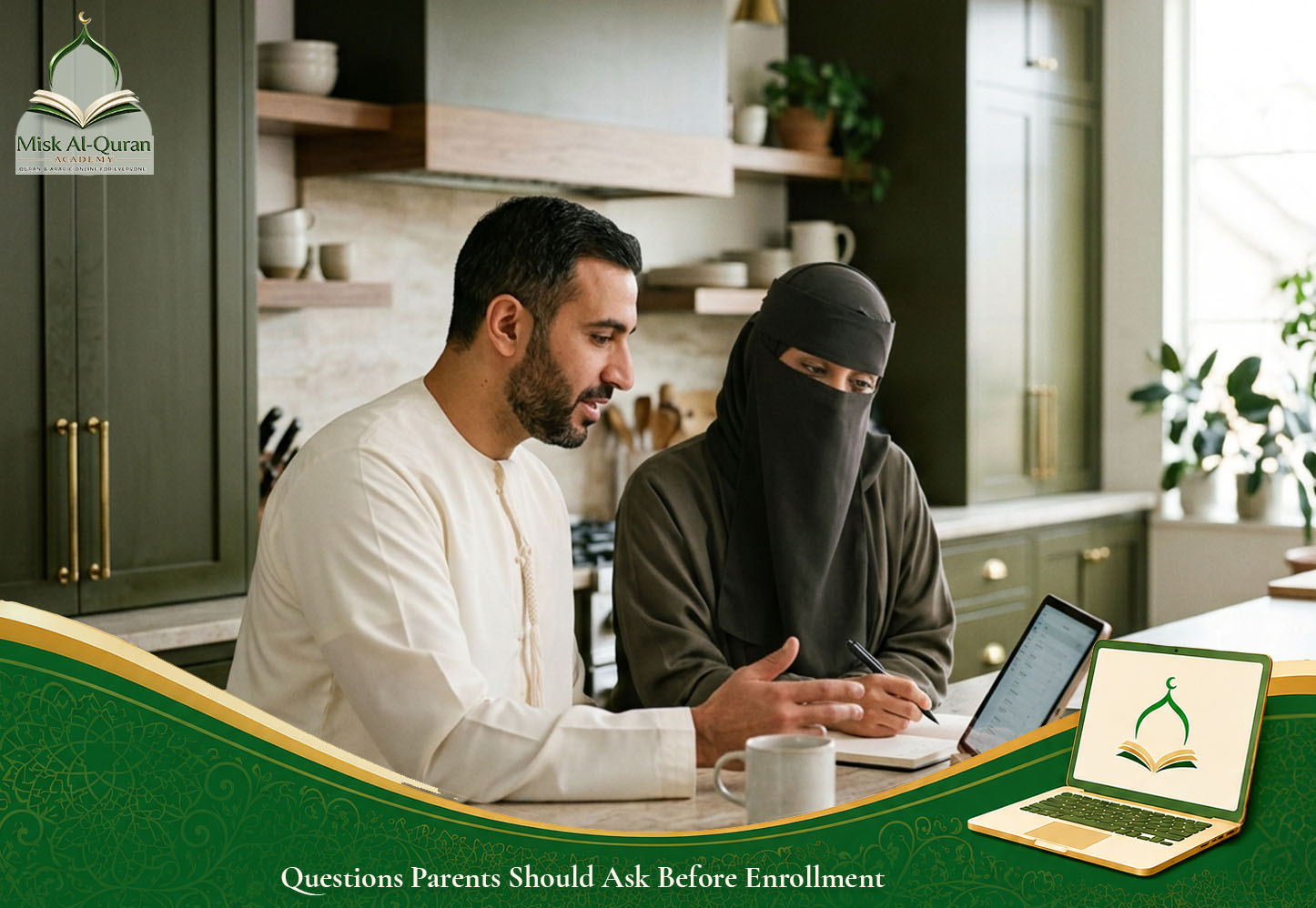
Before choosing a program, parents can prepare a short list of questions. This makes the decision more objective and helps reveal details that may not be obvious from a website. Useful questions include:
- What level is appropriate for my child?
- How is the child’s progress monitored?
- What happens if the child struggles with a lesson?
- How much practice is expected between classes?
- How are parents informed about progress?
- What Quran skills are taught at each level?
- How does the teacher keep young learners involved?
- Can the learning plan change as the child progresses?
The answers should give parents a clear picture of what regular participation will look like. If a program cannot explain how children are assessed, taught, corrected, and supported, parents may need more information before making a decision.
Is an Online Islamic School Suitable for Every Child?
Online Islamic education can work well for many children, but it is not automatically the best format for every learner. A child’s personality, age, attention span, previous learning experience, and home environment can all influence the experience.
Some children enjoy direct interaction through a screen and adapt quickly to online lessons. Others may initially need more support because they are unfamiliar with virtual learning.
The home environment also matters. A child who has a quiet study space and parental support may find it easier to establish a routine. Meanwhile, frequent interruptions can make lessons more difficult.
Parents should therefore treat online education as a learning format rather than a guaranteed solution. The right question is whether the format, teacher, curriculum, and schedule work together for their particular child.
When these elements align, online Islamic education can become a consistent part of a child’s religious learning without requiring the family to reorganize its entire daily routine.
Building a Consistent Islamic Learning Routine at Home
A child’s progress does not depend entirely on the time spent inside the online classroom. What happens between lessons can also influence how well new knowledge is retained.
Parents do not need to turn the home into a second classroom. Instead, small and consistent habits can reinforce what the child has learned.
For Quran study, this might involve reviewing a short passage, practicing a pronunciation point, or revising previously memorized verses. Islamic studies can be reinforced through simple conversations about the topic covered in class.
Consistency is usually more practical than long, irregular study sessions. A child who practices for a manageable amount of time on a regular basis may find it easier to remember material than a learner who studies only immediately before the next class.
At the same time, parents should avoid turning every home interaction into a test. Encouragement, conversation, and positive reinforcement can help children view Islamic learning as a normal part of life rather than an additional source of pressure.
How Can Parents Monitor Progress?
Progress should be measured against the child’s starting point rather than another child’s achievements. A beginner who becomes more confident reading Arabic has made meaningful progress, even if another learner is already memorizing longer passages. Parents can look for practical indicators such as:
- Improved Quran reading accuracy
- Better pronunciation
- Greater confidence during recitation
- Increased ability to recall previously learned material
- Better understanding of Islamic concepts
- More willingness to participate during lessons
- Consistent completion of appropriate practice
Regular communication with the teacher can make these changes easier to identify. Instead of asking only whether the child is “doing well,” parents can ask what has improved, what remains difficult, and what the next learning goal should be.
This creates a clearer picture of development and can also help the family adjust expectations when necessary.
Making the Most of Misk Online Quran Academy
Misk Online Quran Academy can become more useful when parents approach the learning process with clear expectations. Before beginning, families should identify whether the primary goal is Quran reading, Tajweed improvement, memorization, or broader Islamic learning.
Once the goal is clear, parents can help create a suitable routine around the lessons. Regular attendance, a quiet study space, and appropriate practice can reinforce the teacher’s work.
Children also benefit when parents show interest without placing excessive pressure on them. Asking what they learned, encouraging them to demonstrate a new skill, or listening to a short recitation can make learning feel connected to family life.
In addition, parents should allow the learning plan to develop over time. A child’s needs can change as their Quran skills improve. What was appropriate during the first stage may not be sufficient several months later.
That flexibility allows Misk Online Quran Academy to become part of a longer learning journey rather than a series of disconnected online sessions.
What Makes an Online Islamic Learning Experience Child-Friendly?
A child-friendly program should recognize that children learn differently from adults. The goal is not simply to transfer information through a video call. Instead, lessons should give children opportunities to listen, respond, practice, make corrections, and understand what they are learning.
Clear explanations are especially important for younger learners. Complicated terminology can make a simple concept feel difficult. Teachers can therefore use age-appropriate language and examples while gradually introducing more advanced material.
A supportive atmosphere matters as well. Children are more likely to participate when mistakes are treated as part of learning rather than as reasons for embarrassment.
Furthermore, predictable lesson routines can help young learners understand what to expect. When children know that a class will include review, new material, practice, and feedback, they can become more comfortable with the learning process.
These details may seem small, but together they can shape how a child feels about Islamic education over the long term.
When Should Parents Consider an Online Islamic School for Kids?
There is no single age or situation that determines when a child should begin. Some families introduce online Quran education after the child has learned basic Arabic letters, while others begin earlier with age-appropriate instruction.
The more important consideration is readiness. A child should be able to participate in a lesson with reasonable support and benefit from interaction with a teacher. Parents can consider starting when:
- The child shows interest in learning Quran or Islamic subjects.
- The family can establish a consistent lesson schedule.
- The child has access to a suitable device and learning space.
- Parents understand the child’s current learning level.
- The chosen program can adapt instruction to that level.
Starting at the right pace is more valuable than starting as early as possible. A positive first experience can help children develop confidence and maintain interest as their learning becomes more advanced.
Choosing a Long-Term Islamic Education Path
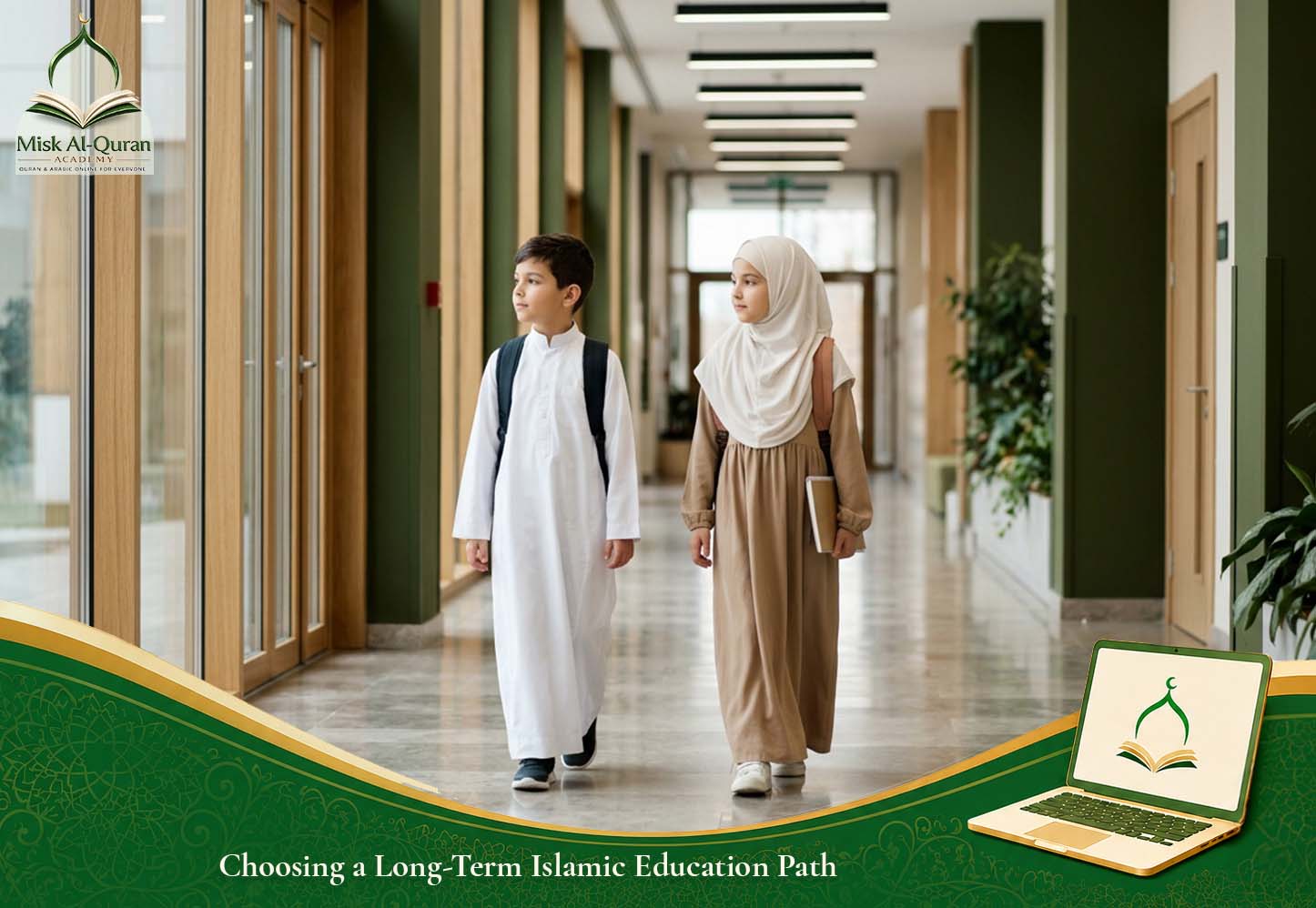
Selecting an online program should not be viewed as a one-time decision. Children’s educational needs change as they grow, and the program that works for a beginner may need to evolve later.
For that reason, parents should consider whether the learning path can develop alongside the child. A useful program should provide clear progression rather than leaving families uncertain about what comes next.
The long-term goal may also change. A child might initially focus on Quran reading and later become interested in memorization, Tajweed, Arabic, or deeper Islamic studies.
A flexible learning approach can accommodate those changes. Consequently, parents should look beyond the first few lessons and consider whether the educational experience can continue to serve the child as their abilities and interests develop.
Frequently Asked Questions
These answers address common questions parents may have before starting online Quran and Islamic learning for their children.
How much parental involvement is needed during online Islamic classes?
The amount of support depends on the child’s age and independence. Younger children may need a parent nearby to help them enter the class, stay organized, or solve simple technical issues. As children become more independent, parents can gradually step back while continuing to follow their progress.
Can siblings learn Islamic subjects together online?
Sometimes siblings can share a lesson when their ages and learning levels are reasonably close. However, children at very different stages may benefit more from separate instruction because each learner can then receive appropriate material and correction.
What should a child do if they feel nervous about speaking to an online teacher?
A short adjustment period can be normal. Parents can help by explaining that mistakes are part of learning and encouraging the child to ask simple questions. Familiar routines can also make online interaction feel more comfortable over time.
How can parents tell whether a child is enjoying online Islamic learning?
Look beyond whether the child says they like the class. Signs can include participating willingly, asking questions, remembering previous lessons, practicing without constant reminders, and talking about what they learned after the session. These behaviors provide a more useful picture of engagement.
Conclusion
Choosing an online Islamic school for kids is ultimately about finding a learning environment that matches the child’s needs, level, and personality. A strong program should provide structured lessons, meaningful teacher interaction, suitable progression, and opportunities for regular practice.
Parents should therefore look beyond convenience. The curriculum, teaching approach, communication, lesson structure, and the child’s response all deserve consideration before enrollment.
For families exploring Quran-focused online education, Misk Online Quran Academy can be part of that evaluation. The best starting point is to identify the child’s current level and learning goals, then consider whether the program can provide the guidance and consistency needed for steady progress.
With the right structure and realistic expectations, online Islamic education can become a practical part of a child’s weekly routine while helping them build stronger Quran skills and a deeper connection with their Islamic learning.
